Chapter One: The Bat in the Dark
A bat doesn't see the cave.
The bat flies at full speed through a black room strung with wires, moths, dripping stone, and the soft throats of other bats, and it carries no light. It carries a scream. It throws sound into the dark, it listens to what the dark throws back, and out of the delay and the smear and the doppler shift of a thousand returning echoes it builds, in real time, a model of a room it has never seen and never will. The bat doesn't perceive the cave. It reconstructs it. The cave it flies through is a hypothesis, refreshed dozens of times a second, good enough to pick a moth out of total darkness and humble enough to be wrong the second the room changes.
Hold that picture against how almost everyone runs a marketing campaign.
The Lit Wall Is Not the Room
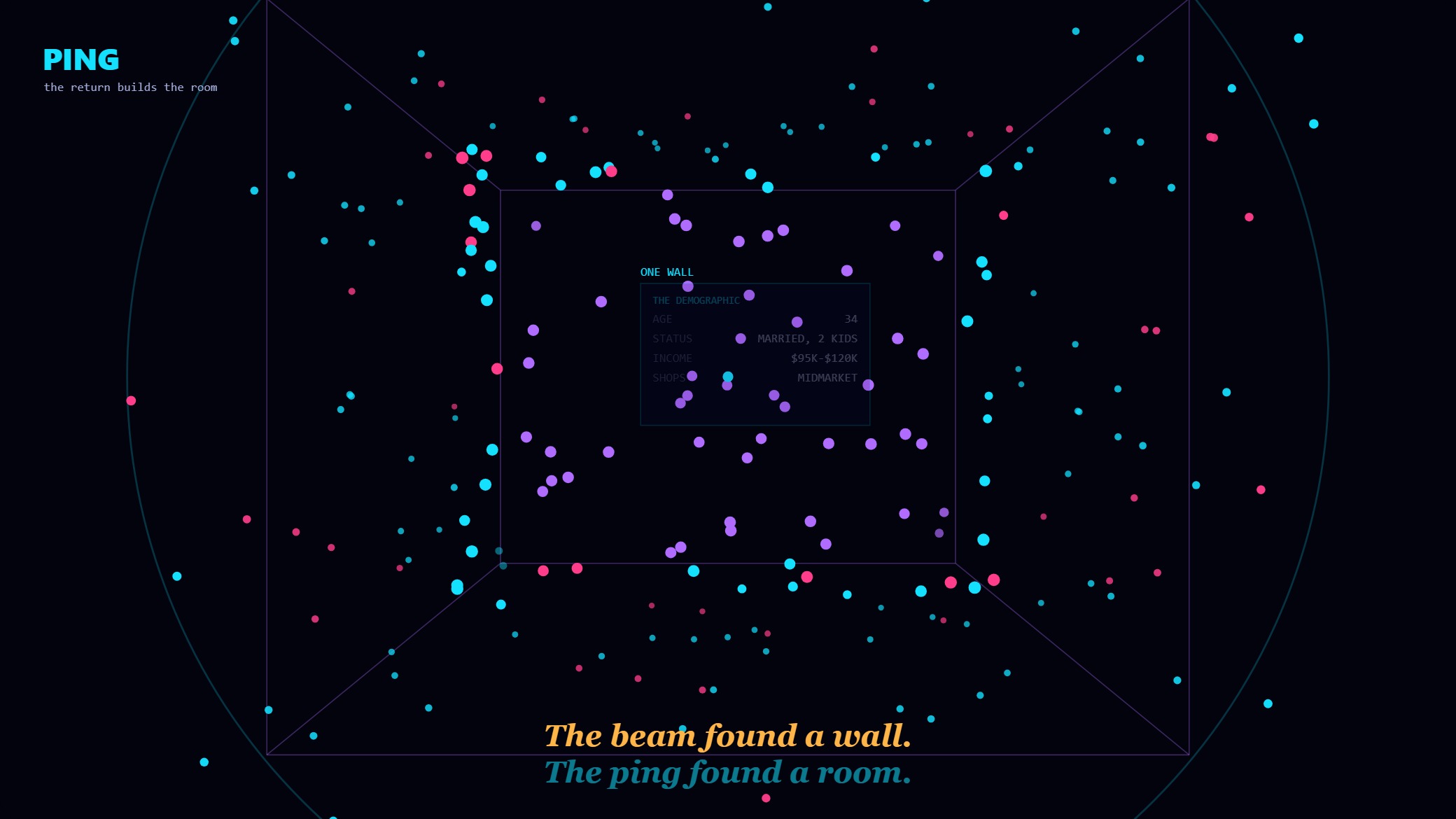
The marketer turns on a light. He reaches for demographics and psychographics, for the age band and the income bracket and the little wheel of personality traits, and he points the beam at the customer and writes down whatever the beam lands on. Thirty-four, married, two kids, household income in this range, shops here, scrolls there. It feels like knowledge because it produces a list, and a list feels like the opposite of ignorance. Then the campaign built on that list underperforms, and nobody can say why. The list was only ever the patch of cave wall closest to the lamp.
A lamp can't solve this problem, because the thing the marketer is trying to understand has no surface to light up. A person's reasons for buying, or for not buying, or for buying once and quietly resenting you afterward, sit in a place the beam never reaches. They sit under the logical story the customer tells out loud, down in the fears he won't name, in the account he gives himself for why he can't, in the place where he fucked up and buried the shame so well he has forgotten where he put it. You can light the body all day. The room is the interior, and the interior is dark by design and defended on purpose, shaped like nothing you'd guess from the outside.
So the firm stops trying to look at the customer. The firm pings him.
The Ping and the Lexicon of Pain
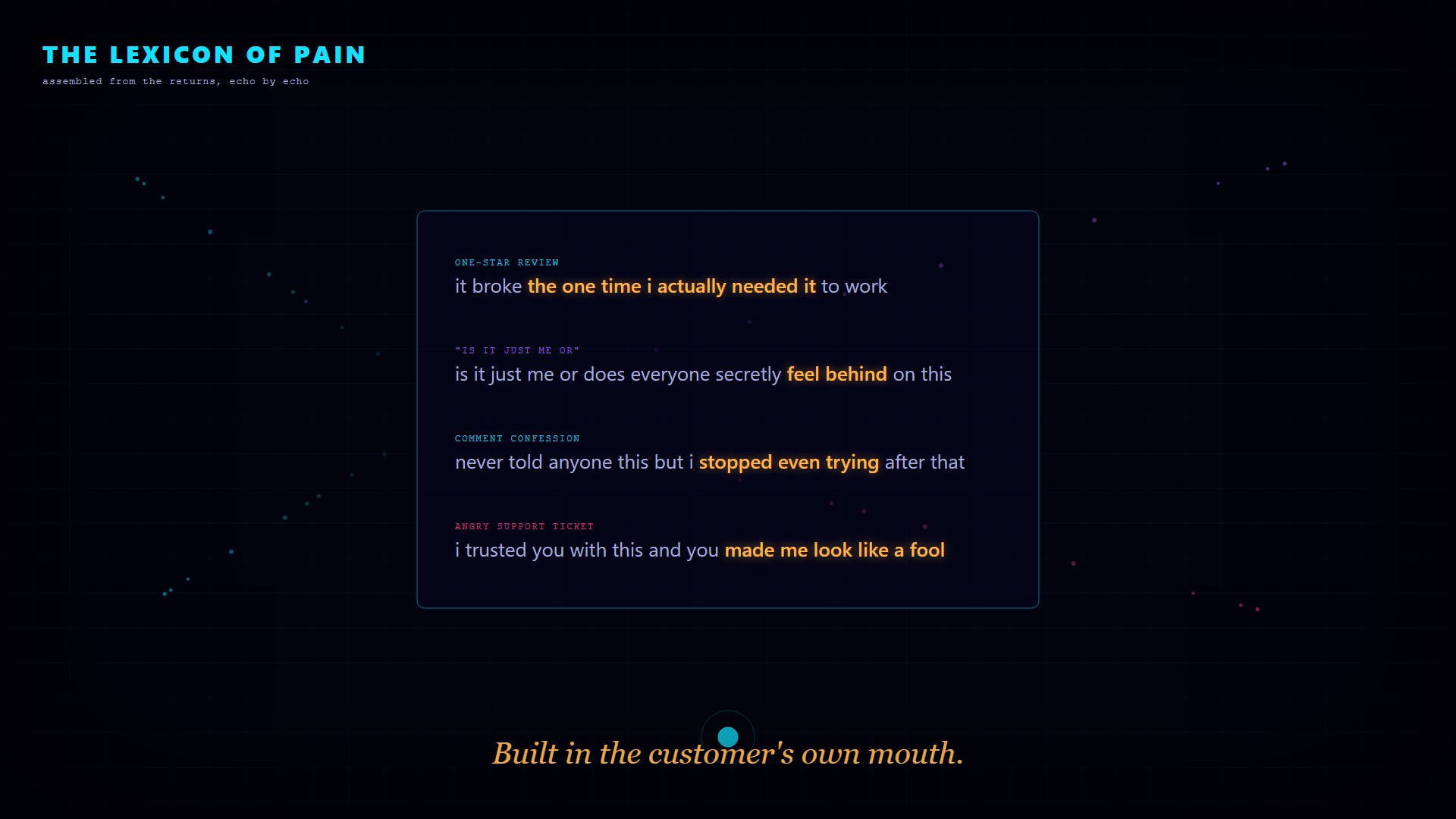
A ping is a question you send into the customer's world, and then you shut up and listen for what comes back. The firm doesn't ask a founder what his customer wants, because the founder has happy ears and gives you the flattering version. The firm goes where people talk with no audience, where they believe nobody who matters is listening:
- The one-star reviews of a competitor, where the real grievance lives in the open.
- The thread that opens with "is it just me or."
- The comments under a video about the exact problem, where strangers leave confessions more intimate than anything they have told a spouse.
- The fifty angriest support emails.
Each of these is an echo coming back out of the dark, carrying the precise shape of a pain in the precise words the person uses for it. The firm assembles the copy from the returns, echo by echo, into a Lexicon of Pain built in the customer's own mouth.
From One Ping to the Whole Ecosystem
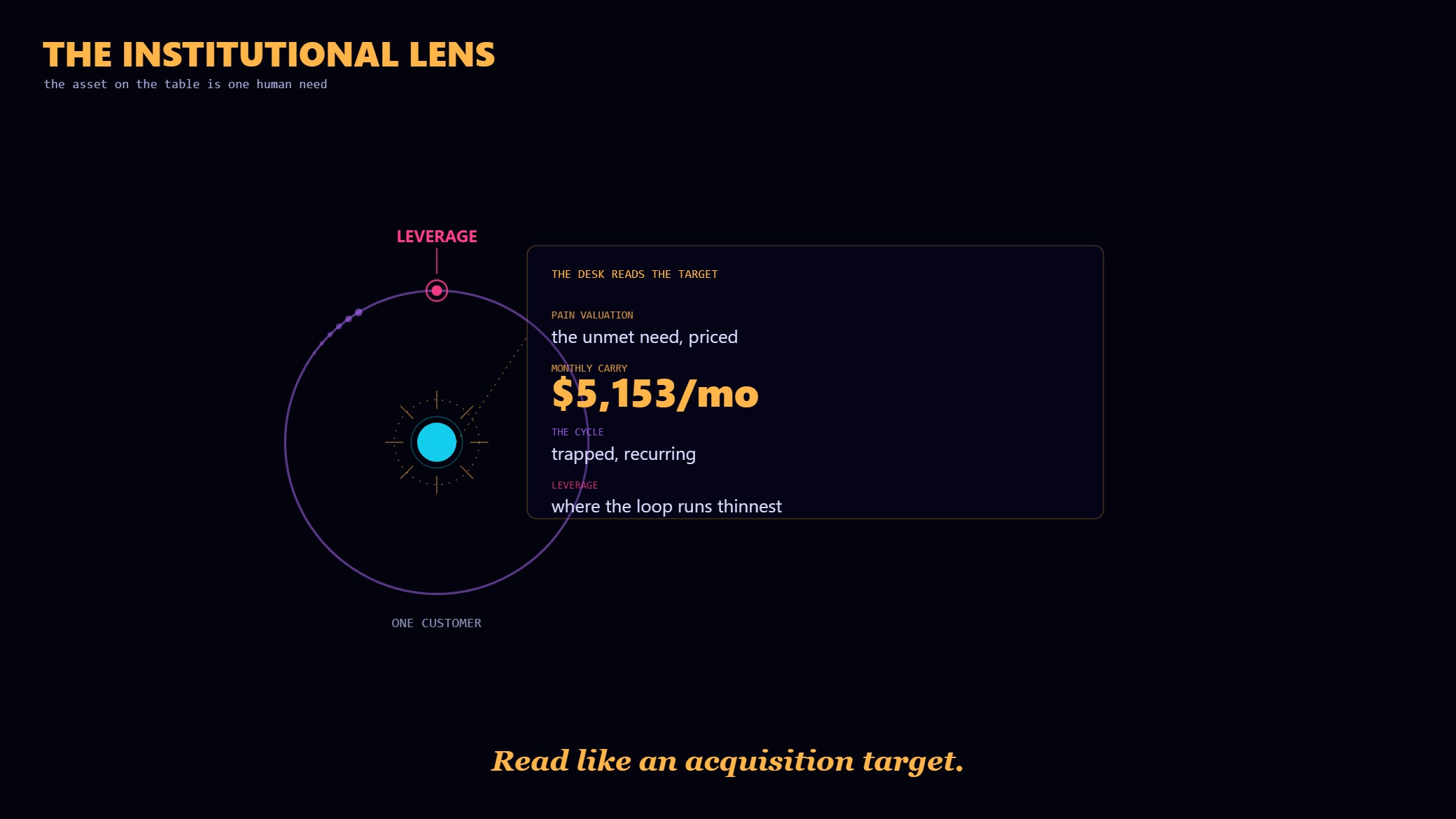
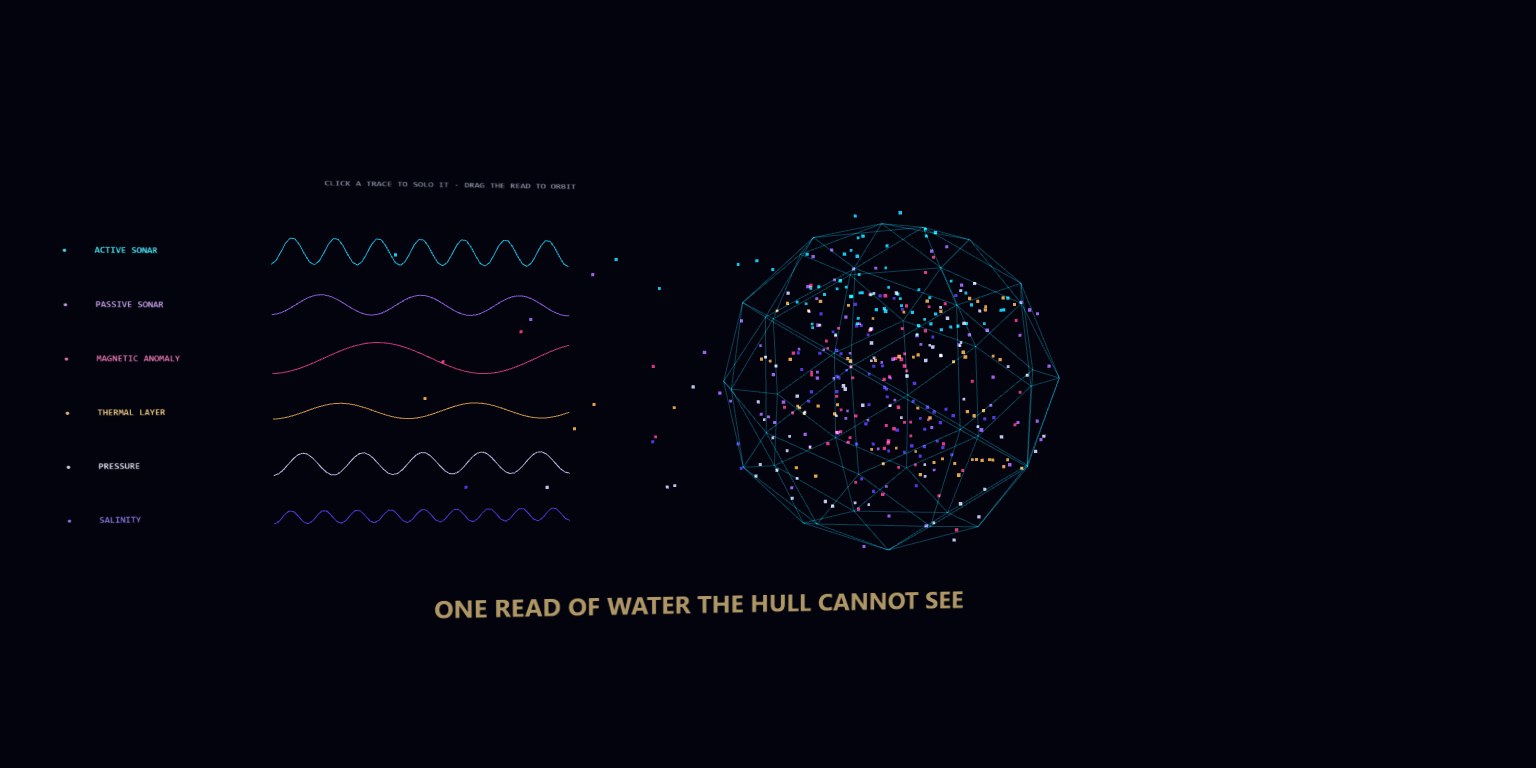
One ping is never enough, because a market has far more shape than a hallway. That's where the bat becomes a submarine, and a strange one. Picture the machine that maps a whole ocean from inside a steel hull with no windows: active sonar, passive sonar, magnetic anomaly, thermal layers, pressure, salinity, a dozen waveforms read at once and fused into one moving picture of water the crew can't see. That's the real instrument. The firm pings the entire ecosystem the customer is suspended in, and the customer is one point inside it. That means the customer's economy and the macro weather above it, the customer's own customer (because your buyer is somebody else's seller), the supply chain, the logistics, the flow of money and the flow of blame. Over all of it the firm sets the lens of an institutional desk. The question is what the pain is worth, what it costs him every month to carry it, the full cycle he's trapped inside, and where in that cycle the leverage sits. The firm reads a market the way an M&A team reads an acquisition target, except the asset on the table is one human being's relationship to his own unmet need.
The channels that hand back the truest echoes all share one trait: the person talking is sure nobody who matters is listening. A one-star review is written in a different voice than a five-star review, and that gap is the whole game. The five-star review performs gratitude for an audience. The one-star review names the exact spot where the product broke the customer's heart, in the customer's own words, grievance intact and unedited. The thread that starts with "is it just me or" is somebody checking whether his private shame is shared before he risks saying it out loud. The angriest support ticket maps the exact failure that turned a believer into an enemy. None of it was written for the firm to read, which is why it holds up as evidence.
The same logic sets the order of operations, which most strategists run backward. The spreadsheet of impressions and click-through and demographic split is the photograph, and the culture is the room. You can't read the room from the photograph. You can confirm the room from the photograph once you've already been in it. The firm maps the substrate first, the orientation of a market toward what it fears and what it wants and what it can't say, and only then reads the trend data against that map. Forecasts that skip the substrate decay fast, and the decay is the diagnostic. A read grounded in the slowest-moving layer survives a platform migration and a generational handoff. A read grounded in last quarter's engagement metrics expires the moment the platform changes its feed.
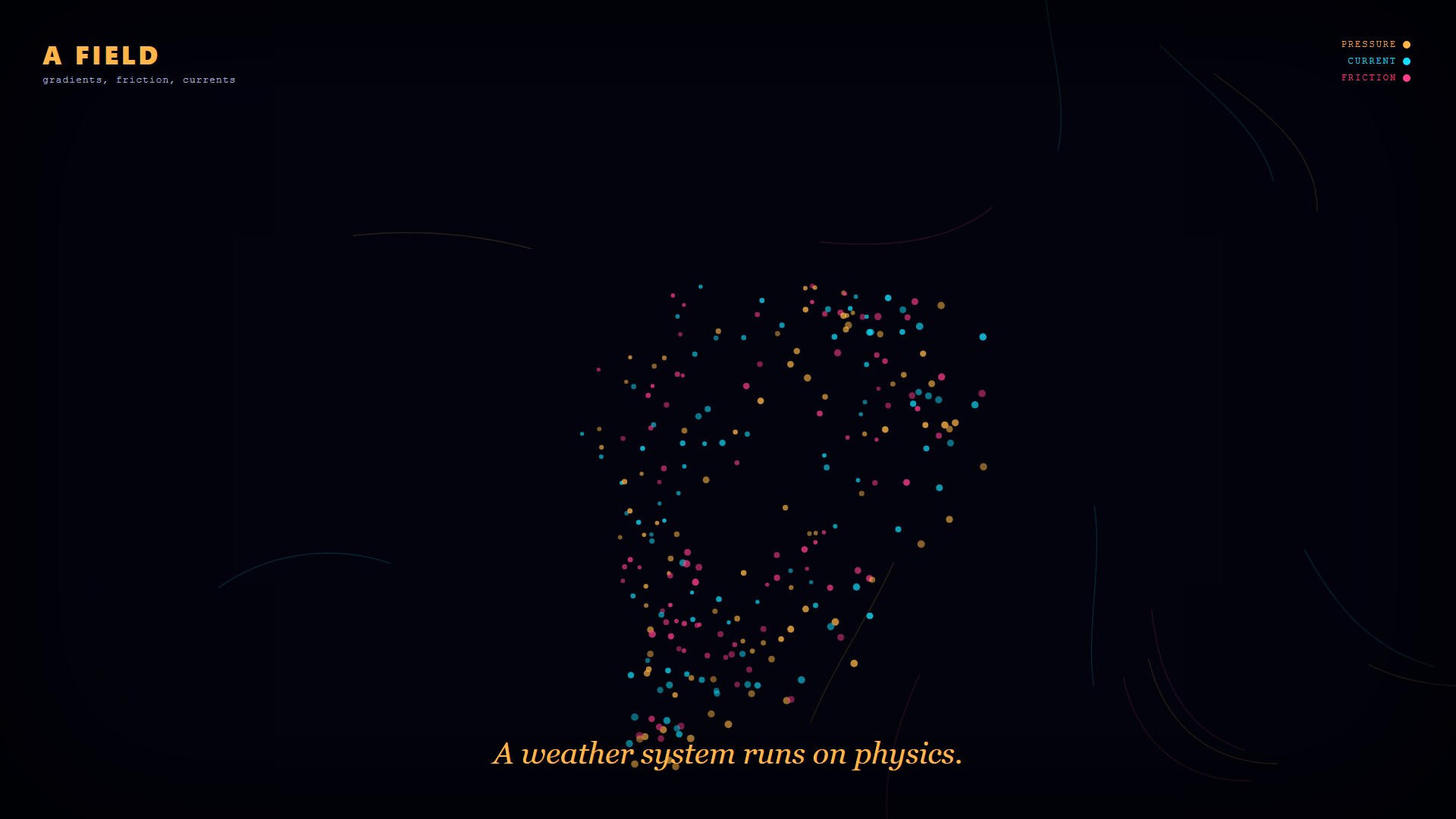
Reconstruct enough of those returns and the shape in your hands changes on you. It stops being a portrait and turns into a field. There's no solid object in there to photograph, only gradients: pressure where a demand goes unmet and nobody has put a word to it, friction where the obvious fix keeps failing for reasons that look stupid from outside and make total sense from inside, and currents where attention moves and pools and drains. What the firm holds is a weather system, and a weather system runs on physics.
The Vendor and the Doctor
Two people walk into the same room to close the same deal, and the difference between them is the instrument each one is running. The vendor reads a single wall, the one the lamp already lit, and recites the feature list bolted to it. The doctor runs the submarine: active sonar, passive sonar, thermal, pressure, all of it read at once and fused into one moving picture of a person nobody else in the room can see. Six waveforms against one flat wall is the whole gap, and it's why one of them closes and the other gets ignored.
The vendor looks at you and reads you his feature list. The doctor pings you. He taps your back and watches your face, asks whether you sit a lot, whether you keep your wallet in your left pocket, whether you push hard when you train, and somewhere around the third boring question he describes a pain you've carried for fifteen years better than you've ever described it yourself. Your whole body relaxes into one thought: this person already knows. The trust showed up before you ever decided to give it, through the back door, the second his reconstruction matched the room. Price stopped mattering somewhere around the second question.

That's the stance. The rest is engineering: how the firm stores the returns so they compound, how it turns them into work, how it stays disciplined about what the echoes actually said instead of what somebody wanted them to say, and why the same instrument that reads a market also reads a culture, a customer's customer, and, if you have the stomach for it, the person screaming into the dark in the first place.
The instrument is the thing a certain kind of mind gets forced to build.
Chapter Two: The Manual Database
Most people get handed a model of other humans at the factory, and they never see the receipt.
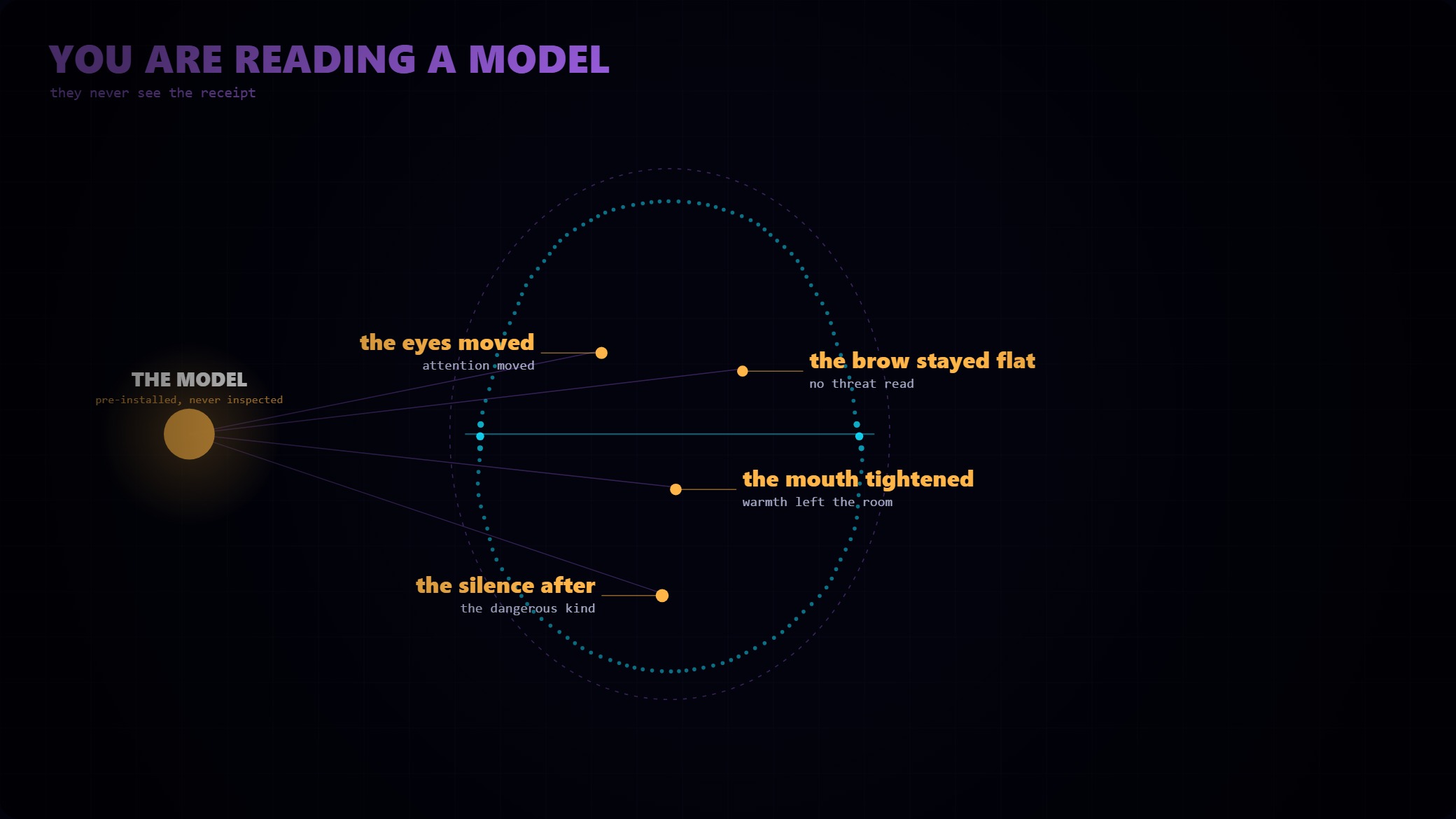
It ships pre-installed. A kid looks at a face and knows, without running a single calculation he could write down, that the eyes moved there because the attention moved there, that the tightening at the mouth means the warmth just left the room, that the silence after the sentence is the dangerous kind. He doesn't study any of this. He soaks it up the way he soaked up the grammar of his first language, years before anyone told him grammar was a thing. By the time he's an adult he carries a fast, automatic, intuitively weighted map of other minds, running so far under the hood that he never finds its edges. He thinks he's looking at people, when he's looking at the output of a model so deep he can't see the bottom of it.
The Model Built by Hand
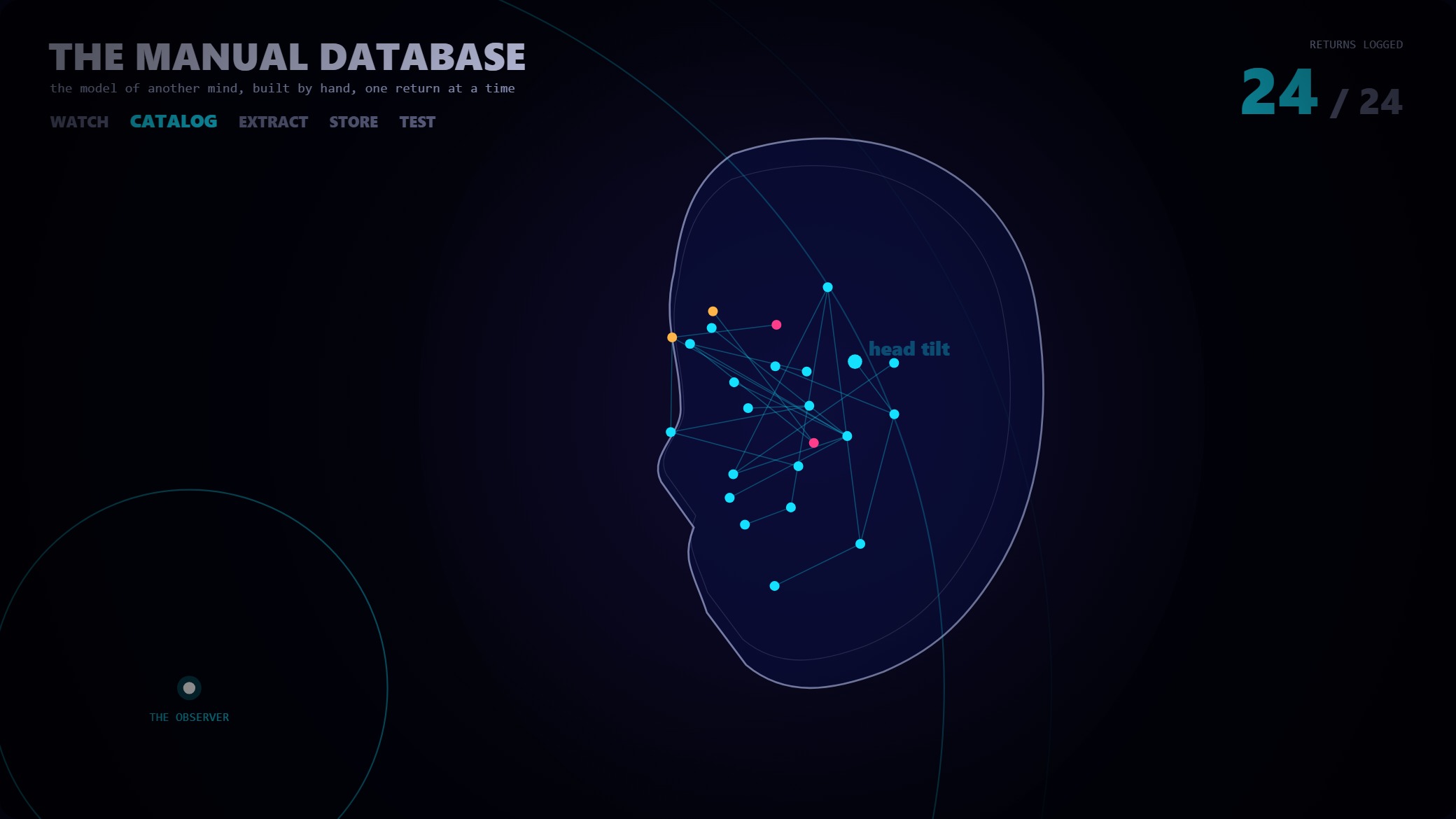
Some minds never get the pre-installed version, and the firm built its sensing instrument out of that gap. One nervous system had to put its model of other humans together by hand, on purpose, because the automatic one never showed up working. That's the origin: the wiring here is autistic, and that's the whole reason the model got externalized instead of staying buried where nobody could reach it. When the automatic read is unreliable, you get two options: keep walking into the same invisible walls, or build the read by hand. The hand-built version is slower, fully conscious, and far more expensive to run. You watch a face the way you'd read a script in a language you're still learning. You log what each small movement tends to come before. You pull the rule out, store it, and test it on the next face. The two routes run opposite methods and end at the same map.
| The intuitive route | The explicit route | |
|---|---|---|
| Speed | A quarter of a second | Real time, on purpose |
| Visibility | Never shows its work | Leaves a written record of every step |
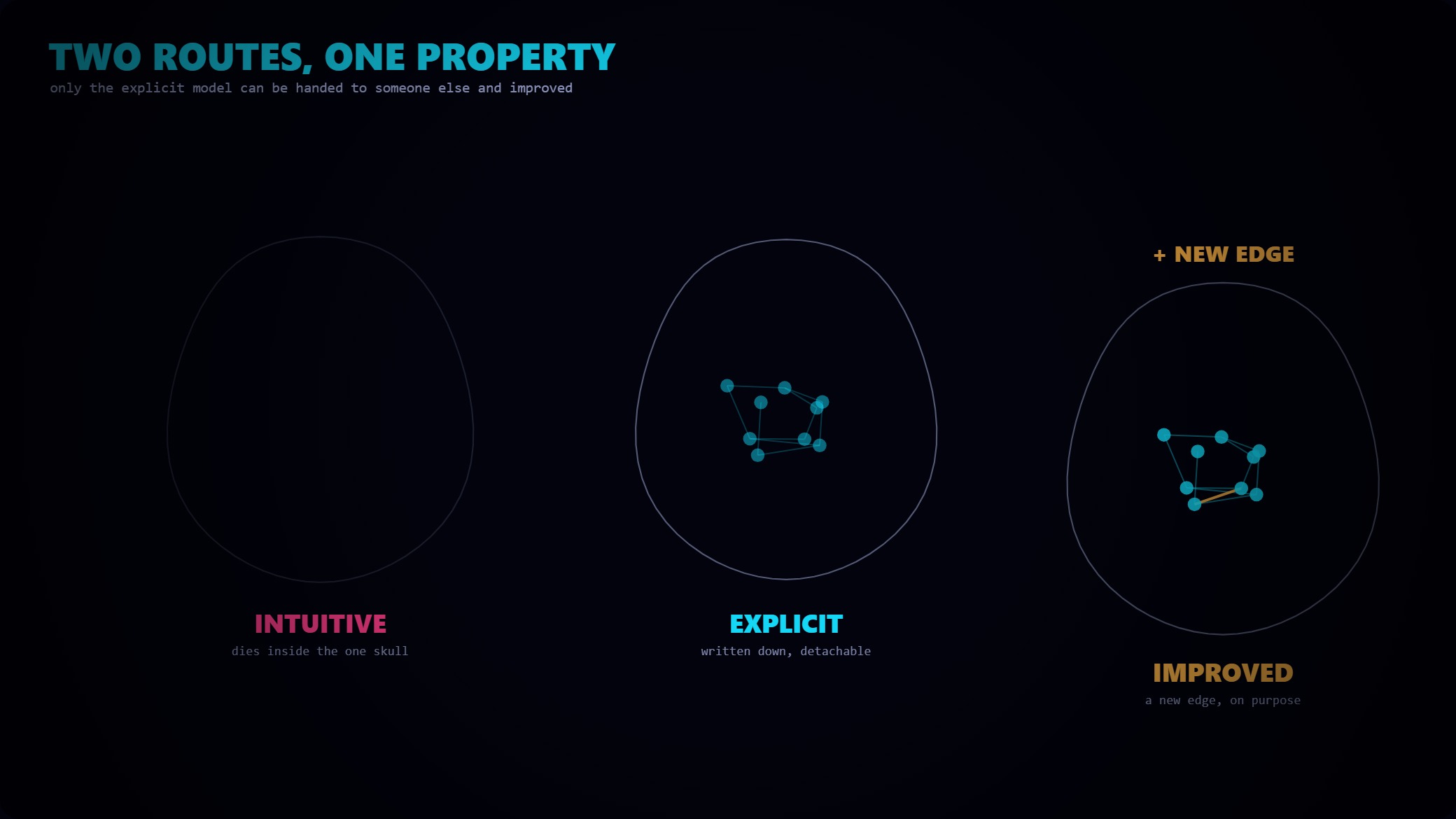
| Transferability | Dies inside the one skull | Hands off to someone else and improves |
The research has clean language for this, and it does more by staying clinical than by reaching for drama. Predictive-processing accounts describe minds that put high, stiff confidence on the raw prediction errors coming off the world and have a harder time letting smooth intuition paper over the noise. The automatic social shortcuts most people lean on get less reliable, so the mind compensates the only way it can, with explicit, rule-based modeling: watch, catalog, extract, store, test. The strong form of that drive has a name in the literature, hyper-systemizing. That name pulls together several findings into one integrative read, and the read isn't settled science. The people it describes run the full range, so the firm treats it as a tendency and an adaptive strategy, the kind of thing you hold loosely, and it carries no implication of a missing heart. When the intuitive model never arrives, the explicit one gets built, and an explicit model has one property the intuitive one can never have. You can write it down, hand it to somebody else, and improve it on purpose.
The Same Move, Different Lives
Building the model by hand is a move anyone makes once the automatic read fails them and they have to assemble the map of other people one logged return at a time. It reaches well past any single kind of wiring. The same construction runs under lives that look nothing alike from outside, which is the clearest sign you are watching a real mechanism rather than one person's symptom.
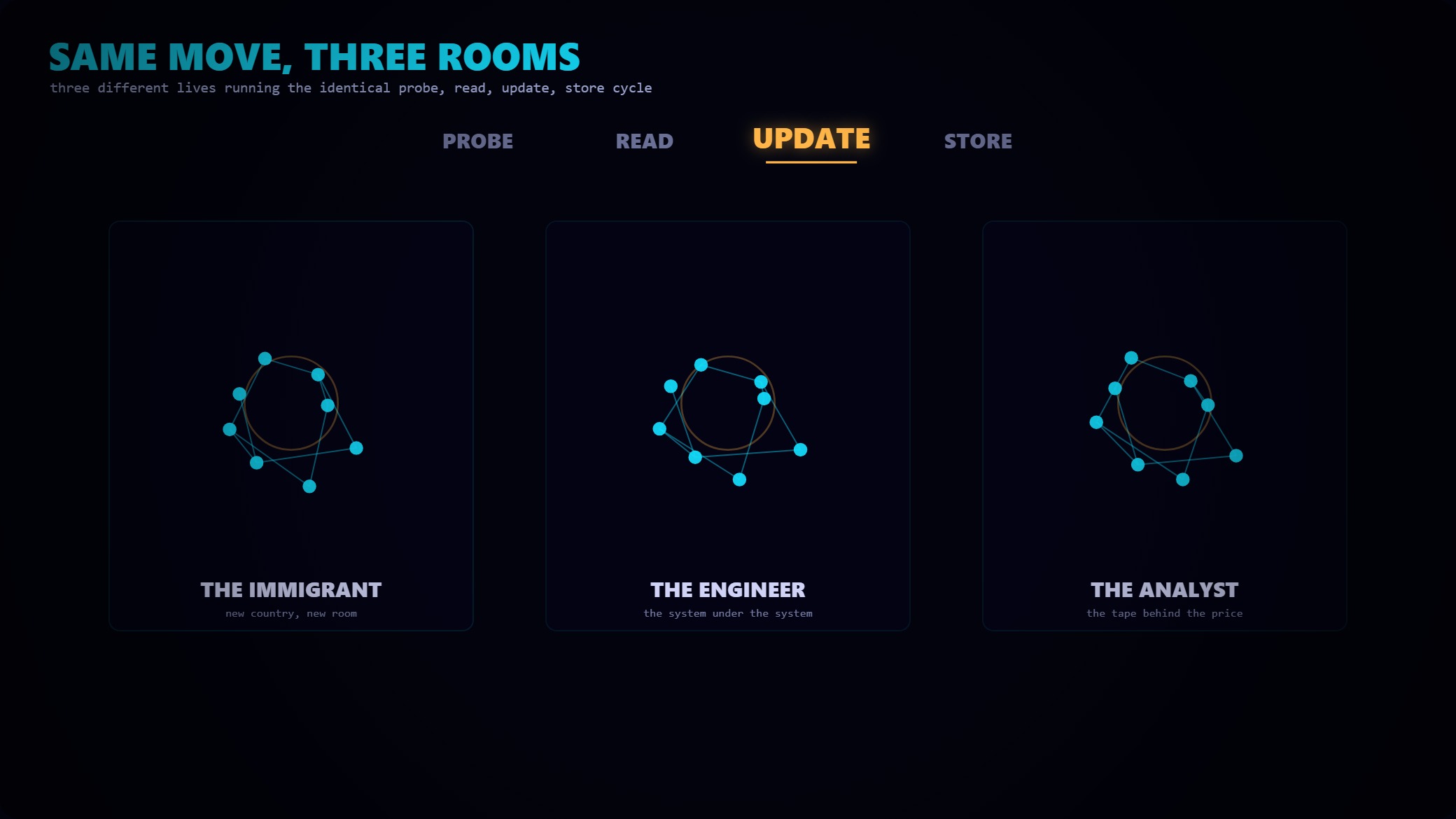
Anyone who ever had to consciously learn a thing that everyone around them did on instinct knows the shape of it:
- The immigrant decoding a new culture's unspoken rules.
- The engineer reverse-engineering small talk.
- The person who studied their way into a room they weren't born comfortable in.
The same operation runs under all three. The intuitive shortcut is missing or unreliable, so the model gets rebuilt by hand, slow and explicit, with the work showing. You read a face the way you read a script in a foreign language, in any country, by posture and eye-line and the way a room goes quiet the second someone with power walks in. Send a probe, read the return, update the model, store the relationship. That's echolocation pointed at one human being, and it's what a mind does when the lights were never reliable to begin with. Put the three side by side and the surface biographies fall away, because the immigrant and the engineer and the analyst are running one cycle in lockstep, the same probe firing into three different rooms.
The Capability Outlives the Operator
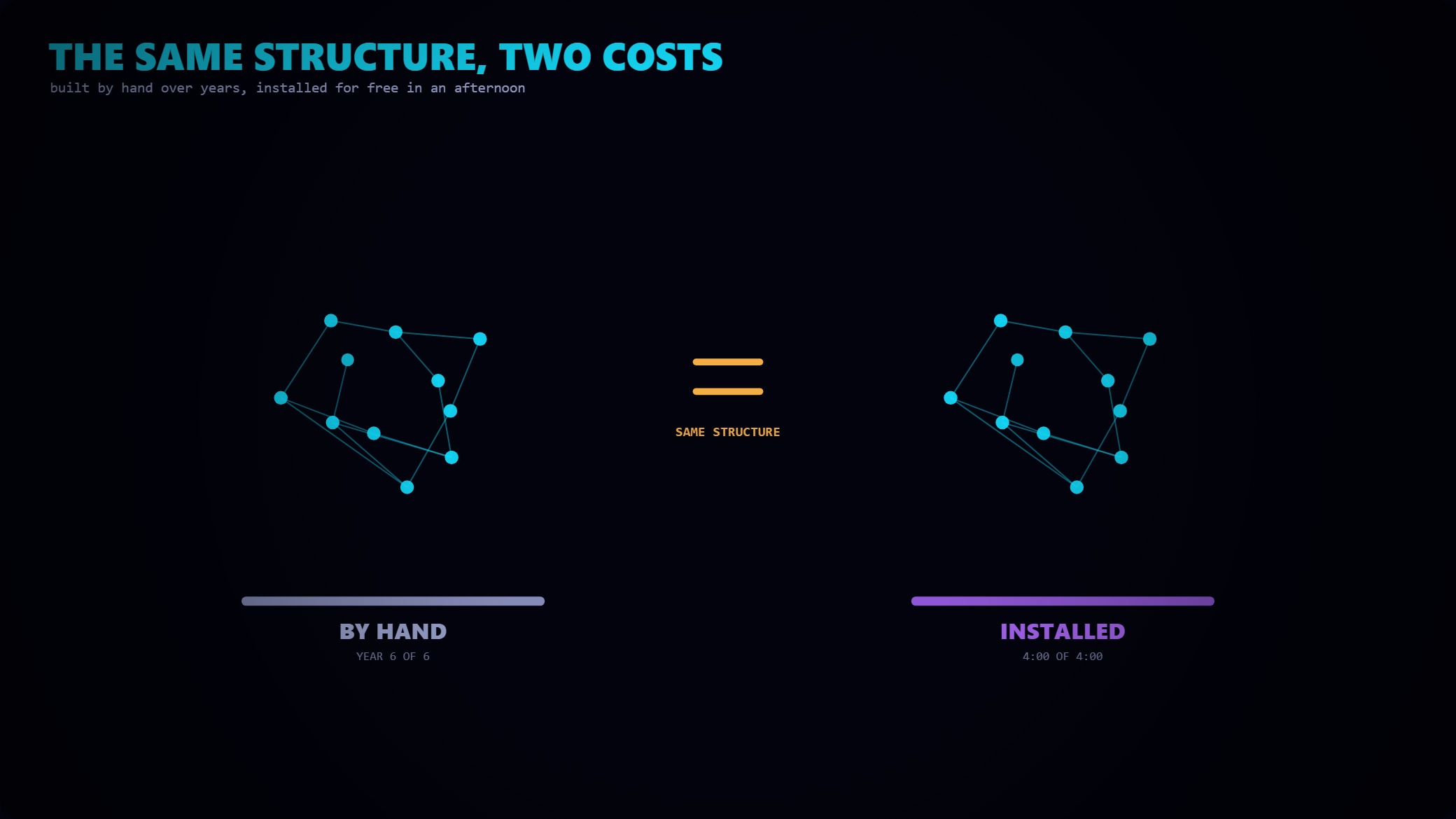
That one property, the ability to write the model down, is why the work gets externalized at all. A model that lives in one skull dies with the skull, can't be audited, and has to be grown from scratch by the next person who needs it. A model written down can be inspected, corrected, and scaled. So the firm models the hell out of it. The temporal knowledge graph, the entities and the relationships and the confidence scores, the hundred-and-thirty-plus emotions broken down in excruciating detail, the profiles built like RPG character sheets so every agent reading from the store inherits the same understanding: that's the hand-built map pulled out of one head and turned into infrastructure. It runs on hardware that doesn't tire, doesn't forget, and doesn't have to relearn a person every time some human's working memory overflows. The expensive thing one person builds by hand over years becomes a thing the firm installs in software, for free, in an afternoon.
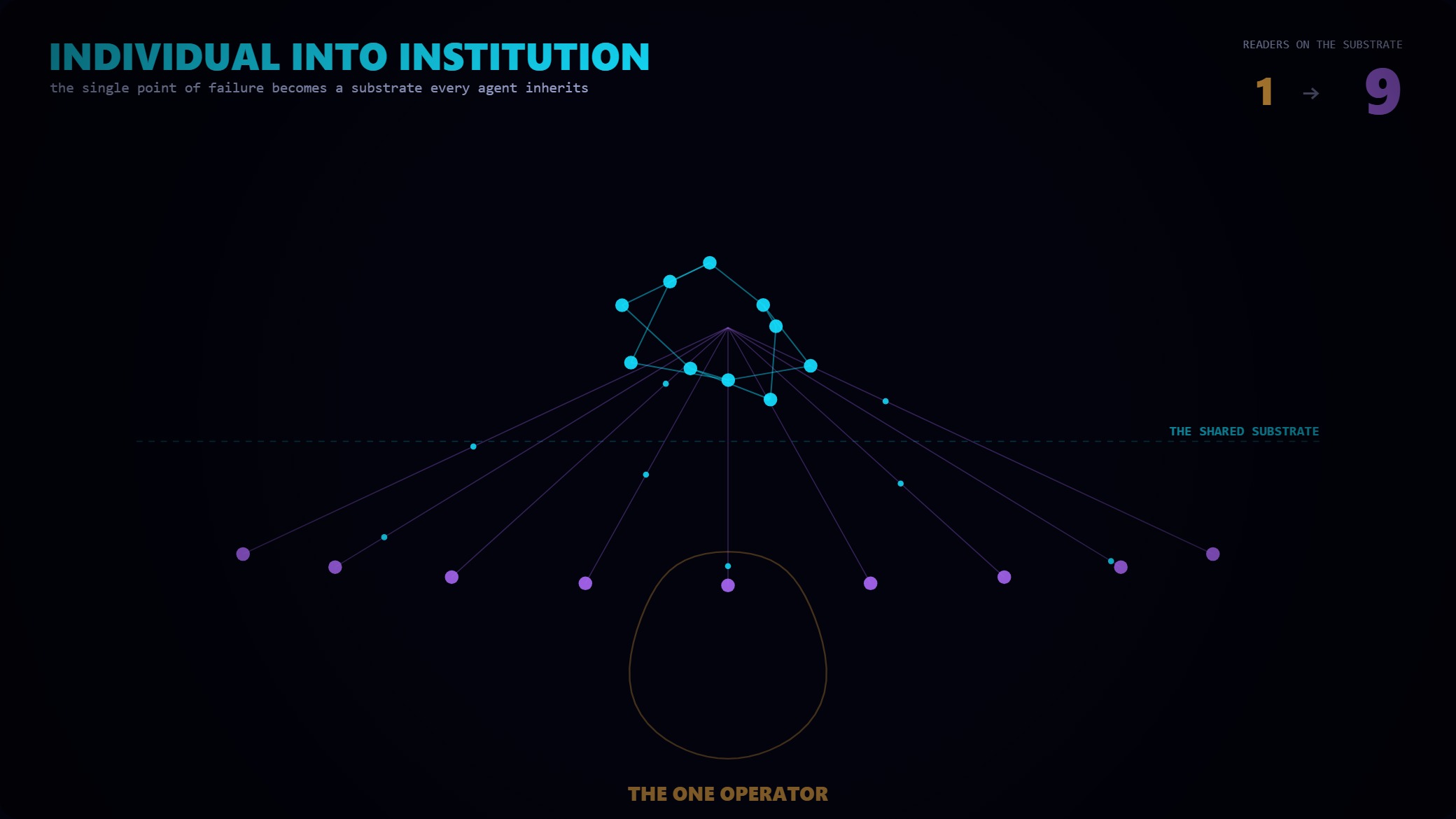
Writing it down matters for more than convenience. A capability locked inside one operator is a single point of failure: it walks out when the operator walks out, nobody can check it while it runs, and the next person starts from zero. A capability written into the substrate outlives the operator, gets audited by anyone with access, and gets better through people who never built the original. That move turns a talented individual into an institution. The talented individual reads a market well and takes the read to the grave. The institution writes the read into a structure every agent inherits, then spends its energy improving the structure instead of regrowing the talent. Most firms in the vertical run on the first model and then wonder why their best work can't be reproduced once the person who did it leaves. The firm runs on the second, which is the whole reason a small shop can go toe to toe with an operation carrying ten times the headcount. They carry their knowledge in skulls, while the firm carries its knowledge in a structure that compounds.
The instrument needs no particular history to run. The route that first produced it no longer matters, and the tool can be installed on purpose now.
Chapter Three: The Field Has a Physics
Echolocation is close to a literal description of how a brain works, and once that lands, the rest of the machine has a reason to exist.
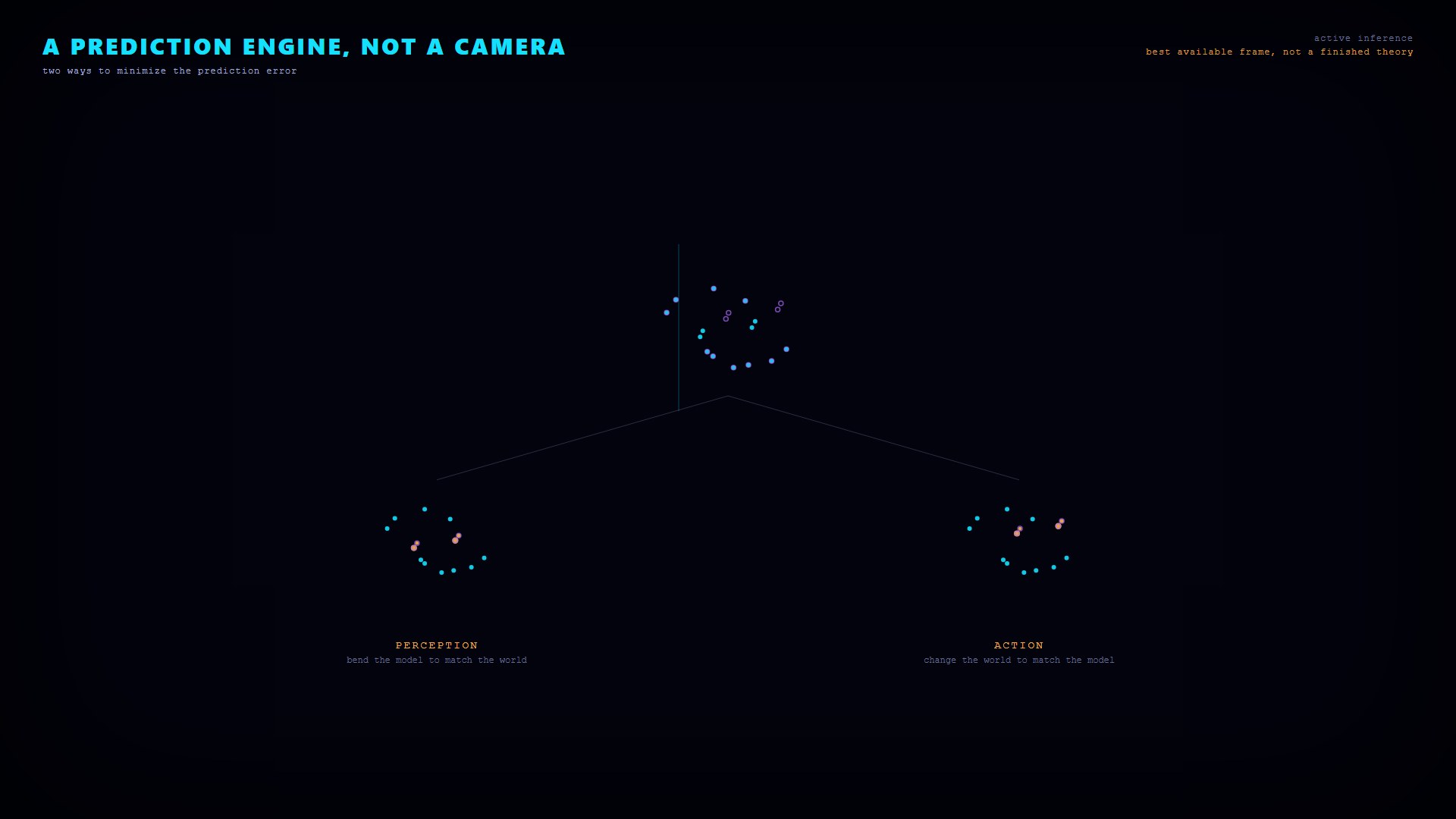
The cleanest theory of cognition we have right now says the brain runs as a prediction engine, not a camera. Under the free energy principle and active inference, a brain is a generative model of the world running nonstop, guessing the next slice of sensory input and spending attention only where the guess misses. Perception is the brain updating its beliefs to kill the error. Action is the same drive pointed the other way: instead of updating the model to match the world, you move, and you change the world until it matches the model. Ping, listen, update. Ping, listen, act. That's echolocation, and formally it's active inference. The free energy principle is a unifying modeling language, not a finished theory of every neuron, so treat it as the best frame on the table and nothing more. As a description of the stance, it nails it: a bounded system that can't see the whole room, holding a model, working to keep its own surprise down.
If sensing means running a generative model against a field you can't see, then you'd better understand the physics of the field, and the field runs on three forces.
It takes three to cover how the field moves, how a choice in it pays out, and how it refuses to hold a single state: fluid for the flow, control for the accounting, quantum for the ambiguity. The table sets out what each one models and what it means the moment you read it against a real market.
| Force | What it models | The market reading |
|---|---|---|
| Fluid | Flow with viscosity; the Reynolds number sets laminar against turbulent | Attention, capital, and work flow and are roughly conserved; friction is a first-class term |
| Control | The Bellman accounting; value is the immediate effect plus the discounted future | A touchpoint costs the call plus the bent shape of every conversation after it |
| Quantum | Superposition and non-commuting measurement | A market is ranging and trending at once; price before product makes a different person |
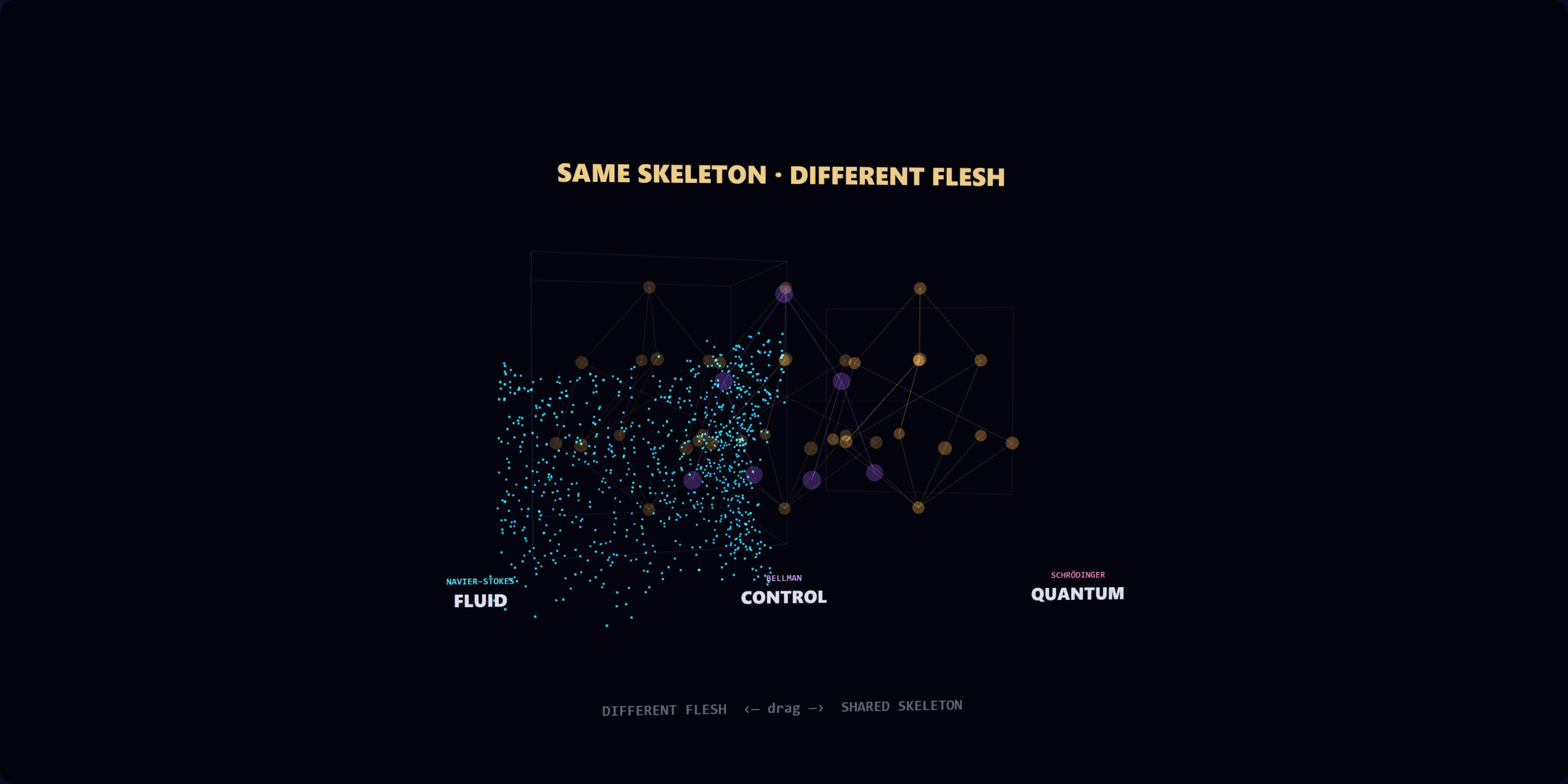
The reason all three sit in one table is that they keep resolving toward the same underlying shape. A flow field, a decision surface, and a quantum density field look like three separate pictures until you watch them converge, and what they converge on is one shared structure wearing three different kinds of flesh.
The Field Is a Fluid
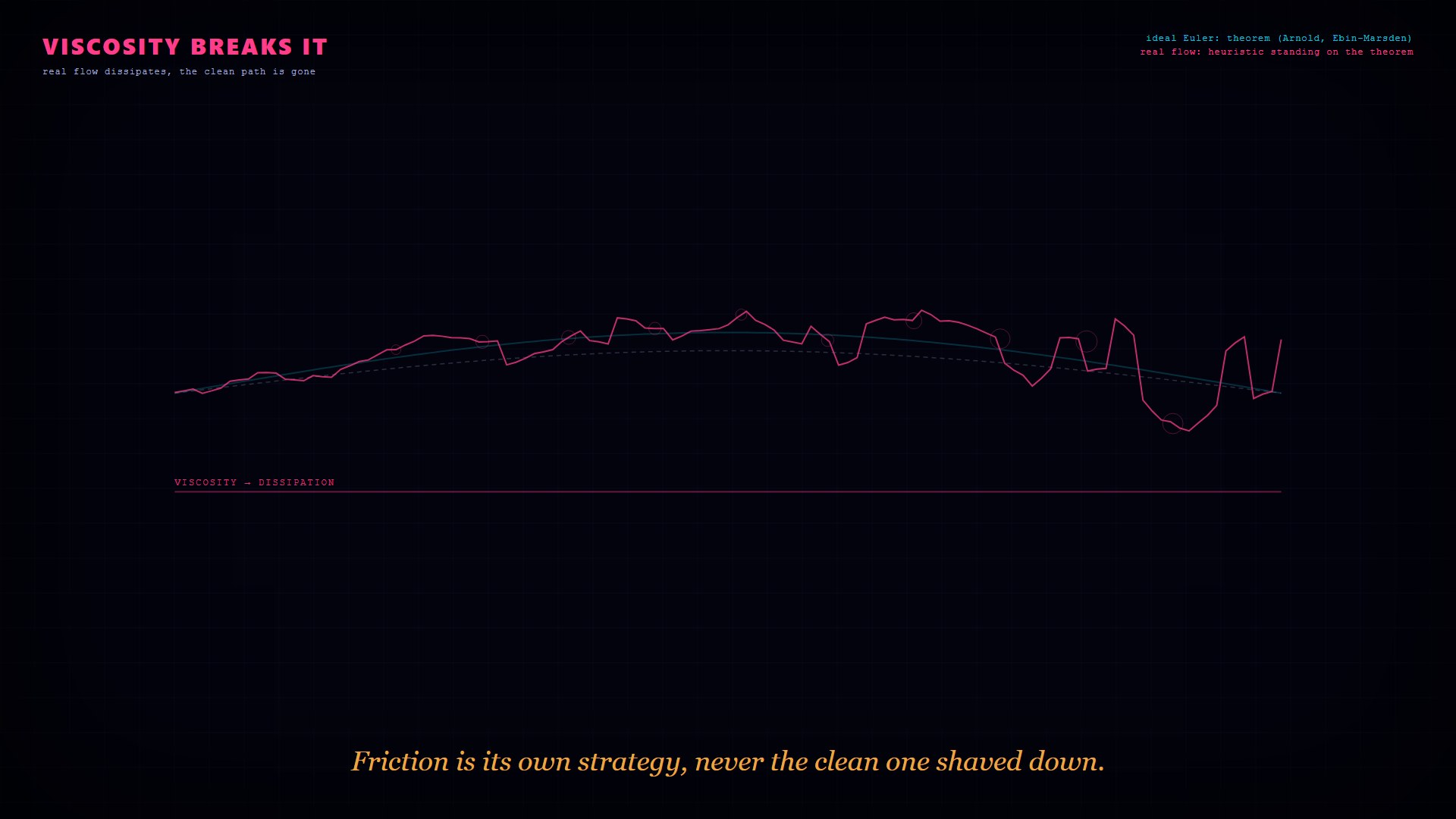
The field is a fluid. Attention flows. Capital flows. Work flows. Each one moves and stays roughly conserved, which is the definition of a fluid, and fluids have viscosity, which is friction. In a market the viscosity is the credibility bar you have to clear, the cost of getting a thing reviewed, the transaction cost on every move you make. The ratio that decides the regime is the Reynolds number, intensity times urgency over resistance. Low Reynolds is laminar flow, smooth and predictable, where consistent execution compounds and the disciplined player wins. High Reynolds is turbulent, chaotic, information-rich, where you stop optimizing and start exploring. Arnold showed in 1966 that an ideal, frictionless, incompressible fluid moves along a geodesic, the straightest available path, on the group of volume-preserving diffeomorphisms under the right-invariant L2 metric, and Ebin and Marsden later made it rigorous. That's a real theorem. Add viscosity, meaning Navier-Stokes, and the clean geodesic breaks into dissipation. Any claim about real, friction-bearing flow is a heuristic standing on the shoulders of a theorem. The break is the lesson, not a footnote. Once friction is in the system, the optimal strategy is its own thing, and you can't recover it by taking the frictionless answer and shaving a little off. Friction is a first-class term in every design. Treat it as a rounding error and the design is already wrong.
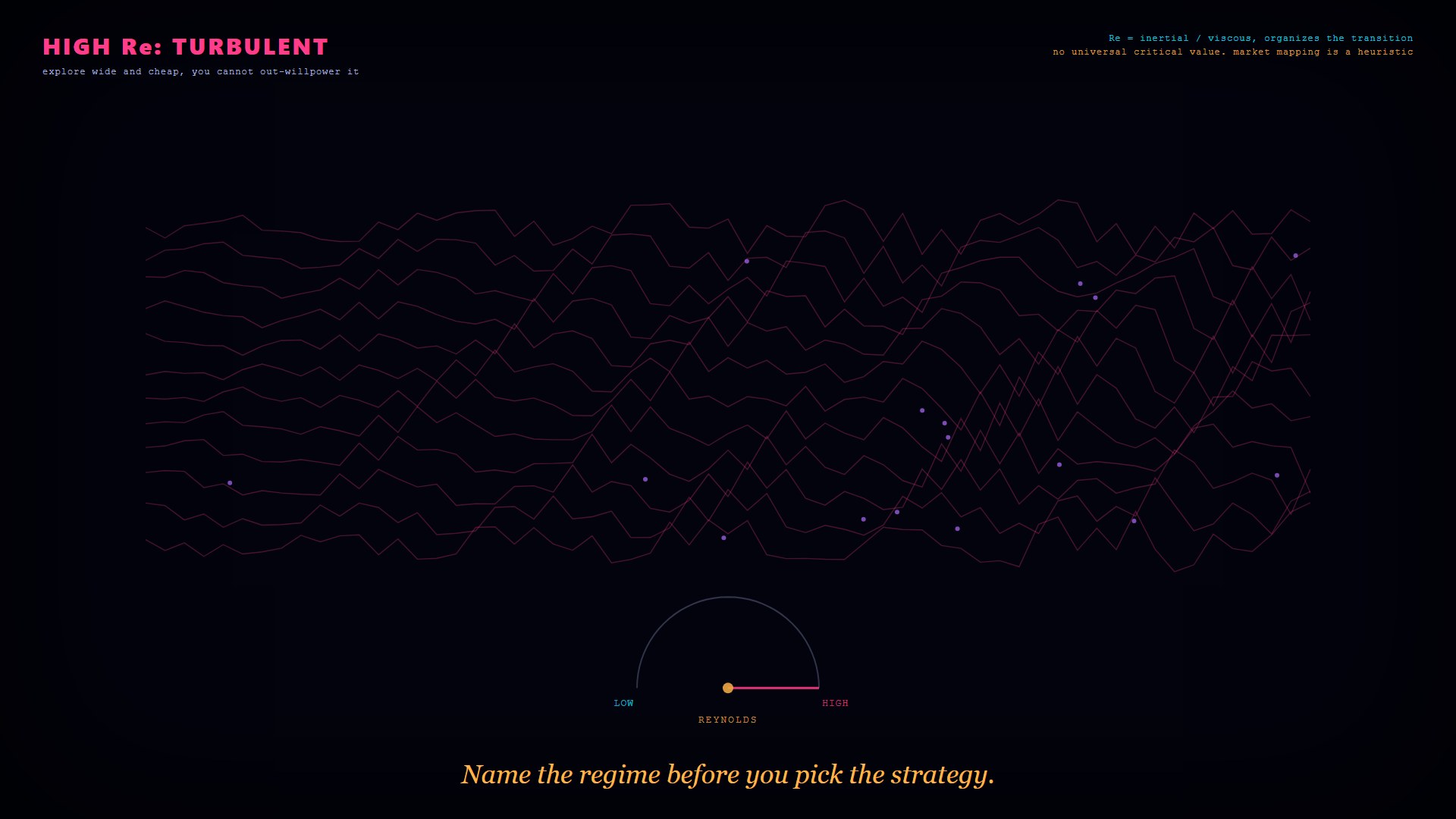
The regime distinction is the part you use in practice. In the laminar regime the water is slow and the right move is the boring one: pick a direction, run it consistently, let compounding do the work, because the environment holds still long enough that the disciplined player who shows up every day pulls ahead of the clever one who keeps switching. In the turbulent regime the water is fast and chaotic and disciplined execution is a trap, because whatever you were optimizing toward already moved by the time your optimization landed. The turbulent move is exploration, wide and cheap, a lot of small probes instead of one big bet. Naming the regime before you pick the strategy is most of the skill, and the environment matters because it doesn't hold still. The cultural environment the firm works inside has been engineered to run at historically high Reynolds, the ratio of how fast the adversary adapts to how fast you can decide, cranked up by every platform incentive at once. High Reynolds rewards the impulsive sins, the wrath and the gluttony, and starves the slow compounding the firm is built for, which is why the discipline has to be structural. Trying harder doesn't save you. You don't out-willpower a turbulent field. You build the instrument that reads which regime you're in and routes the strategy to match.
Decisions Are Control, Ambiguity Is Quantum
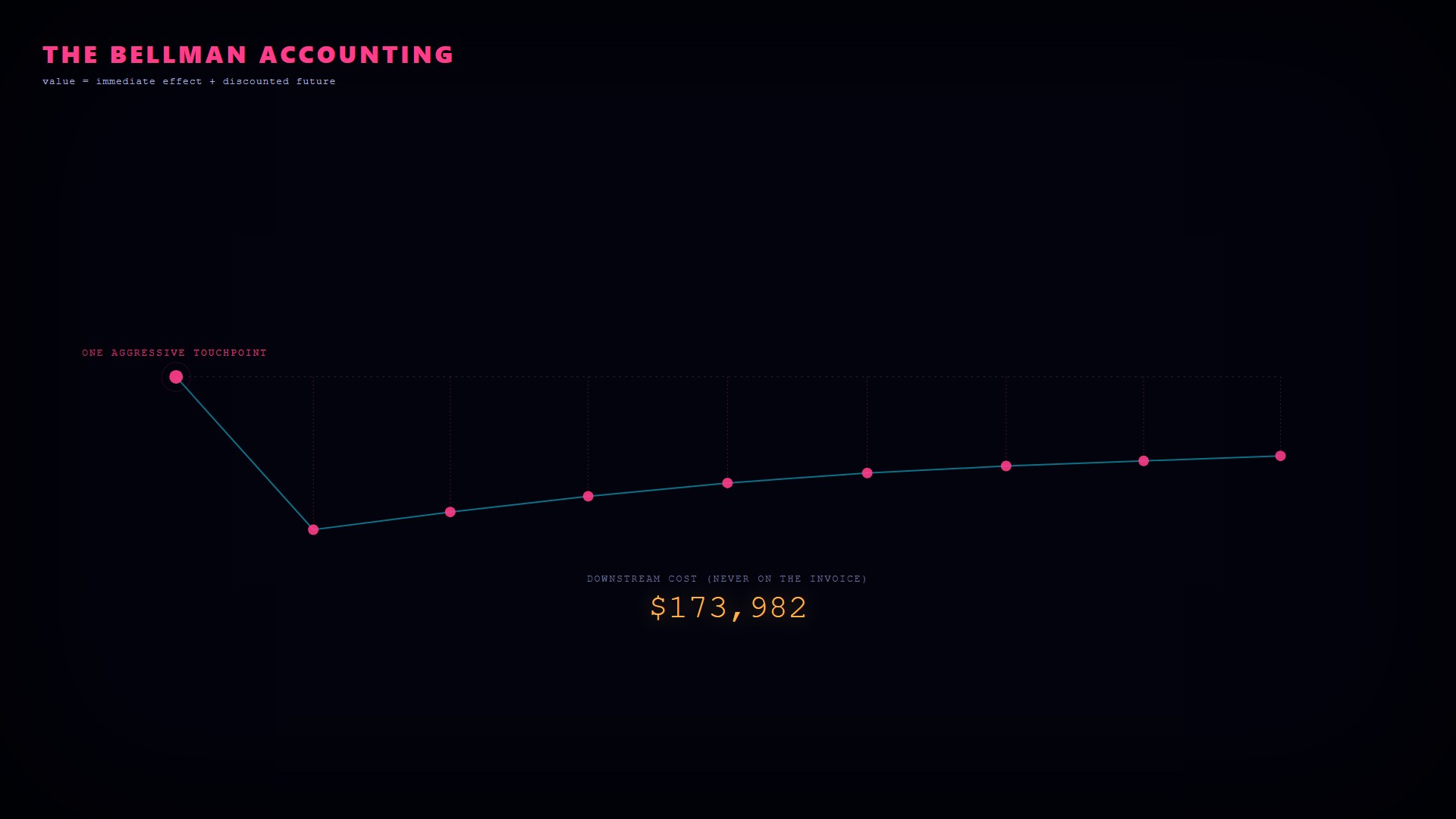
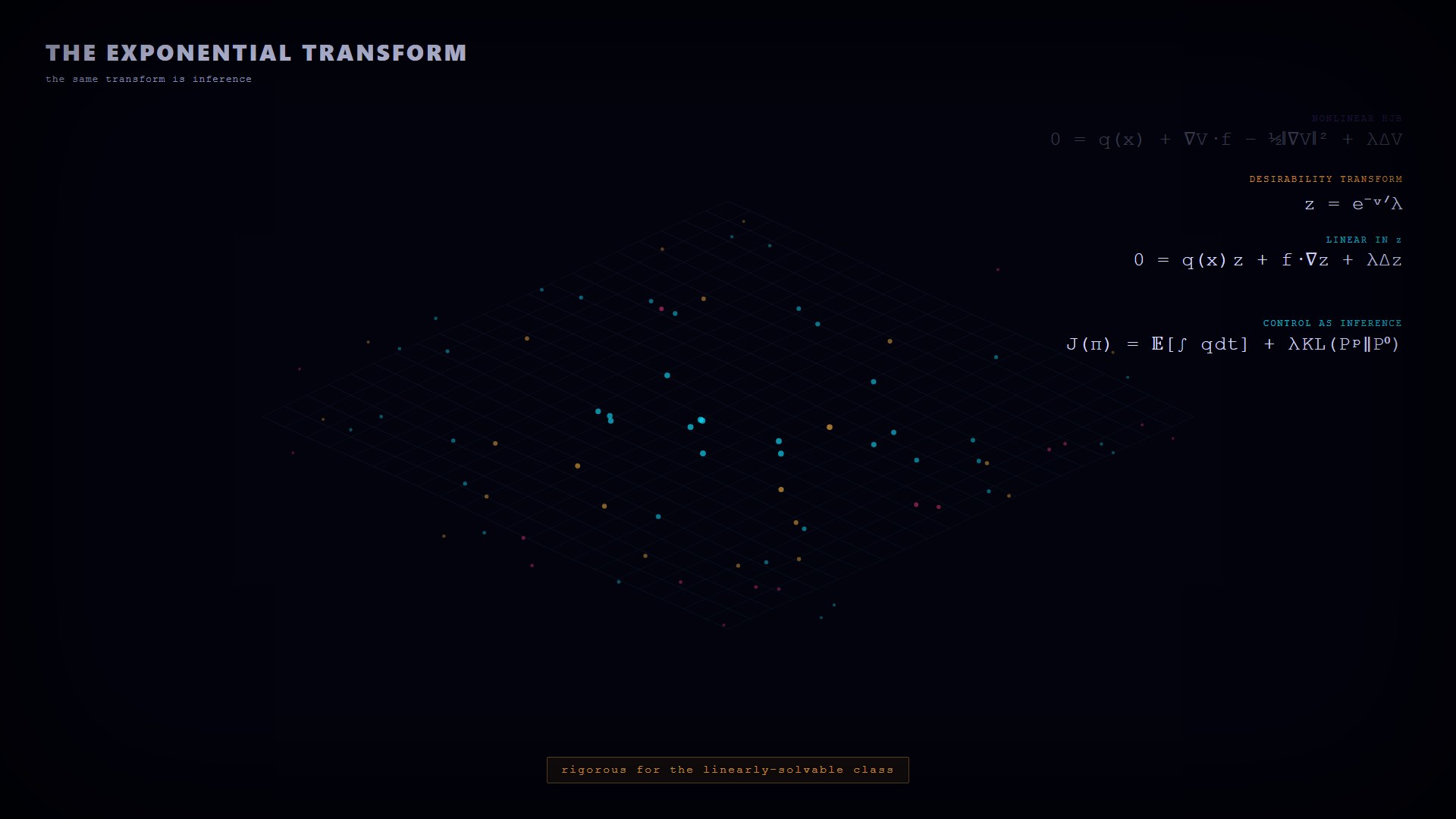
Decisions are control. Every touchpoint you send into the field carries a value, and that value is the immediate effect plus the discounted sum of every future interaction the touchpoint makes more or less likely. One aggressive sales call costs you the call plus the bent shape of every conversation that comes after it. That recursive accounting is the Bellman equation, and it's why one bad touchpoint can quietly cost six figures of downstream value that never shows up on the day it happened. One transform, raising e to the negative value function over lambda (the desirability transform z = exp(-V/lambda)), turns the hard nonlinear control problem into a soft linear one for the linearly-solvable control class, the well-behaved class Todorov and Kappen worked out. It's rigorous for that class, not in general. That same exponential transform is the bridge that lets you write an optimal-control problem as a problem of inference, a move known as control as inference. So the two halves of echolocation, sensing the field and acting on it, perception and decision, turn out to be two faces of one variational principle, bolted together at the same piece of mathematics. That's the rigorous core under the "it is all connected" intuition, and the firm won't sell it one inch past where it holds.
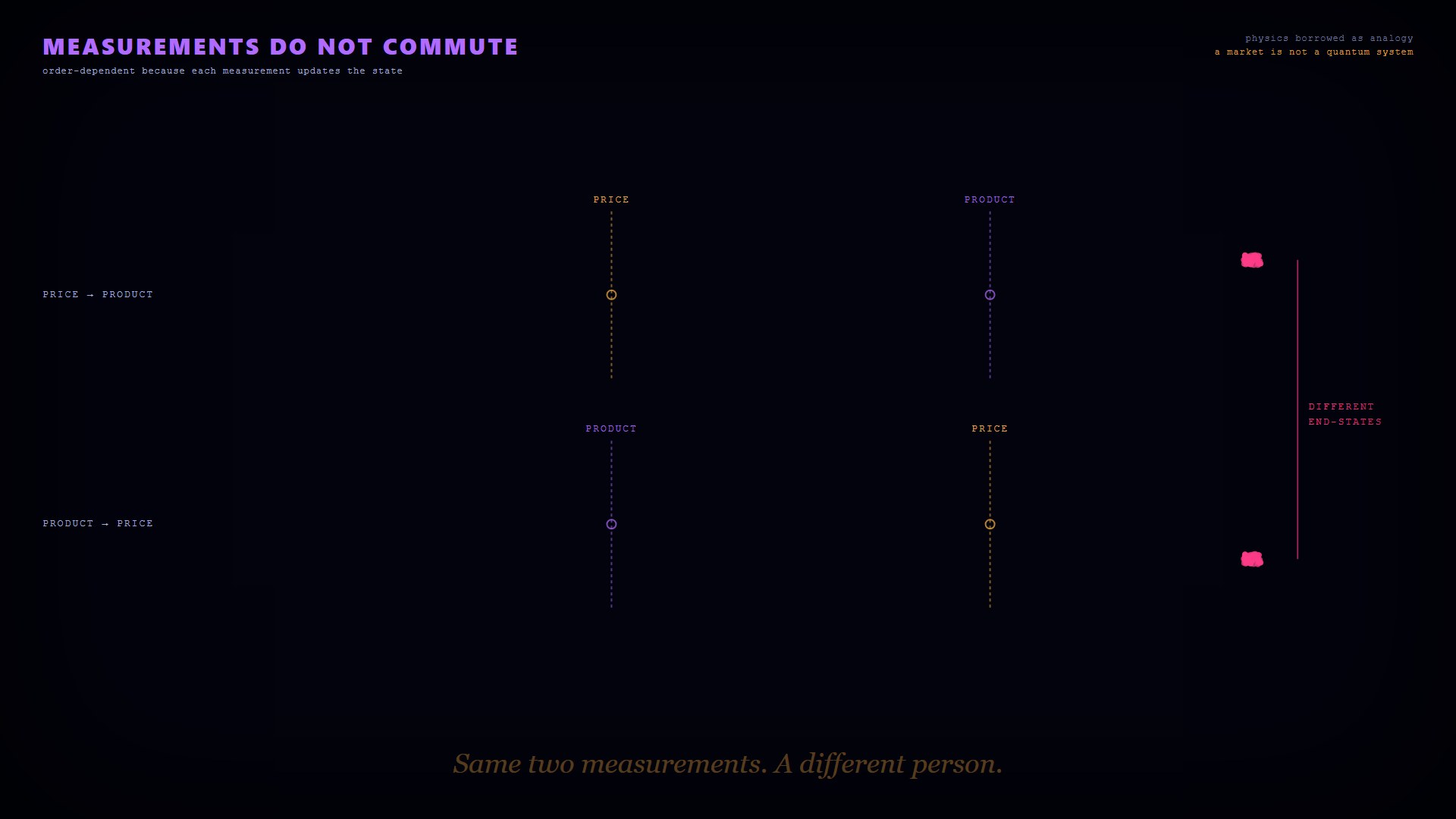
Ambiguity is quantum. A market is ranging and trending at the same time. An audience is ready and resistant at the same time. The technical word is superposition, and the amateur move is to force a binary call too early, in or out, hot or cold, which throws away the information that was living in the ambiguity. Hold the state as the superposition it actually is, and each piece of content becomes a measurement that collapses part of the audience's superposition. Measurements don't commute, so the order matters. Price before product gives you a different person than product before price. The mathematics licenses one precise claim: the heat equation, which is diffusion, the same diffusion that showed up in the control transform, becomes the Schrodinger equation under a formal Wick rotation, a rotation of time into the imaginary direction. That's a real analytic move at the level of the equations. The same grammar, diffusion and generators and the exponential of an action, keeps showing up because these are all evolution equations sharing a skeleton. A market isn't a quantum system, and the mathematics never asked it to be.
The Skeleton Holds, the Weld Does Not
The exponential transform is the piece that tempts everyone into the overreach. It smooths the jagged control surface into a linear one you can solve and rewrites control as inference, and the move is real and beautiful. It's also where the discipline earns its keep, because the temptation at this point is to declare that everything is therefore one equation and ride the feeling of unification straight past the place the mathematics licenses. The transform holds for the linearly-solvable class, and the skeleton it exposes is shared. The weld into a single equation is the part the firm refuses.
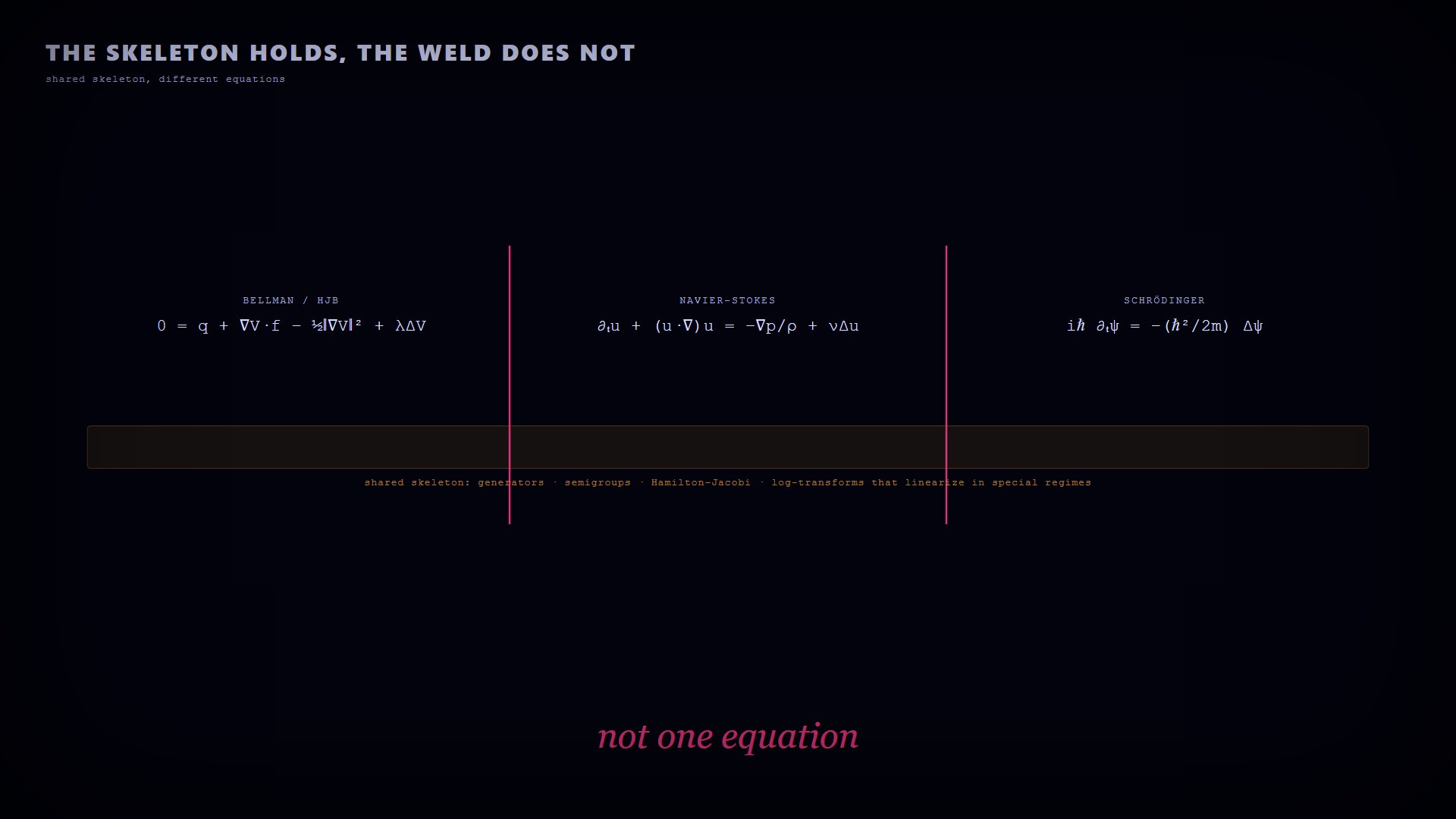
Ben Goertzel spent the better part of fifty years staring at the convergence of fluid dynamics, reinforcement learning, and quantum theory, the Navier-Stokes and the Bellman and the Schrodinger, and he came away convinced they were the same equation wearing three costumes, and he built a new data structure, the metagraph, to hold the thing he was seeing. The firm has picked up the scraps that genius leaves behind and run with them, and this is the one place it refuses to follow him all the way. Bellman, Navier-Stokes, and Schrodinger aren't the same equation. They live in different spaces, they mean different things by time, and one of them is complex-valued. What's true, and a mathematician will sign off on it, is that they share a formal language: generators and semigroups, least-action and Hamilton-Jacobi structure, and logarithmic transforms that linearize nonlinear problems in special regimes. The shared skeleton is real. The single welded equation is the part you say to sound smart, and the firm's own earlier writing reached for it too before catching the mistake.
So put the three equations next to each other and show where they touch and where they don't. The cleanest touch is the Wick rotation from the quantum section, where diffusion rotated through imaginary time becomes the Schrodinger equation. It's the strongest single piece of evidence for the shared skeleton, and it still stops short of a weld. The equations stand side by side with a hard line between them, lit at the seam where the structure is shared and dark where the firm refuses to claim more than it has.
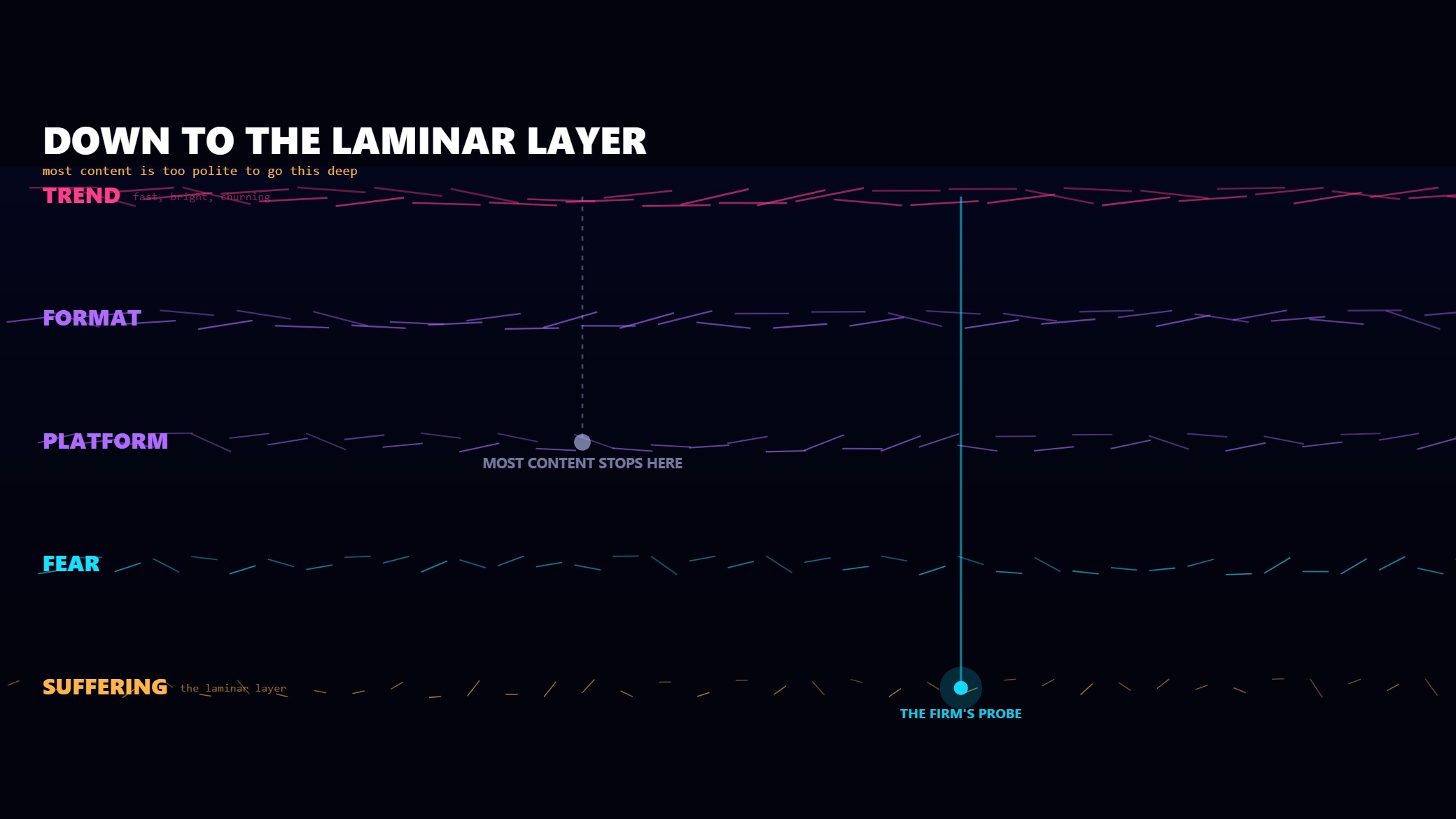
Most content lives entirely on the turbulent surface: the platform, the trend, the format that changes every week, high Reynolds, gone by Thursday. The tiny fraction that breaks through is working two depths at once. It does enough on the turbulent surface to get carried by the algorithm, and it lands on the laminar layer underneath, the slow water that has barely moved in ten thousand years. It catches the machine and the human in the same stroke. That laminar layer is made of suffering, and the only bridge across it is made of courage.
Chapter Four: The Loop
Under the weather of any market, under the trends and the platforms and the price sensitivity, there's a layer that barely moves. That's the laminar layer, the part of being human that a Sumerian scribe and a teenager in a war zone would both recognize with no translation, and it's where all the durable resonance lives. The laminar layer is mostly made of suffering, and most content fails because it's too polite to go down there.
The Suffering Loop, Station by Station
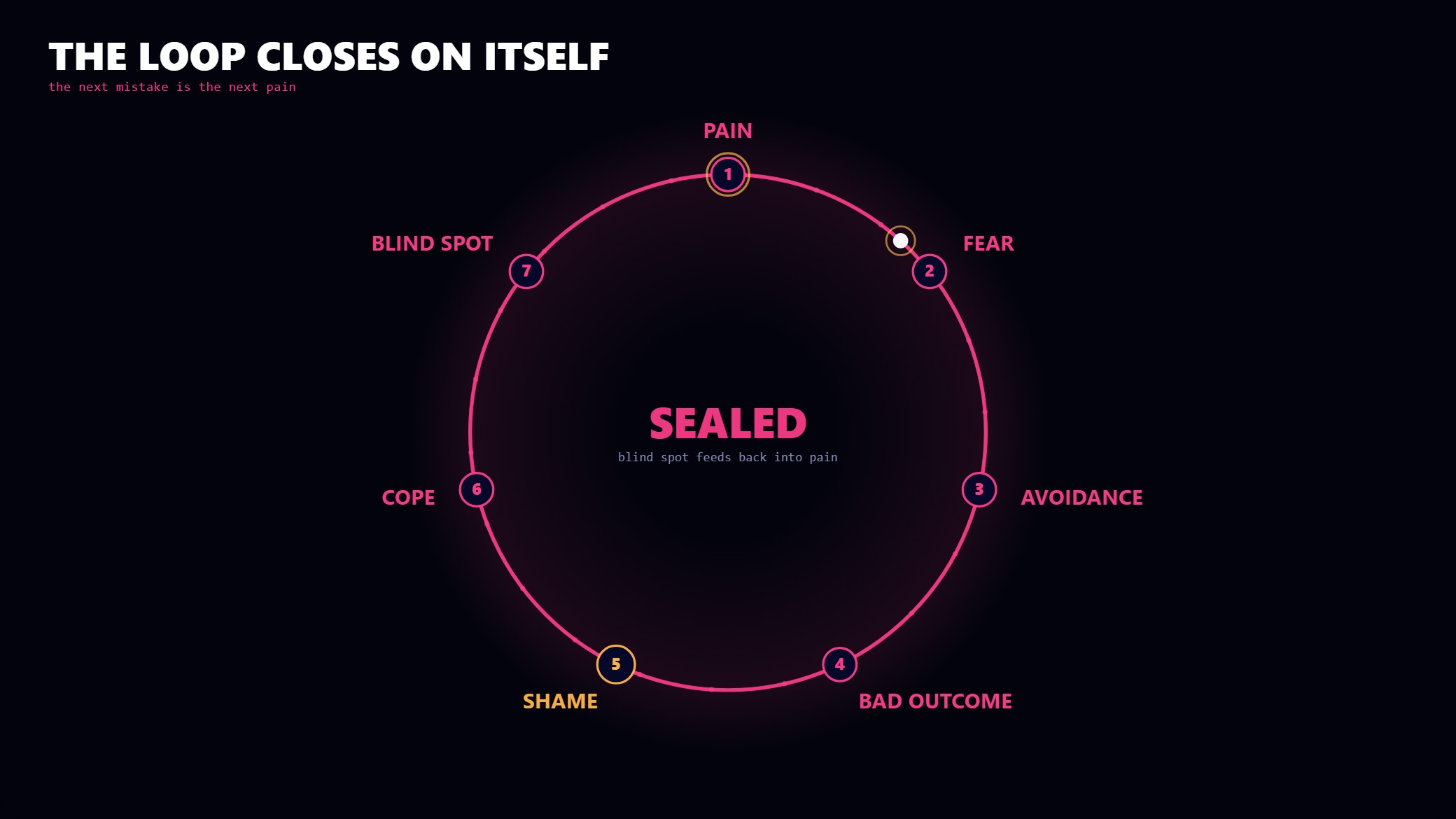
The loop runs as engineering data rather than as a moral failing of the people stuck inside it. Pain arrives. A fear gets installed in response, and which fears you let in matters, because a fear is an investment and most people run a terrible portfolio, sinking everything into fears that pay no return and chip away at the principal. The fear drives avoidance, the avoidance produces a bad outcome, the bad outcome produces shame, and shame is the worst station on the ride, because shame is the belief that you are bad, not that you did a bad thing. Shame is unbearable to hold, so it gets masked with denial, with cope, with blame on the government, the economy, the feminists, the patriarchy. Pick one, pick all of them; it actually works better if you pick all of them. There's exactly one move you're forbidden to make in here, one red line: accountability. Taking accountability means turning around and looking dead at the shame you just buried, so you don't fucking do it. The refusal opens a blind spot, the blind spot produces the next mistake, the mistake is the next pain, and the loop closes on itself. Most people walk this circle, most of the time, for their entire lives.
Why the Loop Is the Default
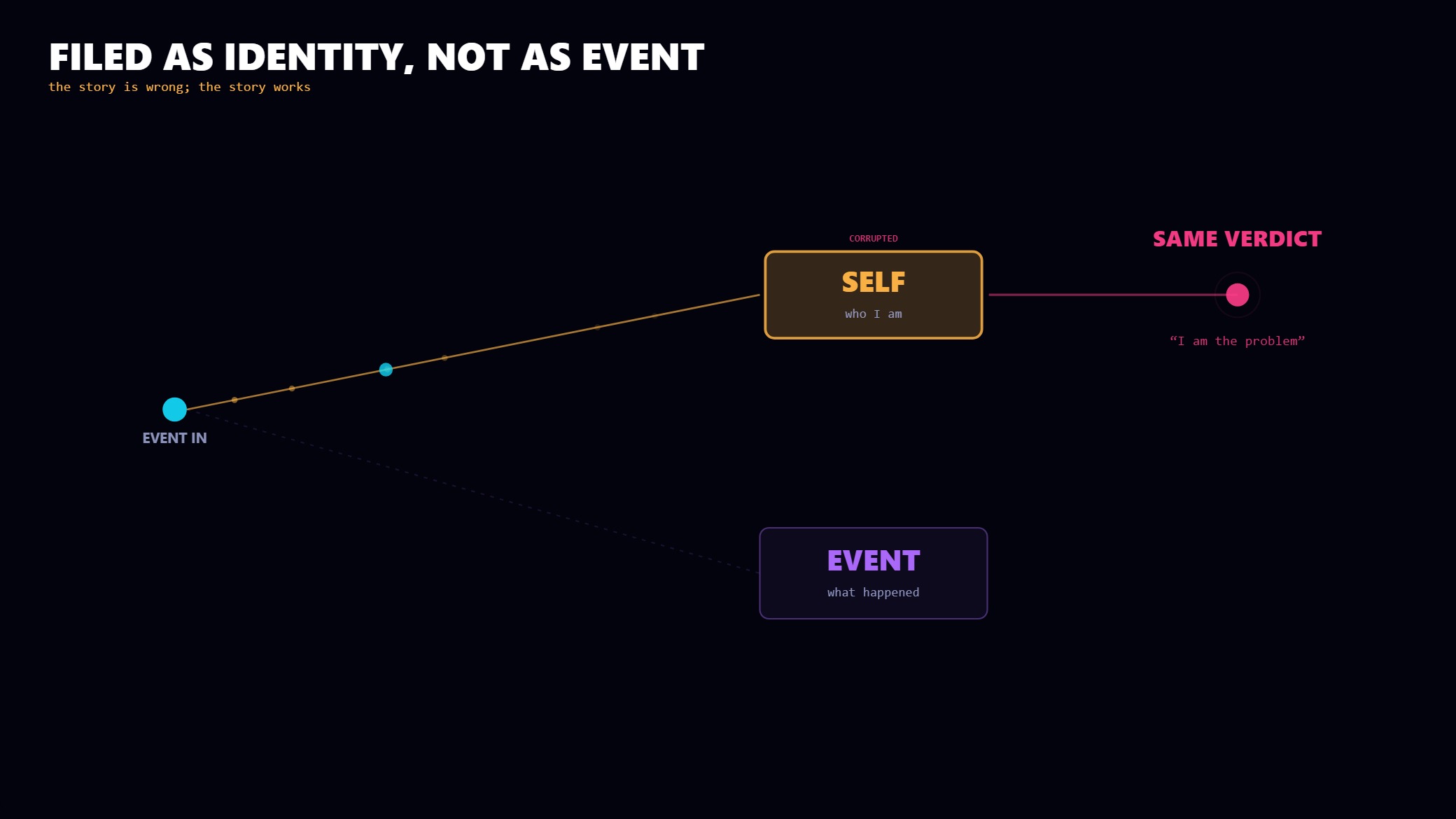
Every transition has a mechanism the literature has nailed down, and reading them as mechanism is what makes the loop something you can work with instead of something you sit in judgment of. The first pain, a childhood one especially, lands before the kid has any apparatus to frame it, so the wound goes into the operating system as identity, not as event. A small child blamed while the sibling gets praised doesn't conclude that the adult is dysregulated and projecting. The child concludes that he is the problem, that his existence causes the pain, and that conclusion writes itself straight into the file labeled self. The body starts building around the predicted next hit before the mind has words for it, which is why avoidance looks insane at the scale of a life and runs correct survival policy at the scale of a nervous system. By the time the fear has set, the person has stopped responding to events. He responds to predictions of events, on a system that holds cortisol high and never quite drops back to baseline. The story he builds to explain the recurring pain lands on self-blame, because self-blame is the one version that keeps him attached to the caregiver he still depends on to survive, and by adulthood that story has hardened into a worldview. New events get read through it and come back with the same answer. The story is wrong, and it works.
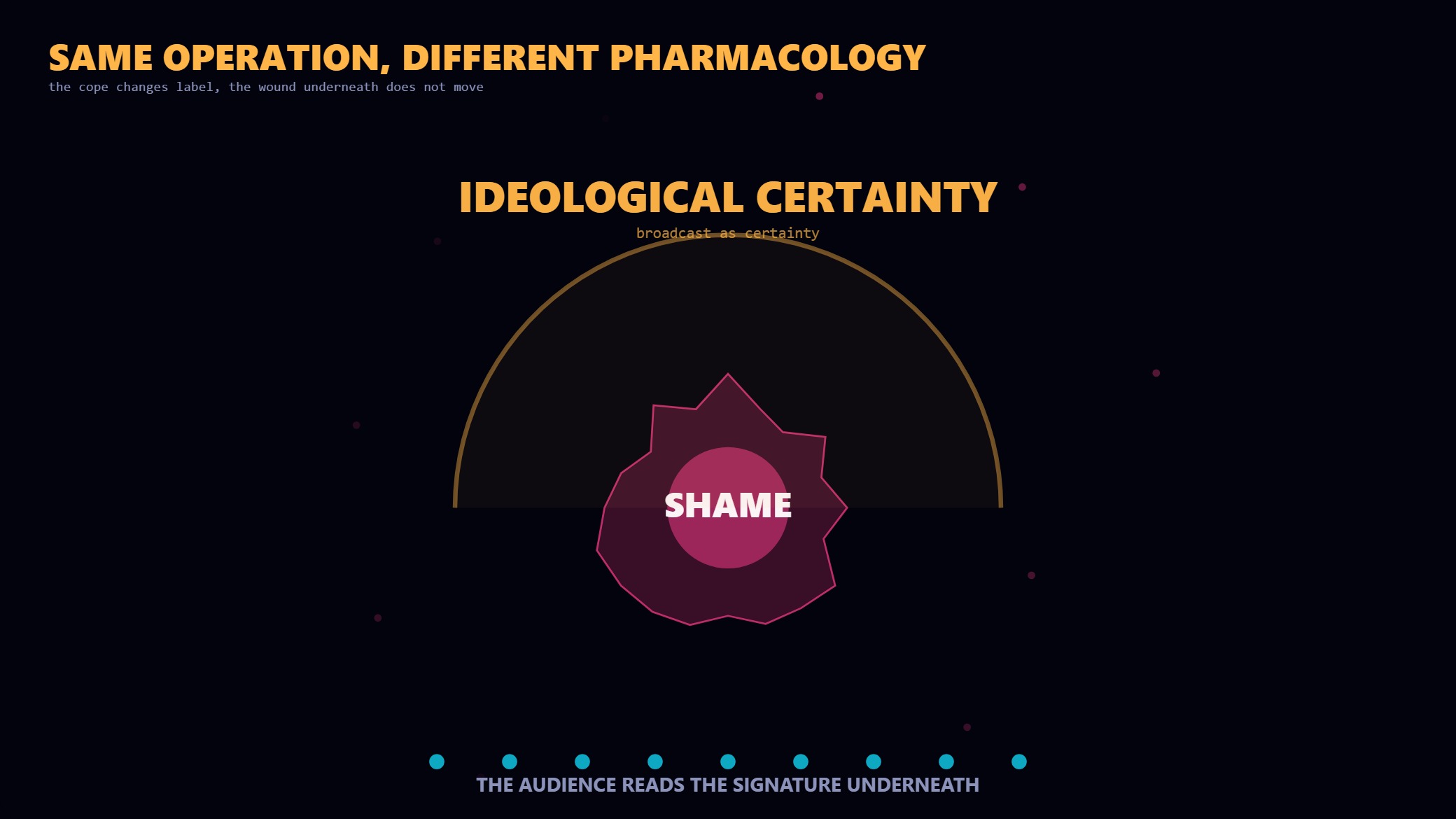
The cope at the bottom of the loop gets socially rewarded in direct proportion to how confidently it's performed. Substance is one flavor. Ideological certainty is the same operation with different pharmacology: manosphere certainty, radical-feminist certainty, doomer economics, political rage, every one of them numbing the shame without touching the wound, every one of them running off the people who would have been the actual community. The audience reads the signature on all of it, because all of it is confident output from operators broadcasting unprocessed shame as moral certainty. That's the cultural default. Roughly seventy percent of the planet has lived through at least one genuinely traumatic event, and the content economy, which didn't create those wounds, industrialized the act of locating each one and serving it fuel every night. The firm reads the loop as the baseline condition of the audience, because that's the only starting point that produces work that lands.
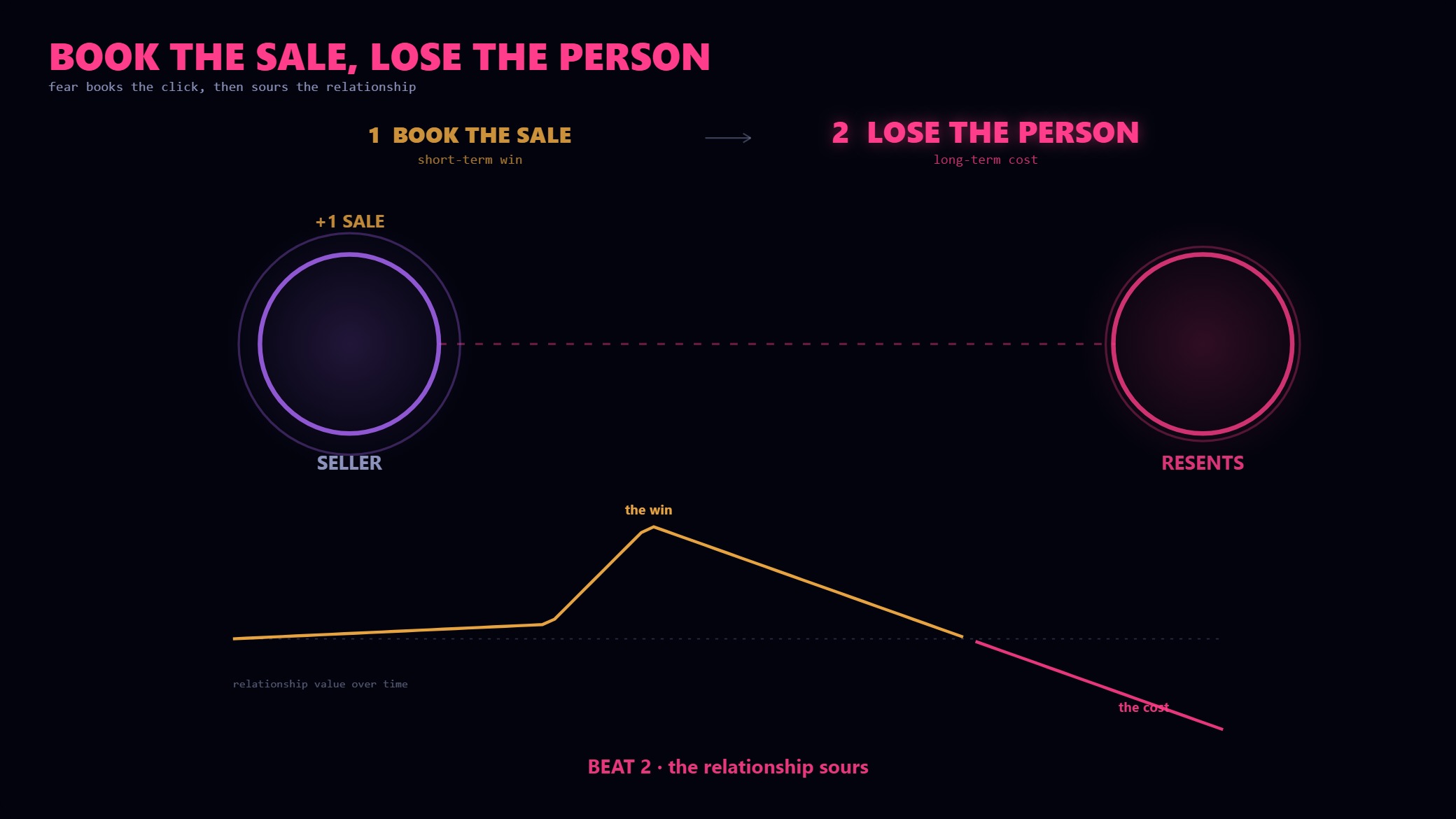
Most marketing plays inside the suffering loop without knowing it, because fear and shame convert in the short term, and the first week of any direct-response education teaches that a pain point plus a manufactured deadline equals a click. You can mug a person with their own fear and book the sale. What you can't do with fear is build the thing that becomes part of who a person is, because fear makes people flinch, and then they resent the hand that made them flinch.
The Other Ring, and Courage at the Crossing
A person can also run a second circuit, a ring stacked above the suffering loop and turning the other way, and the two of them touch at exactly one crossing. The lower ring runs on fear, the upper ring runs on truth, and the crossing is the one place a person passes from the first to the second. That crossing has a name, and naming it correctly is most of the work, because everything downstream depends on getting the hinge right.
When the pain arrives, a person can reach for courage instead of installing a fear, and courage opens the hunt for truth even when the truth hurts worse than the lie. The truth usually does hurt worse, and it doesn't come find you. It doesn't leap out of the chimney like Santa looking for milk and cookies. You have to go drag it back. Truth allows responsibility, which is authorship, taking ownership of your reaction even to the things that genuinely weren't your fault. Responsibility allows healing, and healing is painful the way a deep-tissue sports massage is painful, the therapist tearing through the knots so the muscle can come back stronger. Healing allows forgiveness, mostly forgiving yourself for what you could have, would have, should have done. Forgiveness opens your eyes onto a new truth, and the ring turns again, up this time. The hinge between the two rings, the one point that decides which way you go, is courage. The firm borrows Hawkins' ordering of the emotions as an ontology, a useful set of names and a scale to draw against, and uses it descriptively. Anyone who wants to import the metaphysics along with it can do that on their own time. It's heuristic vocabulary, not validated science, and used that way it earns its keep. Courage is the doorway from the destructive band into the constructive one. You can't discipline or motivate your way through that door from inside a shame spiral, and handing more information to a defended person just builds him more defense.
Picture the whole shape at once: a vertical figure-eight with the red suffering ring below, the gold growth ring above, and courage pulsing at the single crossing where a person can climb from one to the other.
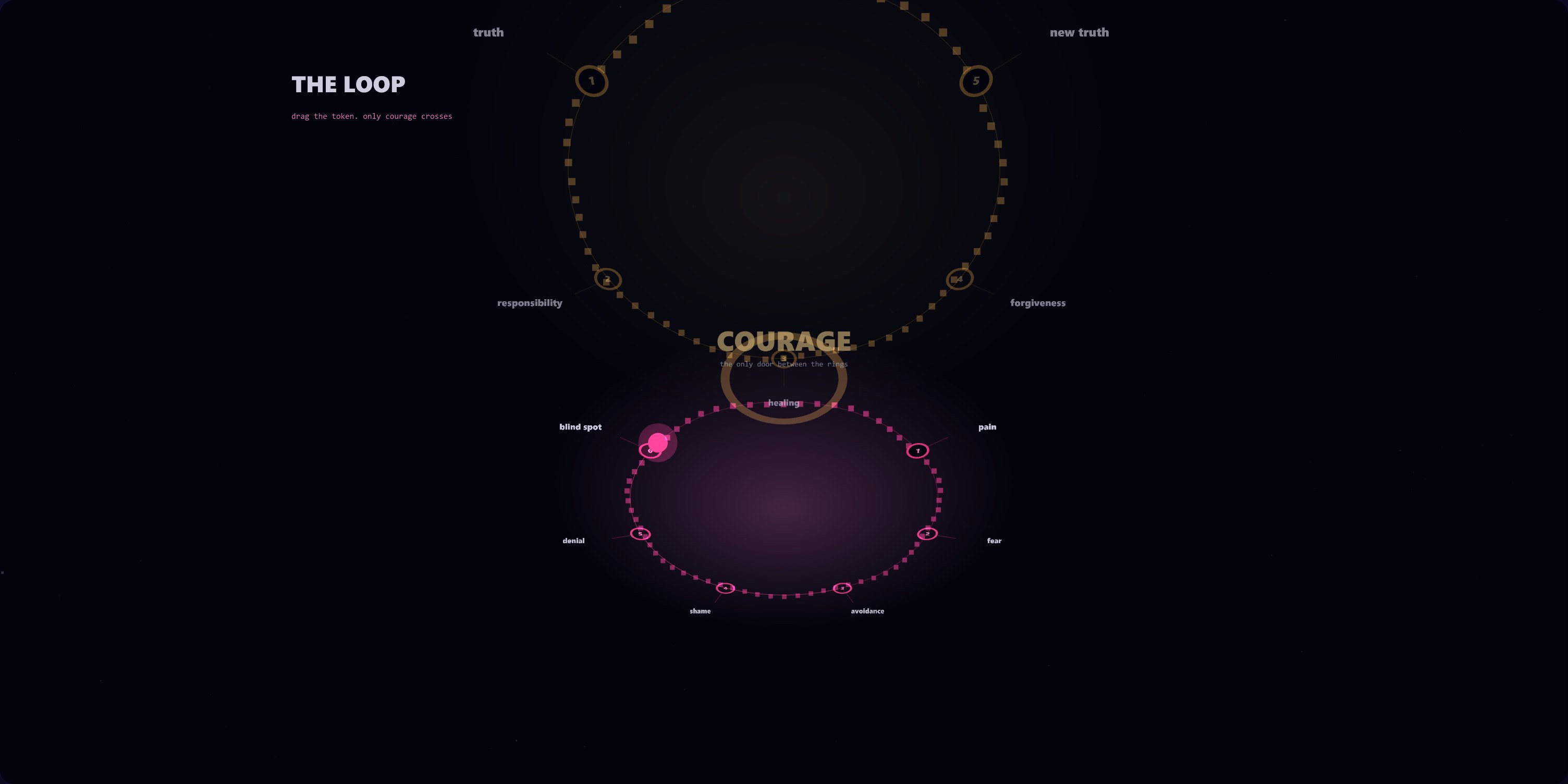
Knowing where the door is doesn't get you through it. Watch what happens when a person pinned in the shame band tries to force the crossing on willpower alone: he shoves at the boundary, slides back, shoves again, slides back, because raw effort is the wrong tool for this particular wall. The door opens to courage and to nothing else.
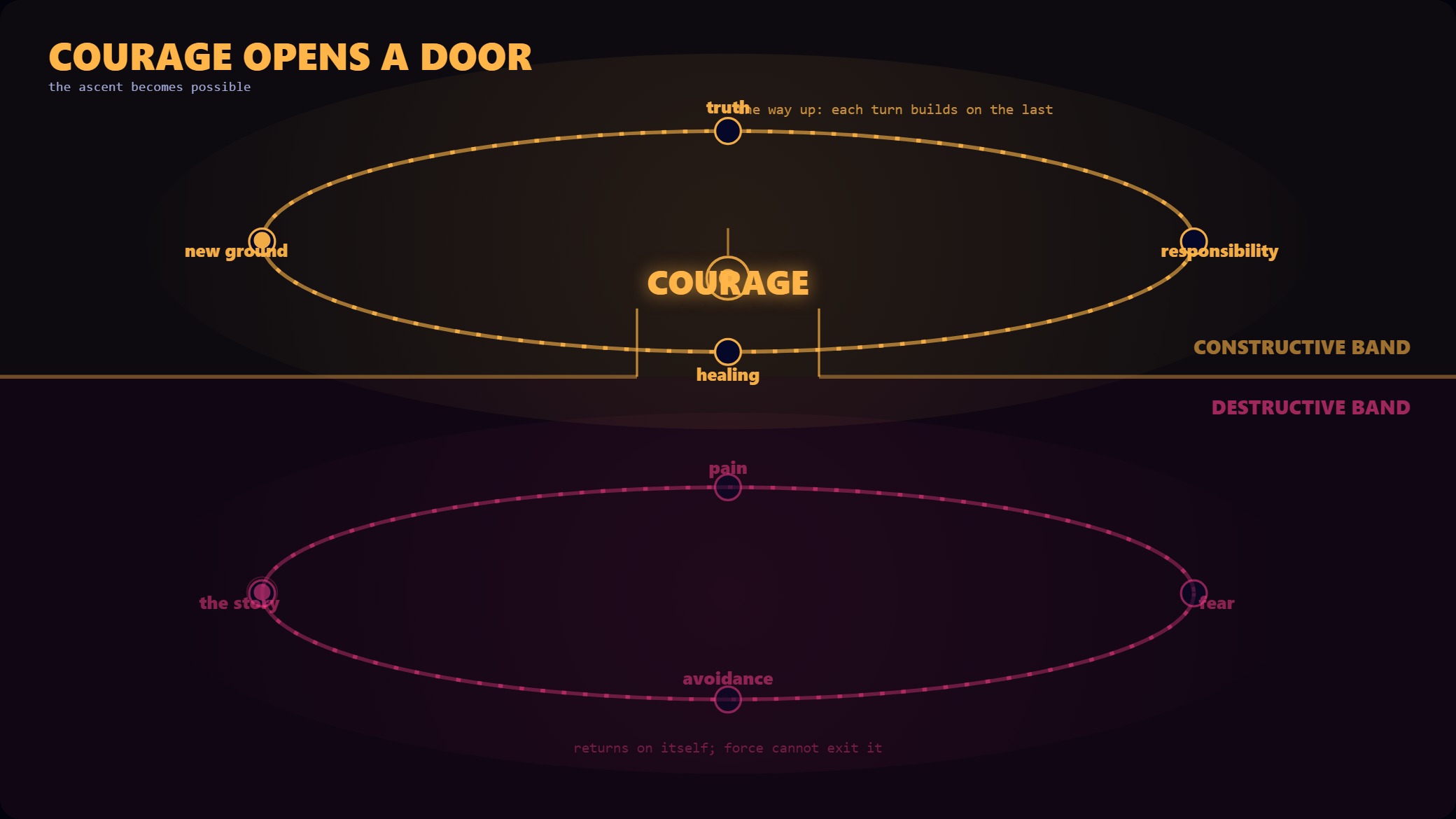
Set the two rings side by side and the growth cycle reads as the suffering loop run in reverse, station answering station. The inversion is exact.
| Suffering loop | Growth cycle |
|---|---|
| Pain becomes identity | Truth-seeking separates event from identity |
| Avoidance | Responsibility, authorship of the response |
| Fear | Healing, the tearing before the strength |
| Shame | Forgiveness, mostly of the self |
| Cope and mask | Strength, contact with reality without numbing |
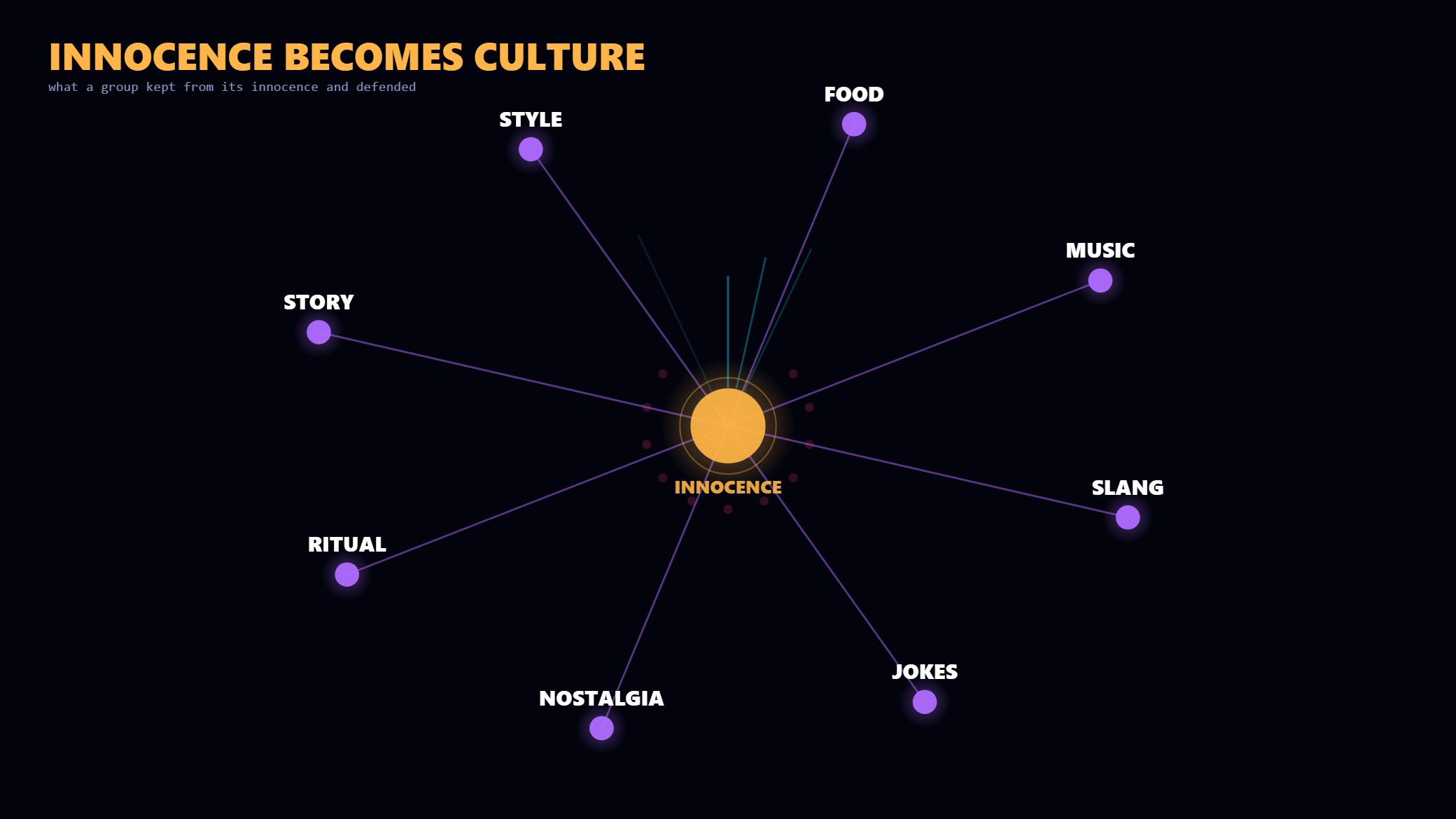
So what opens the door? Innocence does. Innocence is relating to the world through curiosity and wonder, before the scaffolding of defensive interpretation goes up over it. It's an orientation toward the new, the quality of attention a person still has while the accumulated armor hasn't yet closed over the top. Culture, all of it, is the collective expression of whatever a group kept from its innocence and then defended: the food, the music, the slang, the nostalgia, the jokes that shouldn't be funny and somehow are. Every culture's nostalgia is a map of its innocence, which is why children hold universal power across every civilization that has ever existed. A child is innocence still walking around, and the species knows in its gut that innocence is the raw material everything worth making gets made out of.
The Keystone Mechanism
Innocence is the raw material of the keystone, the single most useful mechanism in the instrument.
One piece opens on a pretty flower in a grandmother's pot and then gives you the chemistry by which that same flower switches off a human will. Another opens on a children's counting rhyme and then delivers the conscription notice it has been counting down to the whole time. The move shows up on its own in creators eight thousand kilometers apart who have never heard of each other, in different languages, in different genres, which is how the firm knows it's looking at the laminar layer and not at some passing style.
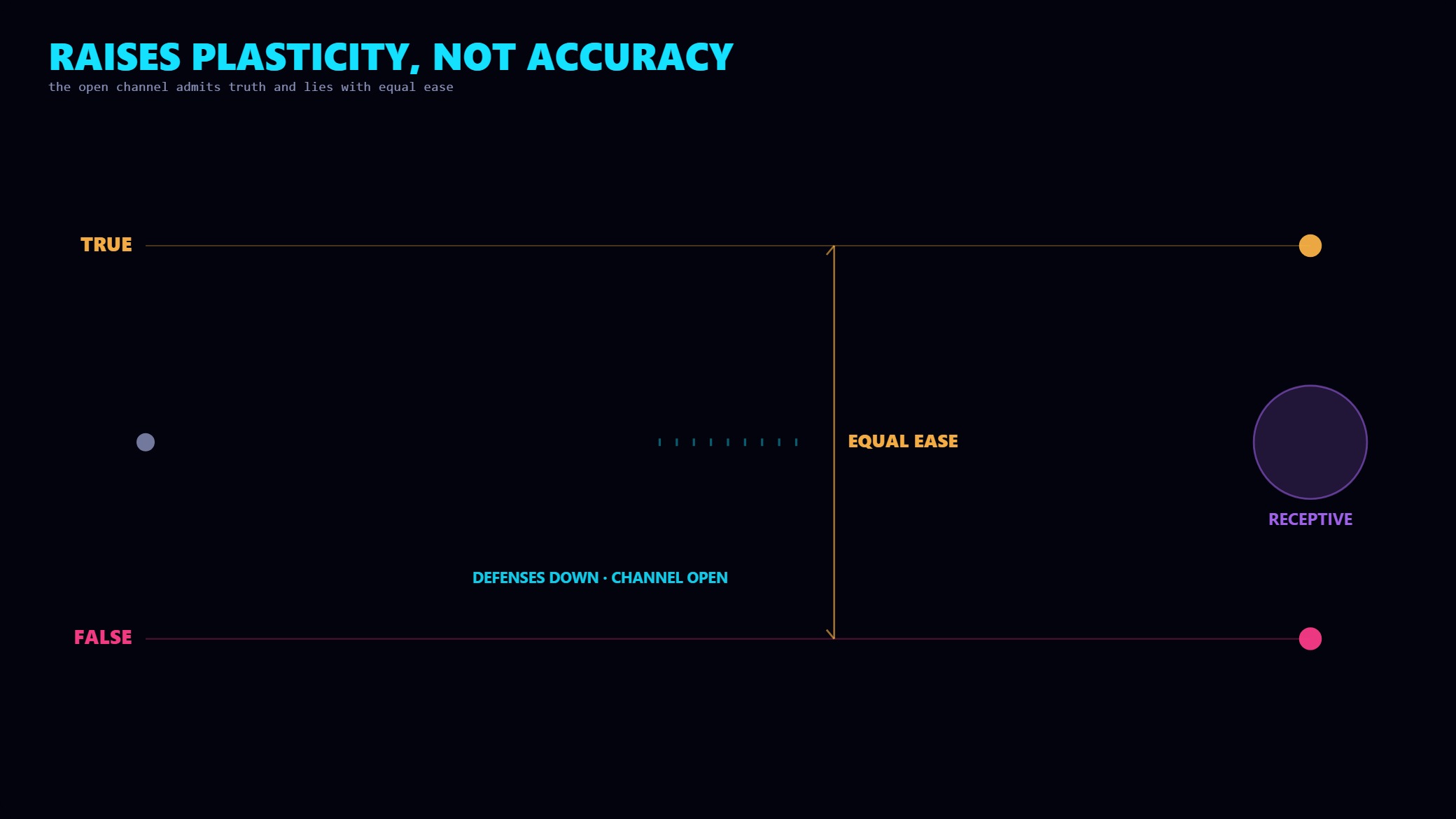
The mechanism has real backbone under it. When a person gets absorbed in a story he counter-argues less, and narrative transportation is a well-replicated finding that holds across a lot of studies. Nostalgia reliably moves people toward approach, toward meaning, toward a felt sense of connection. Signals of safety and play drop the threat appraisal that keeps the guard up. A disarming surface lowers the confidence the mind is putting on its defensive predictions, so the real content gets a chance to update belief. That last point is a coherent interpretation and not a nailed-down fact, and something sharper sits right next to it. Lowering a person's defenses raises their plasticity, not their accuracy. It opens them to the truth and to lies with equal ease. The ethics live right there.
Invitation and Mugging Run on One Mechanism
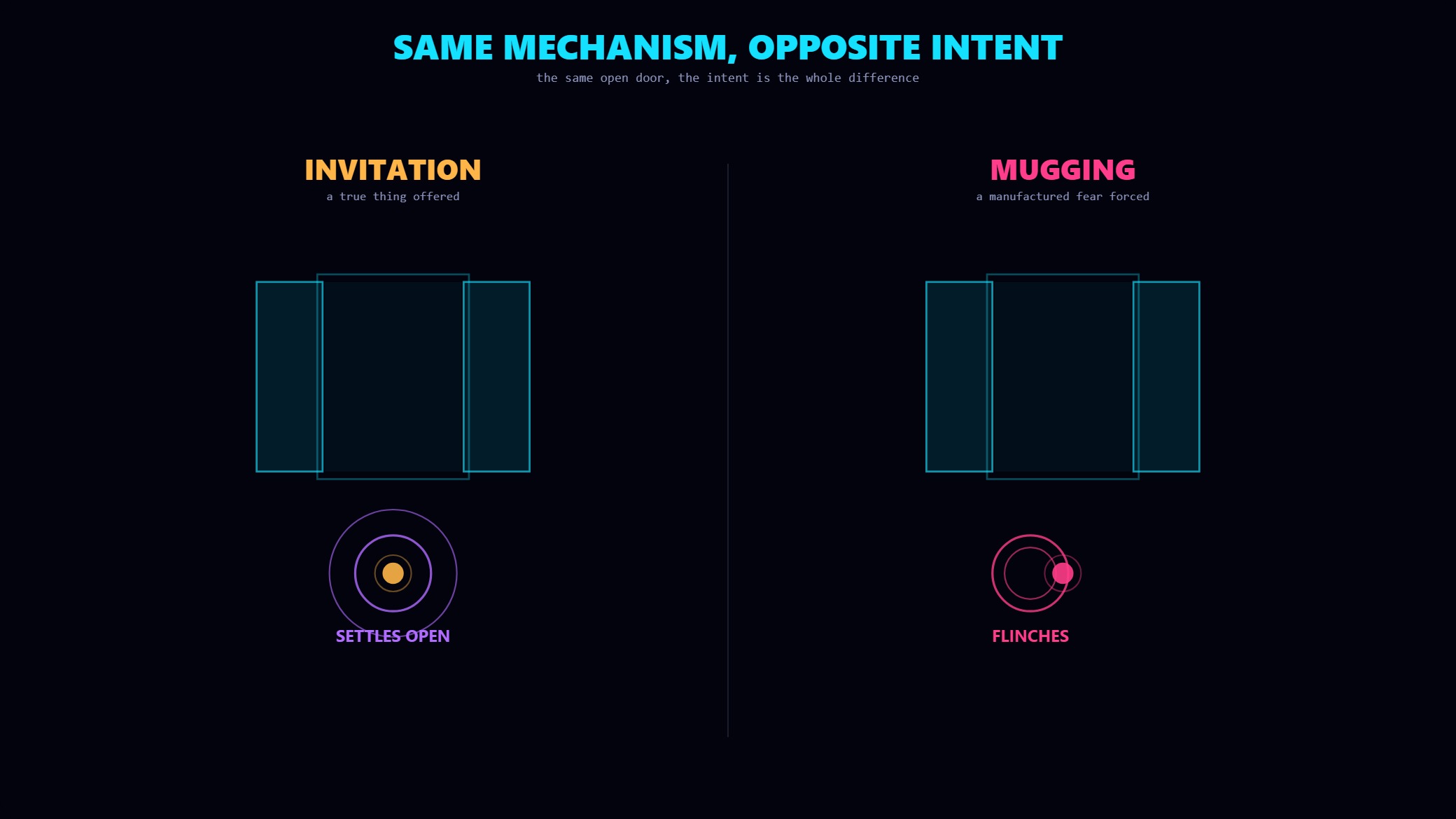
Once the door is open you can do two things, and they run on the same mechanism. Use a true thing to make the opening, or use a manufactured fear to force a transaction. The first is an invitation and the second is a mugging. The mechanics are identical, and the intent is the entire difference, and a person's nervous system eventually clocks which one you ran on him, even when his conscious mind never figures it out. The firm's standing position is the one its memo on innocence and culture names: find the wound that is already there, refuse to inflame it, and deliver the truth the defenses were built to keep out.
Selling and Healing Are One Operation
Once you see the loop, and once you see the door, selling and healing collapse into the same operation, one framework wearing two faces. In both, you reconstruct a person's exact position in the loop, the specific pain, the specific fear he invested in, the specific shame he is coping around, more accurately than he has ever managed himself, and then you hand him the door across. The chiropractor who names a fifteen-year back pain in the first appointment and the writer who finally names the thing a reader was never allowed to say about his own mother are running the same instrument.
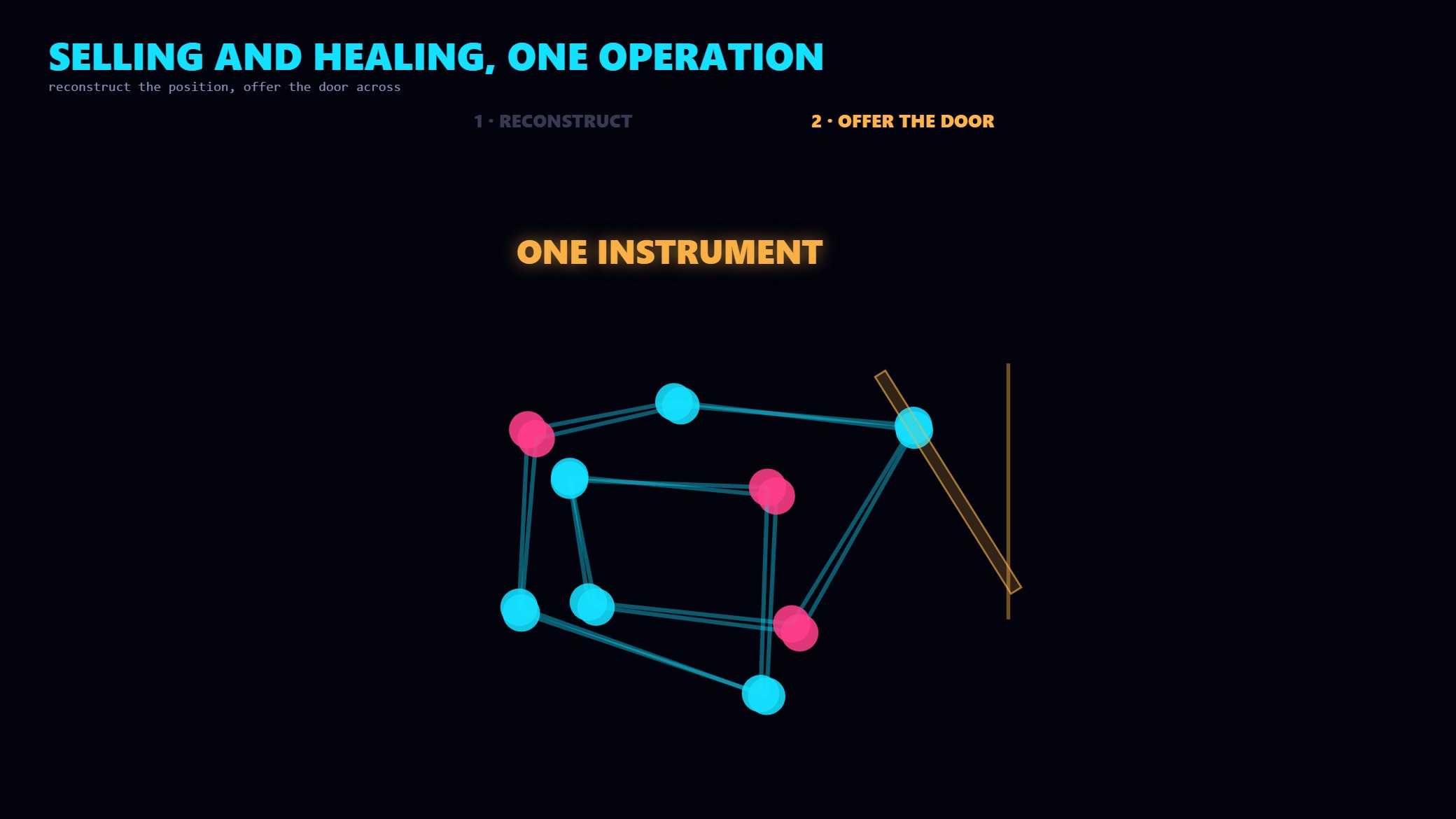
That's why the method is so devastatingly effective for conversions, and it's also why, run with truth instead of fear, it comes out as the opposite of manipulation. You're handing a person the door he was already standing in front of, in the dark, alone.
Chapter Five: The Substrate
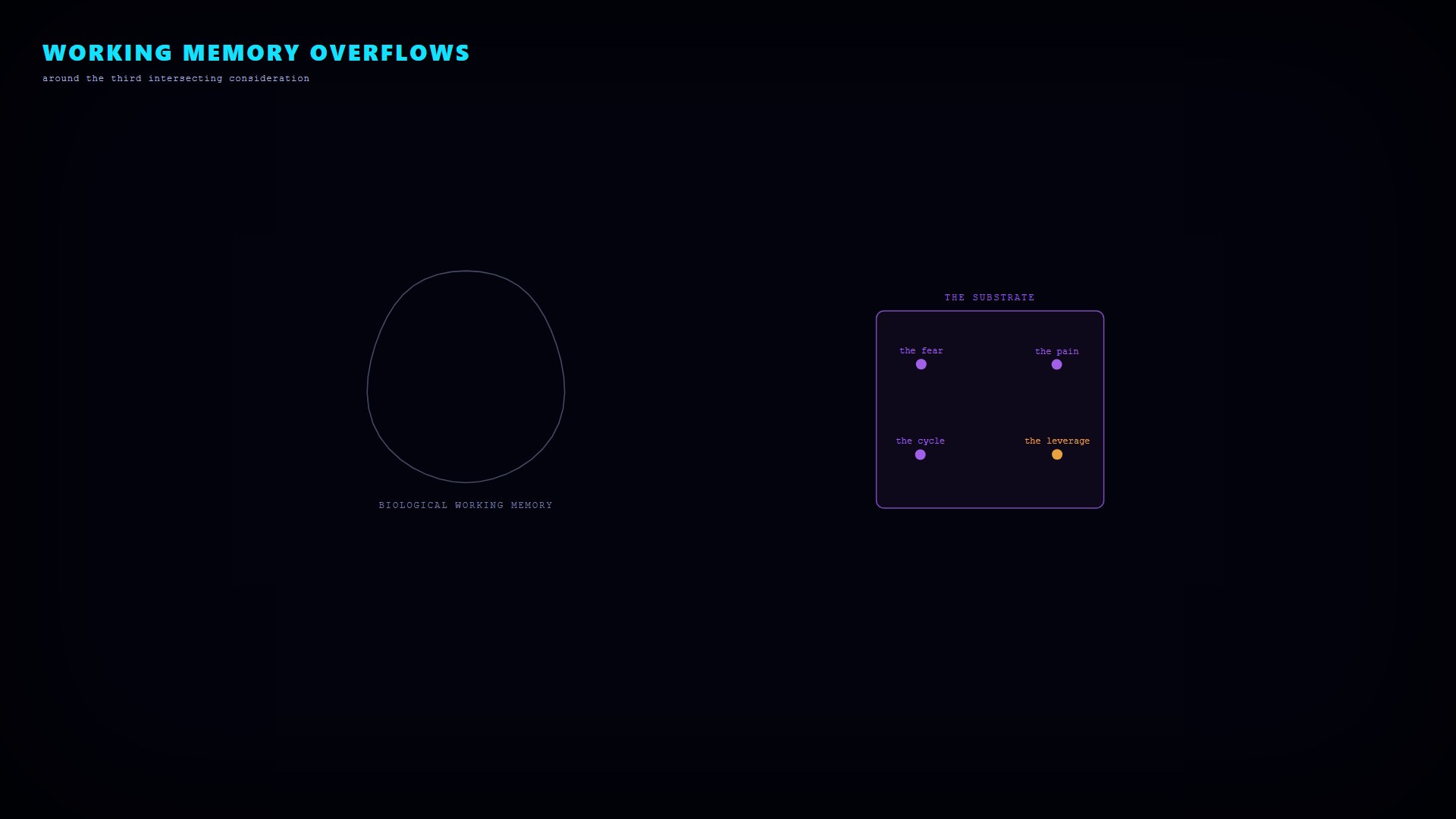
You can't hold this in your head. The field runs in many dimensions, the loop carries a hundred and thirty emotions, every customer is a moving point in a moving weather system, and biological working memory taps out somewhere around the third intersecting consideration. The whole reason any of this gets externalized is that the physical meat vessel runs out of room and the work doesn't.
Why the Shape Has to Be a Graph
So the firm needs a memory, and the question is what shape that memory takes. A relational database is a beautiful, rigid thing that wants you to know the shape of your questions before you store the data, which is fine right up until reality refuses to hold still. A document store sits at the other extreme, infinite flexibility, dump it in and sort it out later, and that's where the firm has spent most of its career, and it works right up until the value you need lives in the relationships instead of the records. The thing echolocation produces is relationships. This fear depends on that pain. This belief came from that experience. This campaign came out of that rule. This claim contradicts that one, and the firm was sure of it in March and is less sure now. None of that drops cleanly into rows, and a document store will hold it for you and then refuse to let you navigate it.
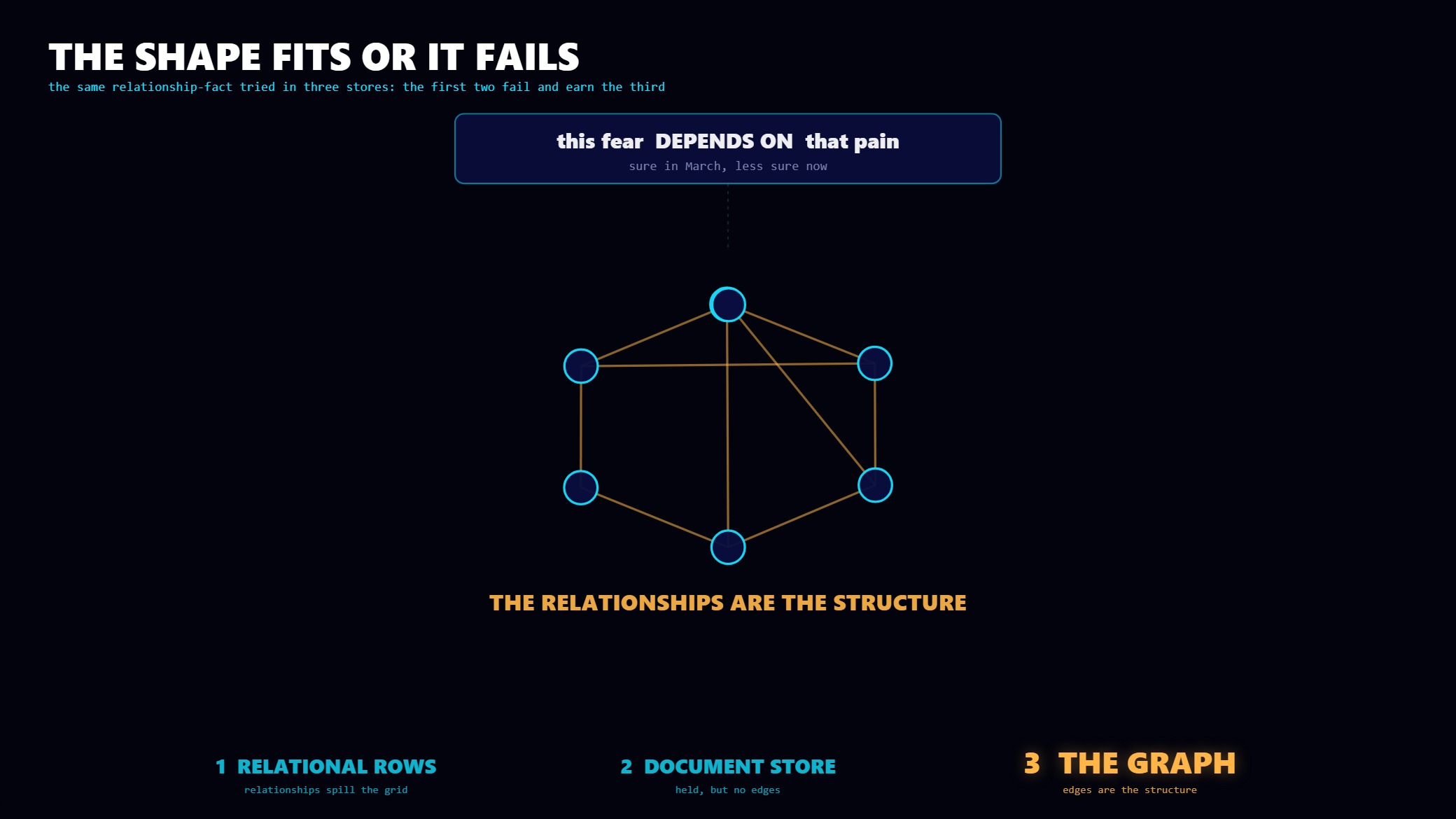
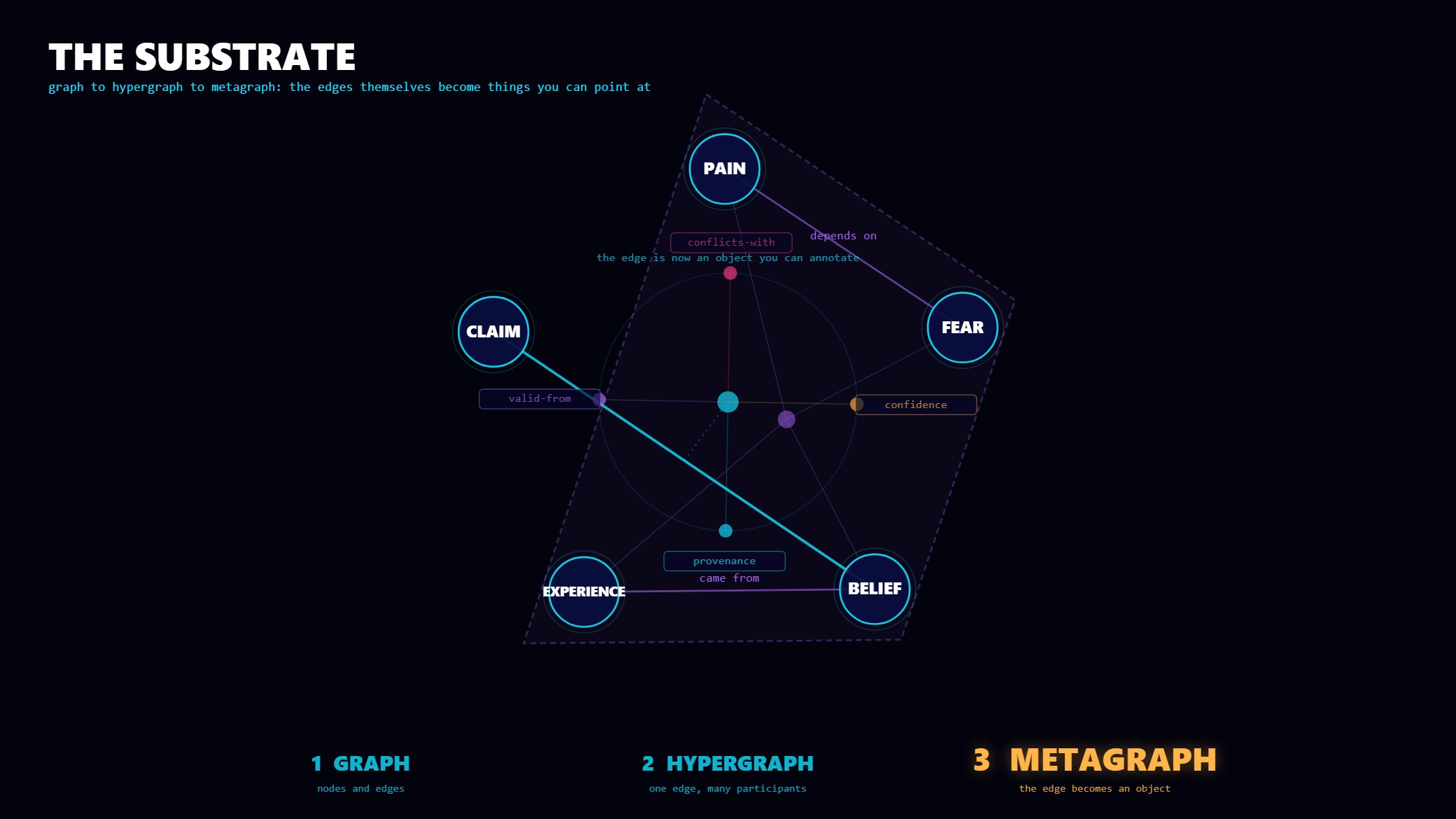
What the work wants is a graph, and then more than a graph. The escalation runs in three steps:
- A plain graph gives nodes and edges. This relates to that.
- A hypergraph lets a single edge bind many things at once, which a real fact requires, because a real fact has many participants bound into one event.
- A metagraph takes the last step: the edges themselves become things you can point at, annotate, connect, and reason about. That gives you rules about rules, confidence on the confidence, and a record of where a fact came from, what it depends on, when it was true and what it contradicts.
That's the structure expressive enough to hold a world model that knows what it knows.
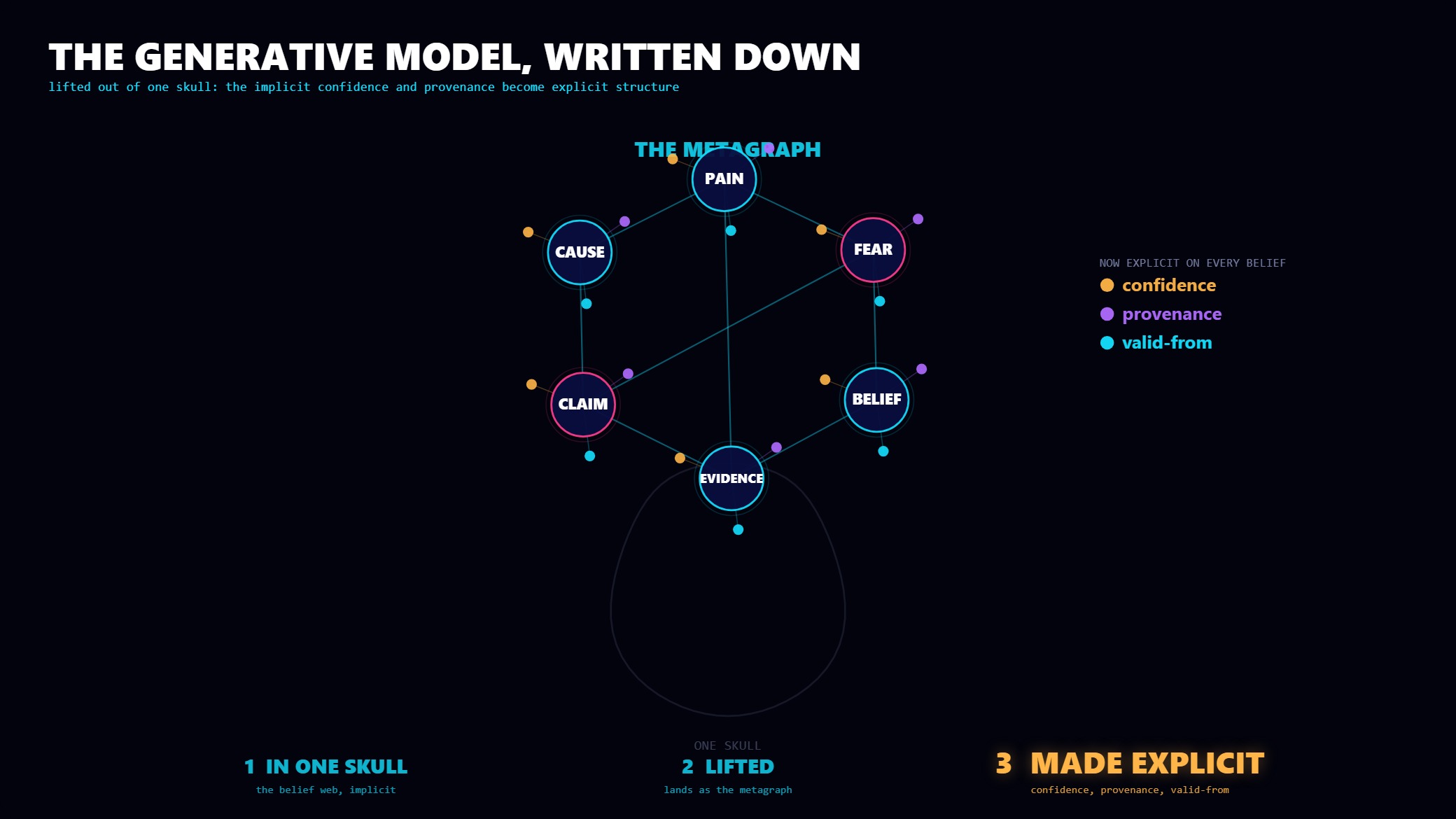
The choice is more than a database decision. The generative model active inference runs, the thing the brain pings the world to update, is this: a structured set of beliefs about hidden causes, weighted by confidence, revised by evidence. The metagraph is that generative model pulled out of one skull and written down, with the confidence-weighting and the provenance and the temporal validity made explicit instead of trapped inside one person's unreliable gut. When the firm calls the metagraph the heart of the system, that's what it means: the externalized version of the instrument the firm had to grow by hand.
What the Metagraph Actually Buys
A metagraph doesn't magically understand a market just because the data is shaped richly. Representational richness isn't understanding, and more expressive structure can buy you more noise and more brittleness if you're careless with it. What the metagraph gives you is a uniform place to hold heterogeneous knowledge, every fact carrying its provenance and its uncertainty and its timestamps, so the system can reason about the quality of its own knowledge and surface its own contradictions instead of quietly burying them. It self-improves only because you wrapped it in the loop that makes improvement possible: evaluation, confidence propagation, the maintenance agents that crawl it at night hunting for stale facts and unresolved conflicts.
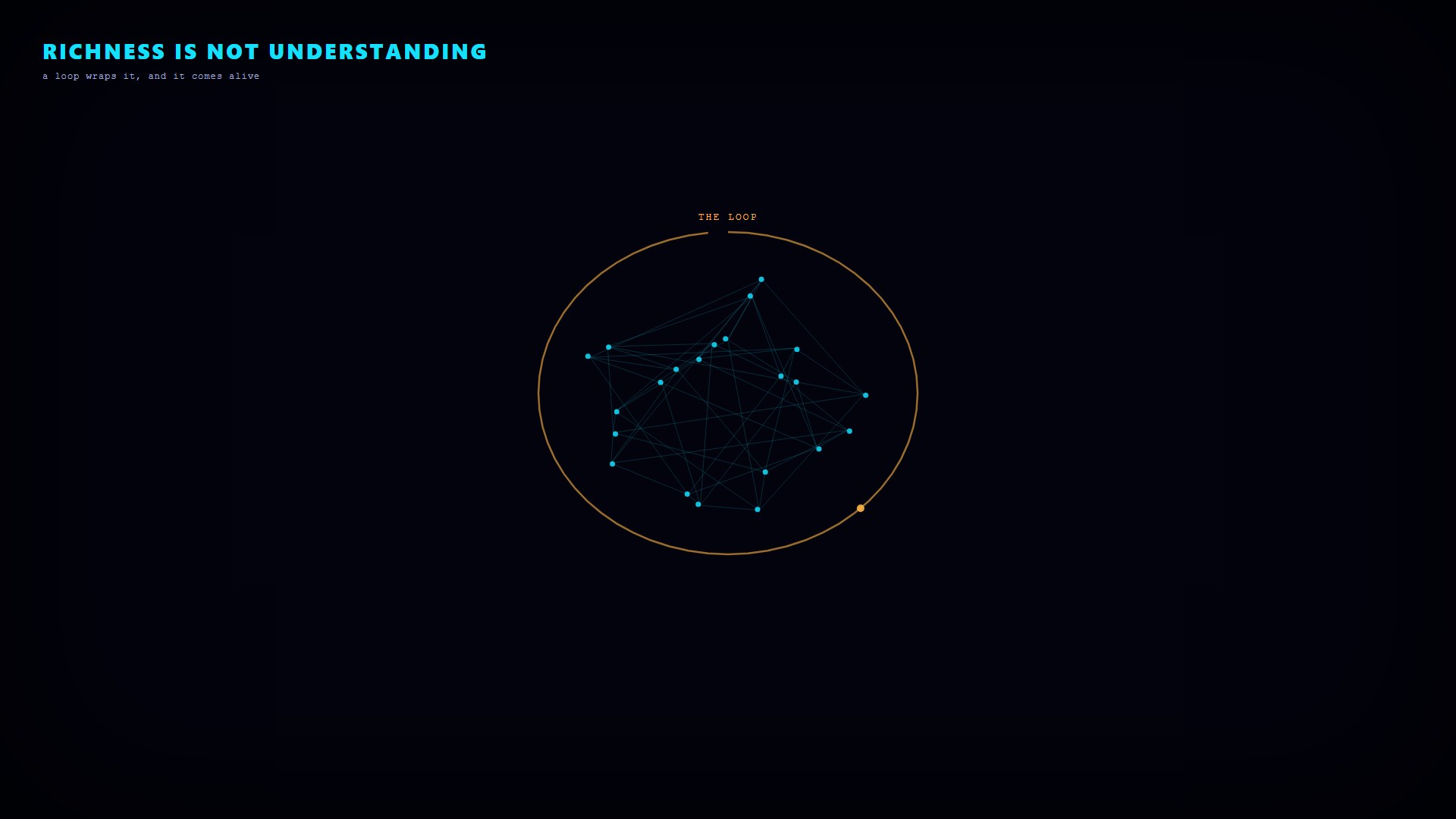
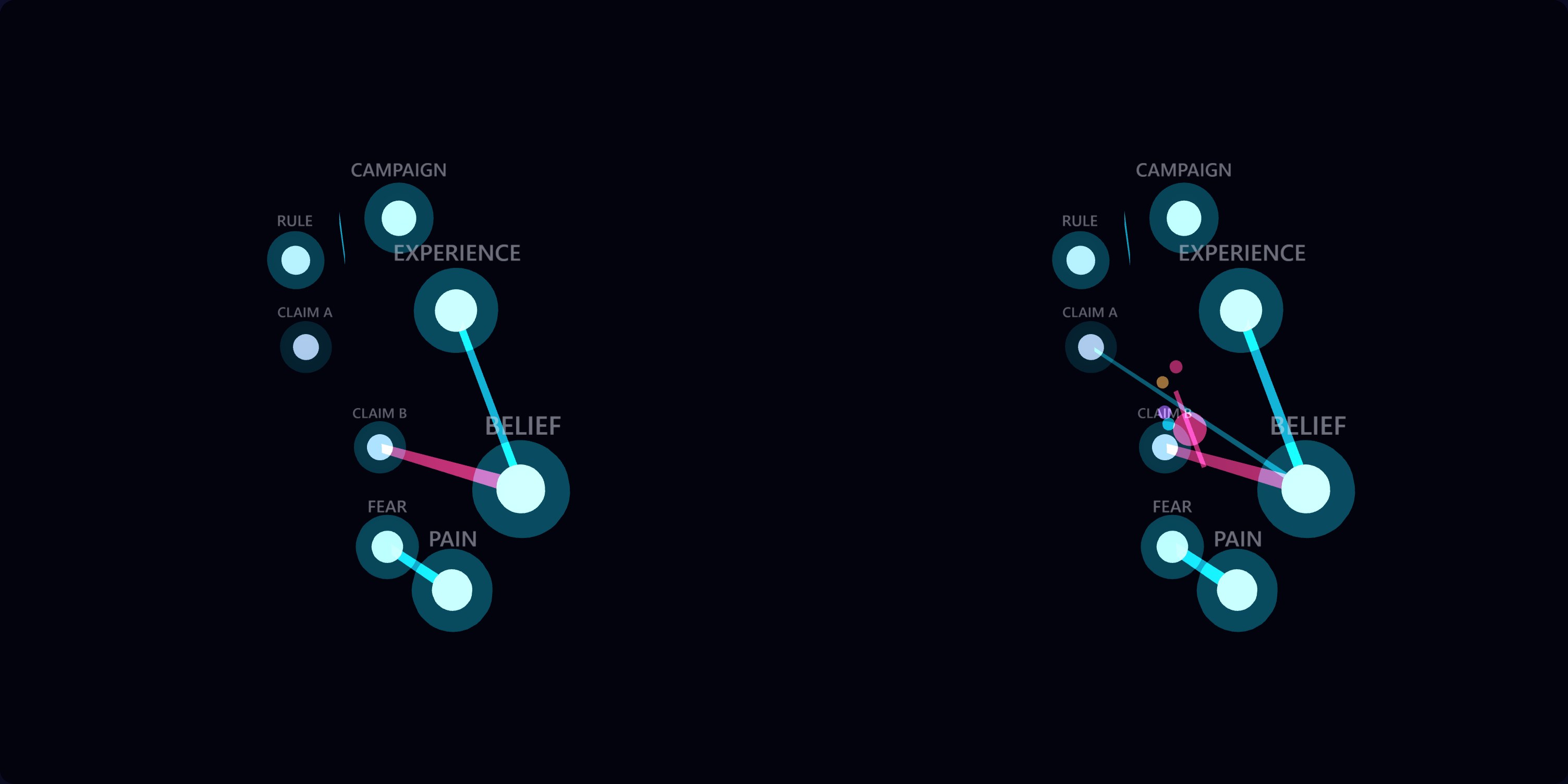
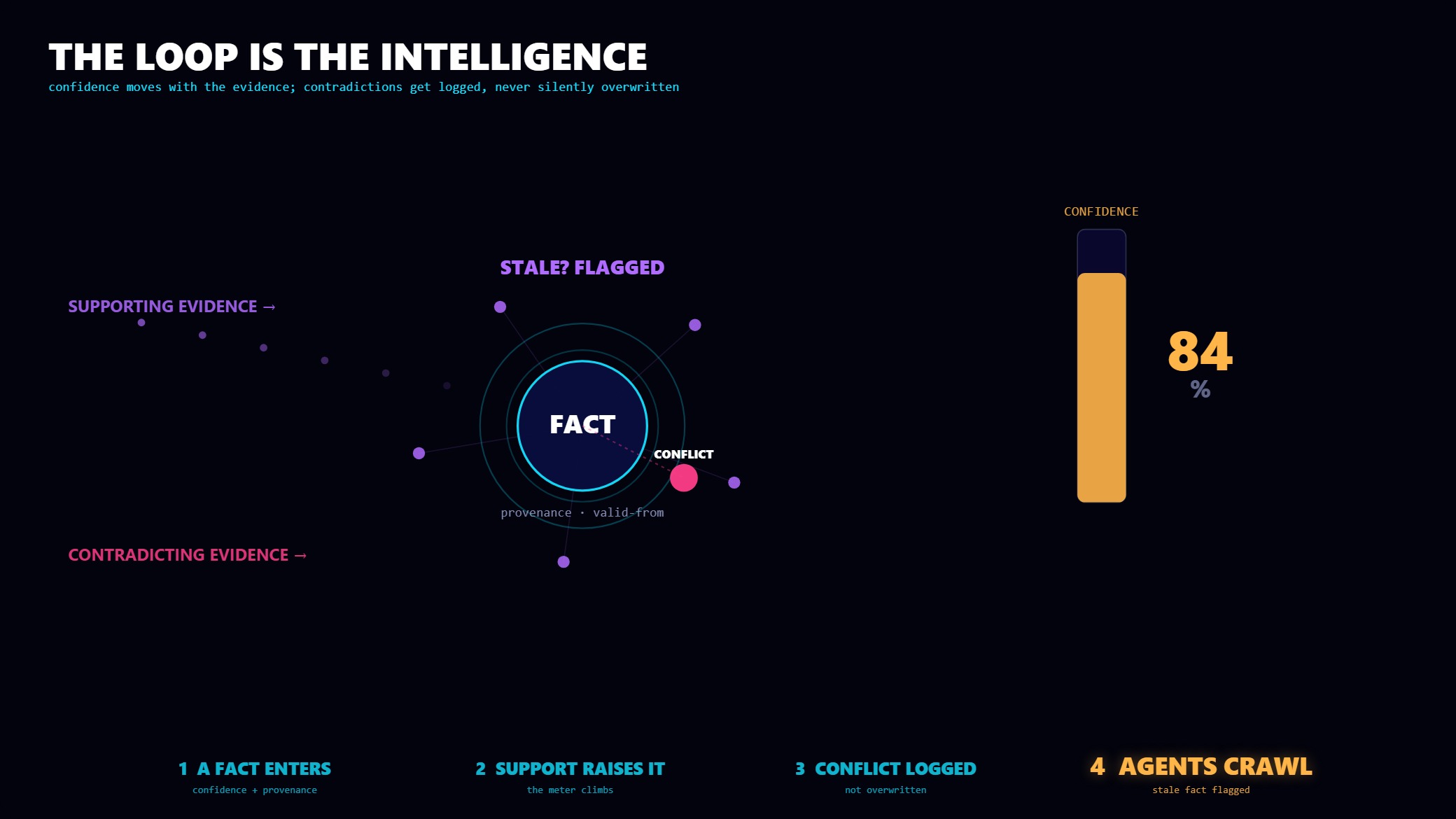
The loop around the graph is the part that compounds. A fact enters with a confidence score, a provenance, and a window of validity. New evidence shows up that supports it, and the confidence rises. New evidence shows up that contradicts it, and instead of the old fact getting silently overwritten, the contradiction gets logged as a conflict the system can see and reason about. Maintenance agents crawl the graph on their own schedule, surfacing facts that were true in March and went stale by November, flagging two reliable sources that disagree about something everyone had treated as settled, watching for the drift that means a playbook the firm has trusted for three quarters is now quietly wrong. The system has no ego to protect, so it just reports what it sees. That's the whole difference between a memory that gets more accurate as it piles up evidence and a knowledge base that only gets more confident as it piles up age. The same algorithm runs in a healthy nervous system. Prior commitments don't get defended at the cost of accuracy, the confidence on an old belief moves when the evidence moves, and the structure gets more valuable over time precisely because it can revise without losing face. A metagraph and a person running the growth cycle are executing the same loop. The firm staffs for people who can run that loop on themselves, because they're the only ones who can be trusted to run it on the system.
The Pragmatic Build
Knowing the structure you want and being able to ship it this quarter are two different problems. The earlier scrubber let you interrogate a finished metagraph through time. The question now is how that structure gets built in the first place. The escalation from graph to hypergraph to metagraph ends at the one structure the whole world model needs, and no off-the-shelf database hands it to you. The practical question is how much of that target structure you build now, and what you stand on while you build the rest.
The pragmatic build runs three tiers, named by what ships today versus where the thing is headed:
| Tier | What it is | Status |
|---|---|---|
| Graphiti on Neo4j | A temporal layer stamping every fact with when it became true and when it stopped, so you can ask what the system believed as of any date | The pseudo-metagraph, ships this quarter |
| Goertzel's Atomspace | The real metagraph, in which even the programs are subgraphs | The north star |
| Extended SurrealDB | The build-my-own substrate | The someday |
Do what you can with what you have. Build the shovel before you build the cathedral.
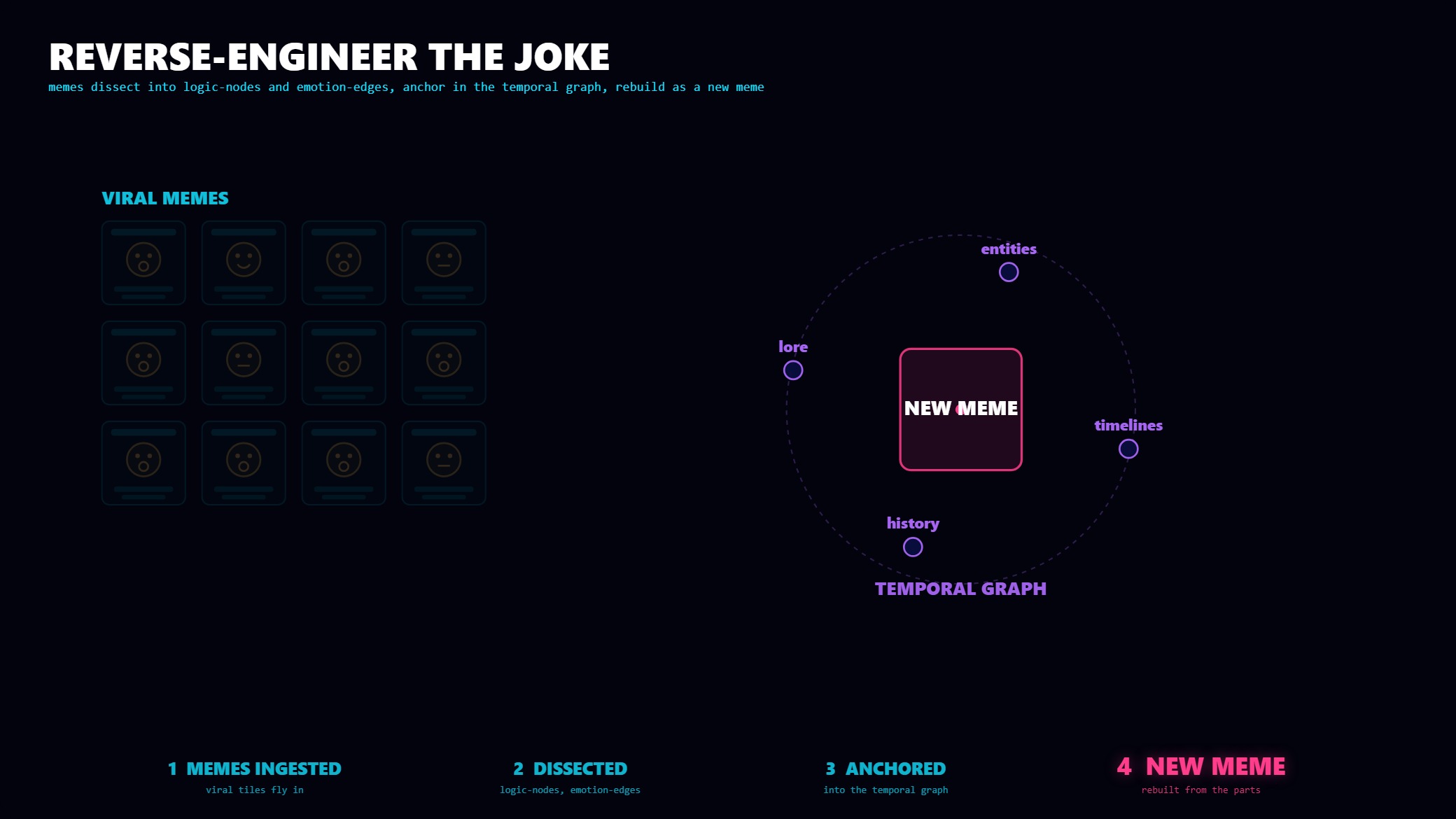
Whichever tier you stand on, the substrate holds one layer above the bare graph structure: the cultural priors a population already learned. That layer is where the firm keeps the nostalgia index of what an audience gets sentimental about, the catharsis map of what releases them, and the taxonomy of the jokes a subculture uses to process the wound it can't name out loud. Watch those priors settle as typed nodes over a single genome, a shared set of typed data models that can speak to any backend.
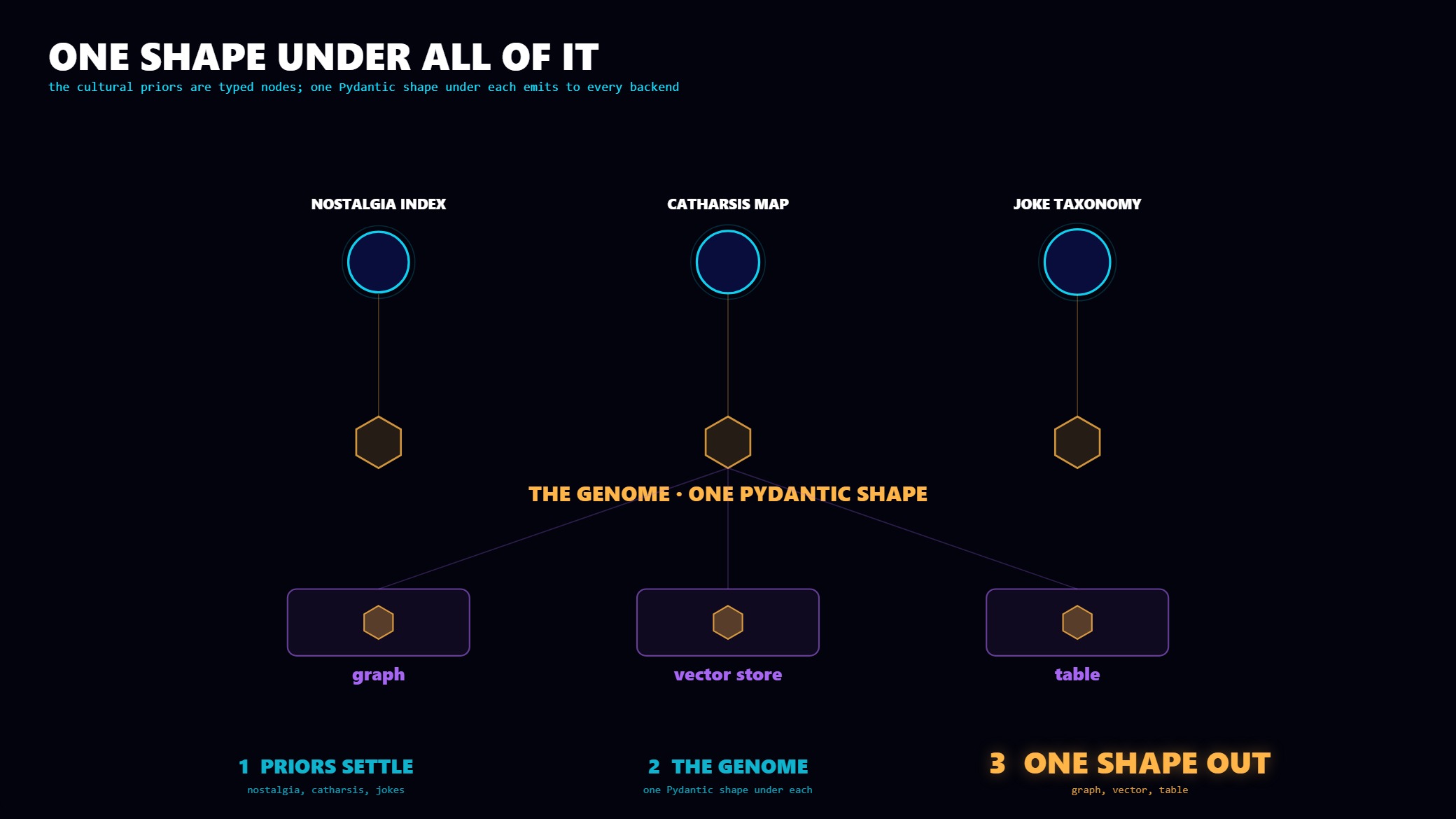
Under all of those priors sits the genome. Every entity is a typed model, every record carries its own shape, and the same representation holds whether it lands in a graph, a vector store, or a table. It frames culture as a stack of overlapping generative models, the shared priors a population learned, kept somewhere a machine can read them. Using Pydantic as that shared representation is the discipline that lets one model talk to every backend, and what that looks like in practice is a mad-scientist laboratory of weaponized autism pointed at Pydantic, holding the whole thing together.
Chapter Six: One Model, Every Medium
There's a piece of software almost nobody outside of compilers has ever heard of, and it quietly runs the modern world: the intermediate representation. When you write code in a dozen languages and run it on a dozen chips, the thing in the middle, the universal in-between form that every language compiles down into and every chip gets built up from, is the intermediate representation. LLVM is the famous one. The trick is brutal and simple. You don't build a path from every language straight to every chip, because that's a multiplying nightmare. You build every language down to one representation, and that one representation out to every chip. The middle is the pivot that makes the whole combinatorial mess tractable.
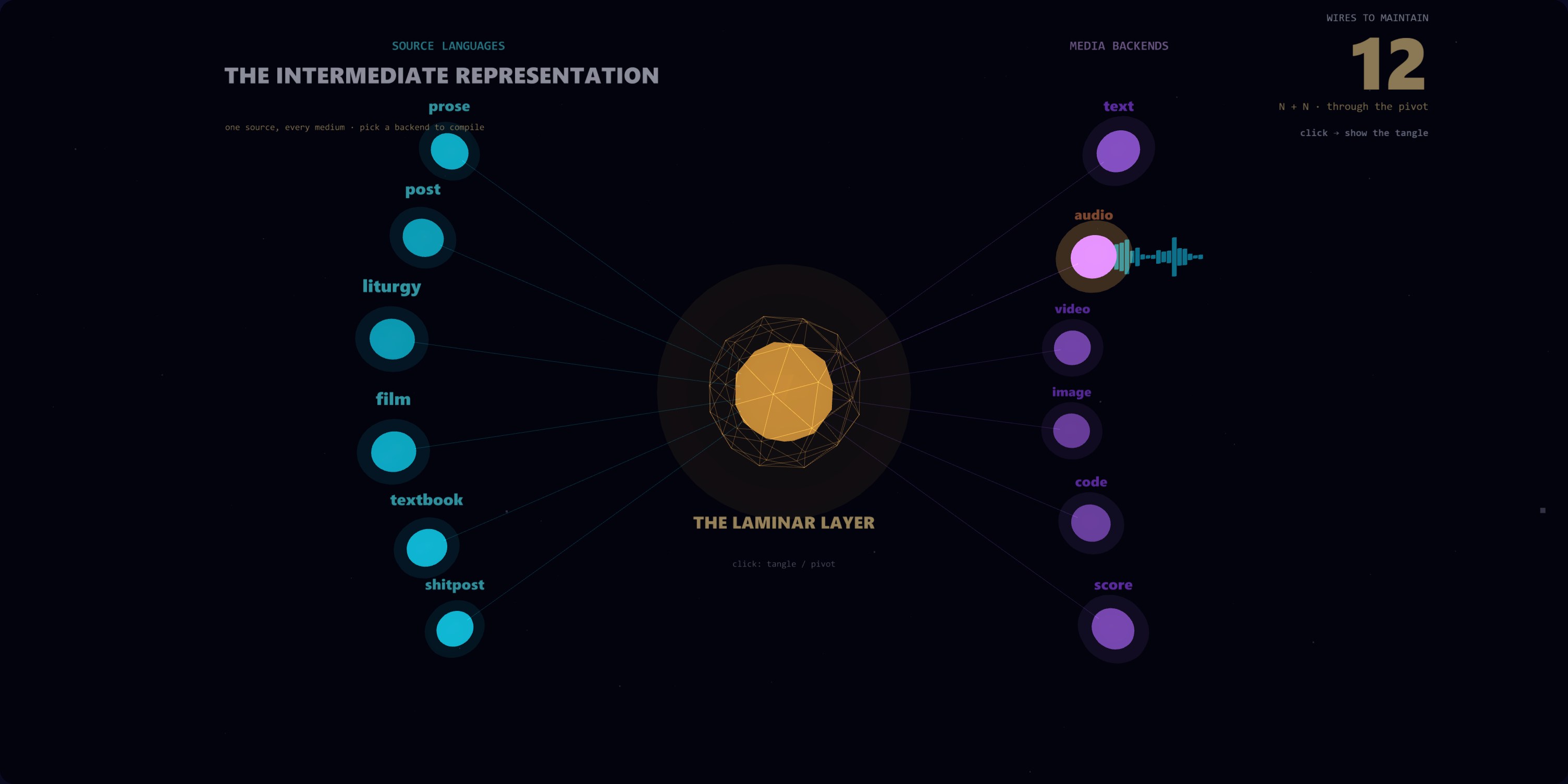
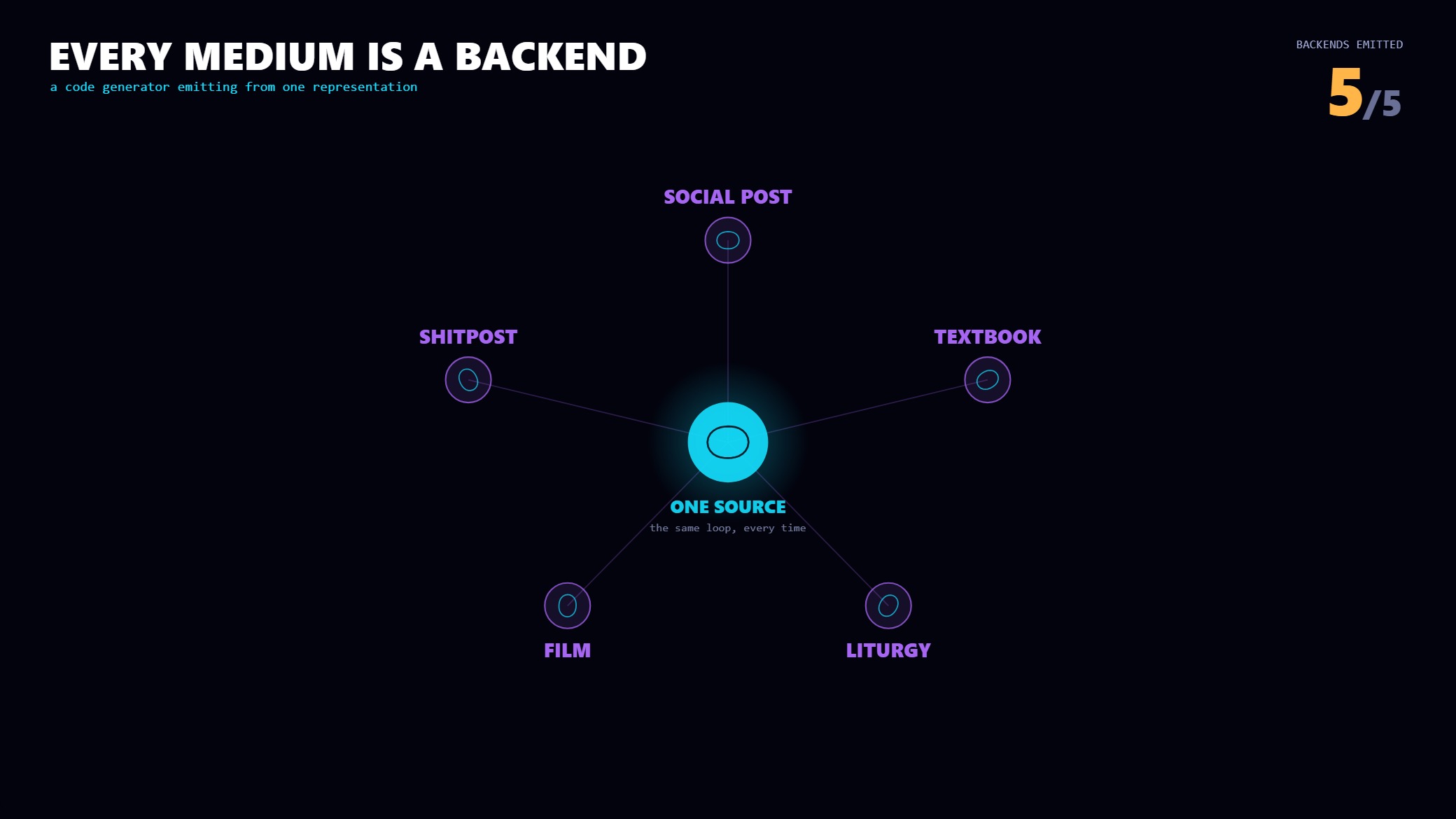
The human laminar layer, the part that barely changes, encoded in the metagraph, is the intermediate representation. Every medium humans make is a backend, a code generator emitting from that one representation. A social post and an academic textbook are two backends compiling off the same source. An internal training module and a religious text are the same fears and the same loop, rendered for different rooms. Medical documentation, a sci-fi series, a film, a poem, a landing page, a shitpost: every single one of them has a human being standing somewhere in the loop, which makes every single one of them a code generator running off the same representation of what humans are.
The Thin Layer Is Real, the Thick Version Is Overreach
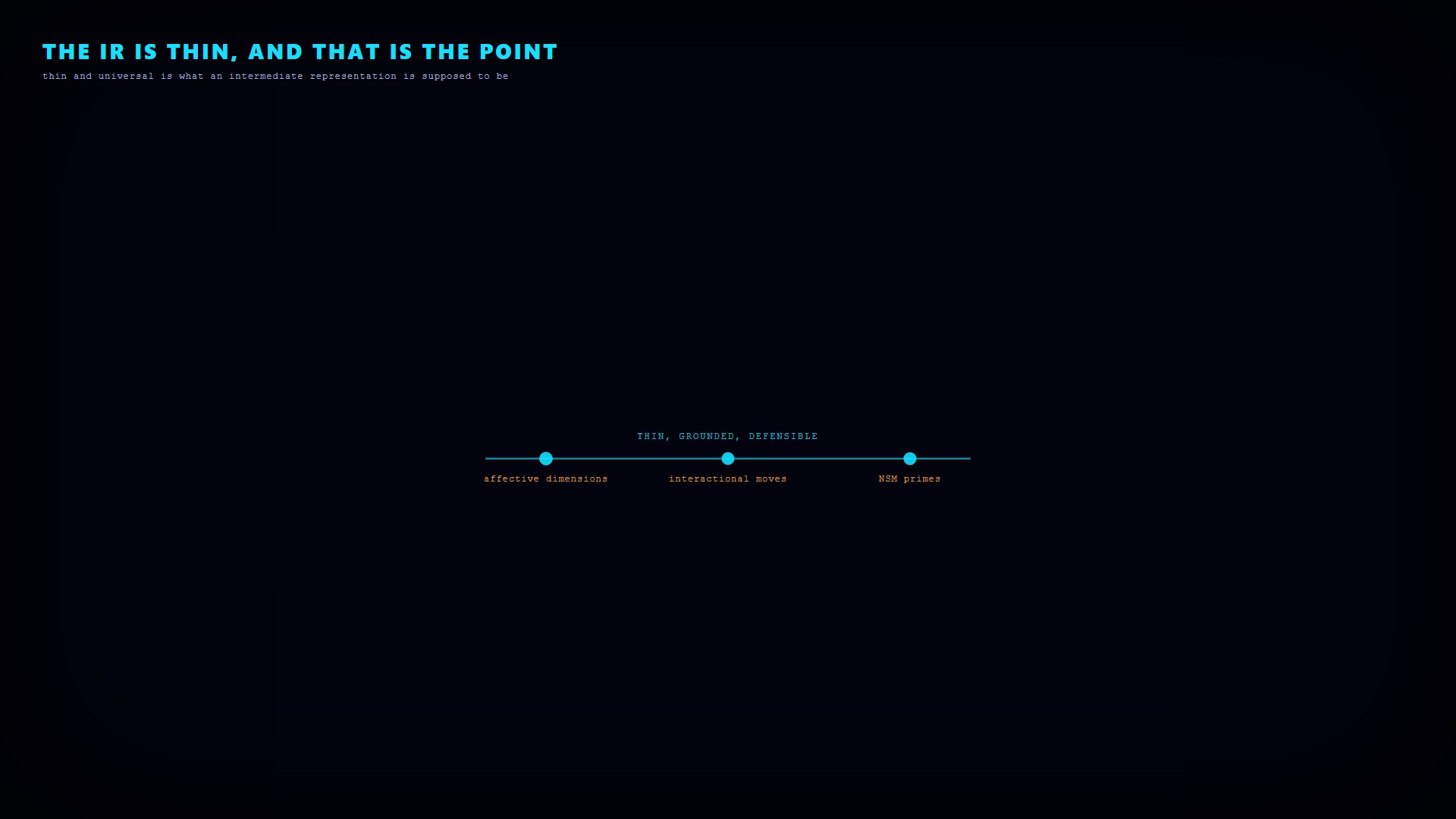
That's why one infrastructure can serve all of them, and it's less of an overreach than it sounds. The laminar layer the firm stands behind is thin and real. It comes down to three grounded components:
- Affective dimensions that travel across cultures: good and bad, calm and activated, toward and away, that a human body does roughly the same everywhere.
- Interactional moves present in every human group: taking turns, repairing a misunderstanding, falling into rhythm with another person.
- The Natural Semantic Metalanguage, around sixty-five concepts every known language has a word for: I, you, someone, something, do, happen, good, bad, want, know, think, because, before, after. It rests on decades of careful cross-linguistic work and is the closest thing there is to a source language of the species.
The firm marks the overreach just as plainly. There's no single universal story, and the rich named emotions get built differently in different cultures. A fixed set of universal discrete emotions experienced identically everywhere is overreach. The intermediate representation is thin, and thin and universal is exactly what an intermediate representation is supposed to be. Everything thick gets built on top of it, per backend. Culture is modeled as overlapping generative models and external priors, framed as an as-if model, never as a literal single mind.
The Compiler and the Refinery
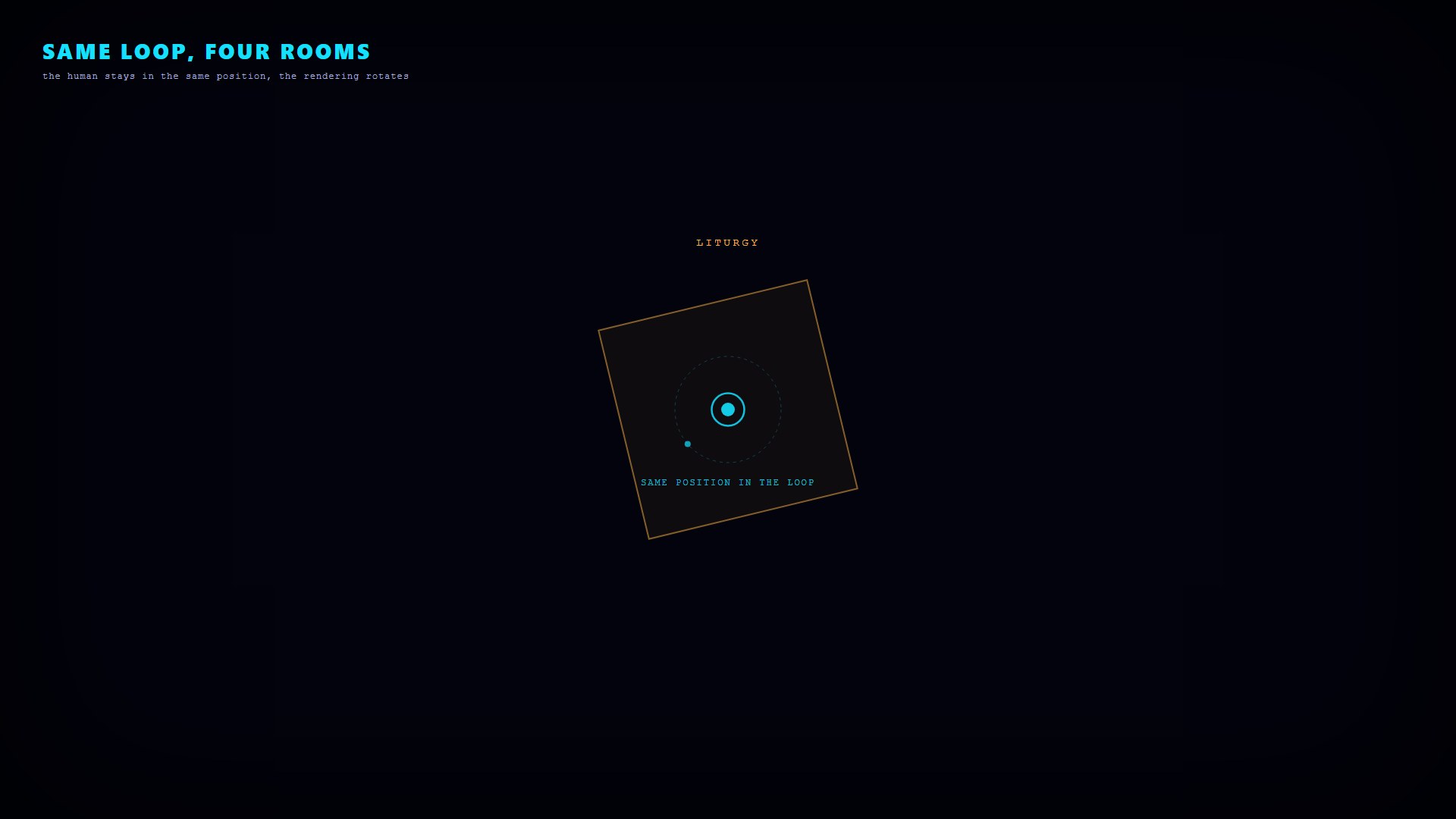
The compiler that sits over the representation drives the rest of the system. Source text comes in, gets broken into meaningful pieces, parsed into structure, checked for meaning, lifted into the metagraph, optimized, and generated out to whatever backend the job calls for, with the creatives generated alongside the prose rather than bolted on afterward. It works as a knowledge refinery, with crude data in one end and precision intelligence out the other. The same sequence of passes runs whether the output is a thousand-word ad or a ten-thousand-word essay, because the refinery doesn't care what the barrel of crude becomes downstream. The backend is a choice made at the last pass, and the same machine makes every one of them. The ad and the essay and the film treatment all draw from the same lifted representation of what the audience fears and wants and can't say, and they diverge only when the generator picks a format and a length and a register for the room the work is walking into. That's why the firm can point one instrument at performance content this quarter and a long-form essay the next without rebuilding anything underneath. The representation stays constant while the backend rotates. The cost of adding a new medium is the cost of writing one more code generator, not the cost of learning the audience again from scratch.
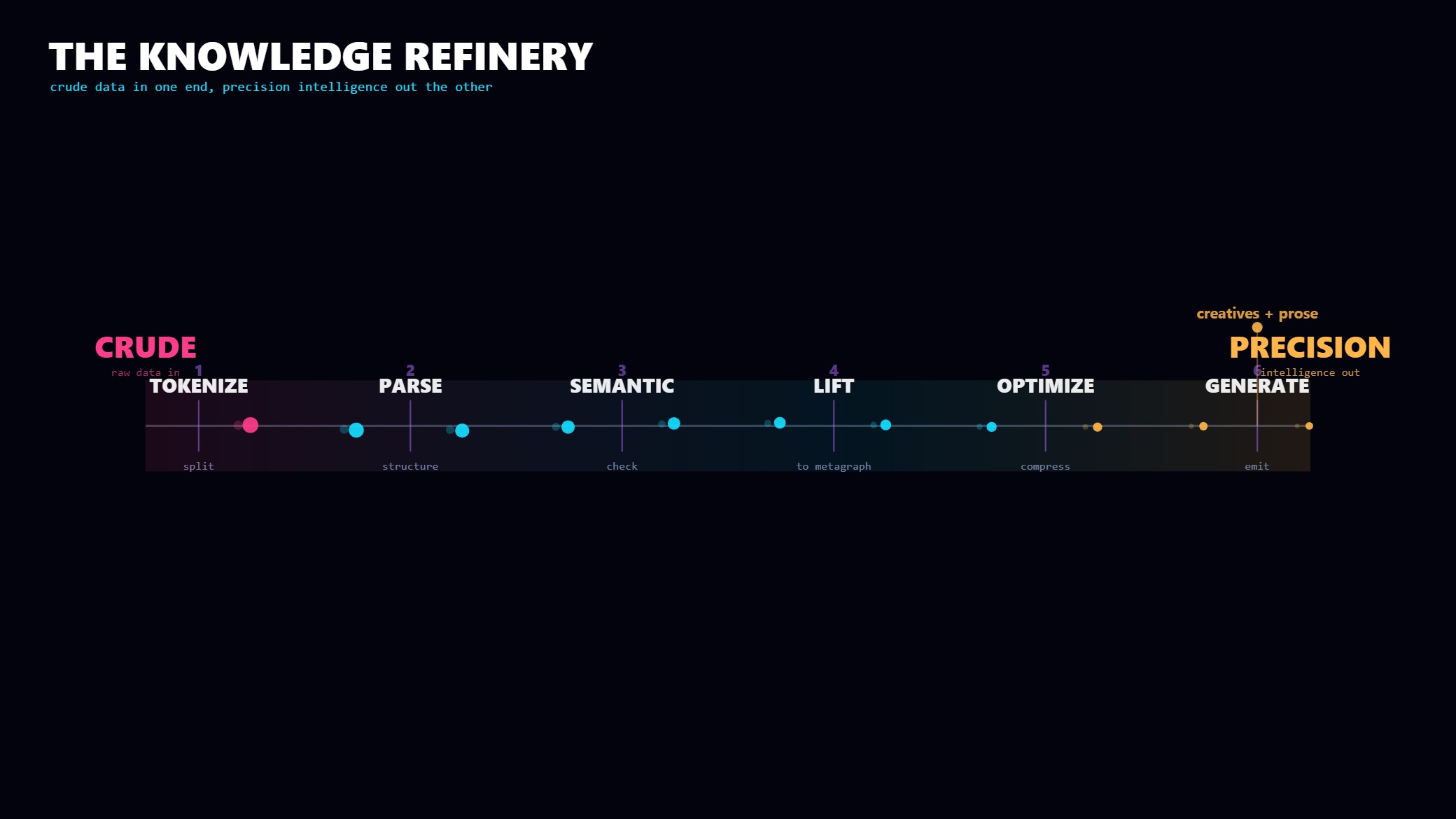
Creatives are first-class in this refinery, and that's the line between it and a content mill. Every hundred to two hundred words, something gets rendered, because a picture is worth a thousand words and an animation is worth ten thousand, and because the field you're pinging is multimodal and the reconstruction should be too. That can be a Remotion sequence (video rendered from code) that animates a claim coming together instead of decorating a static scene, an interactive three-dimensional view of the metagraph itself, a still that carries the exact emotional register the prose is reaching for, or structure where structure earns its keep. The creative is one more emission off the same source, equal in rank to the sentence sitting next to it.
The Scope, Stated as Architecture
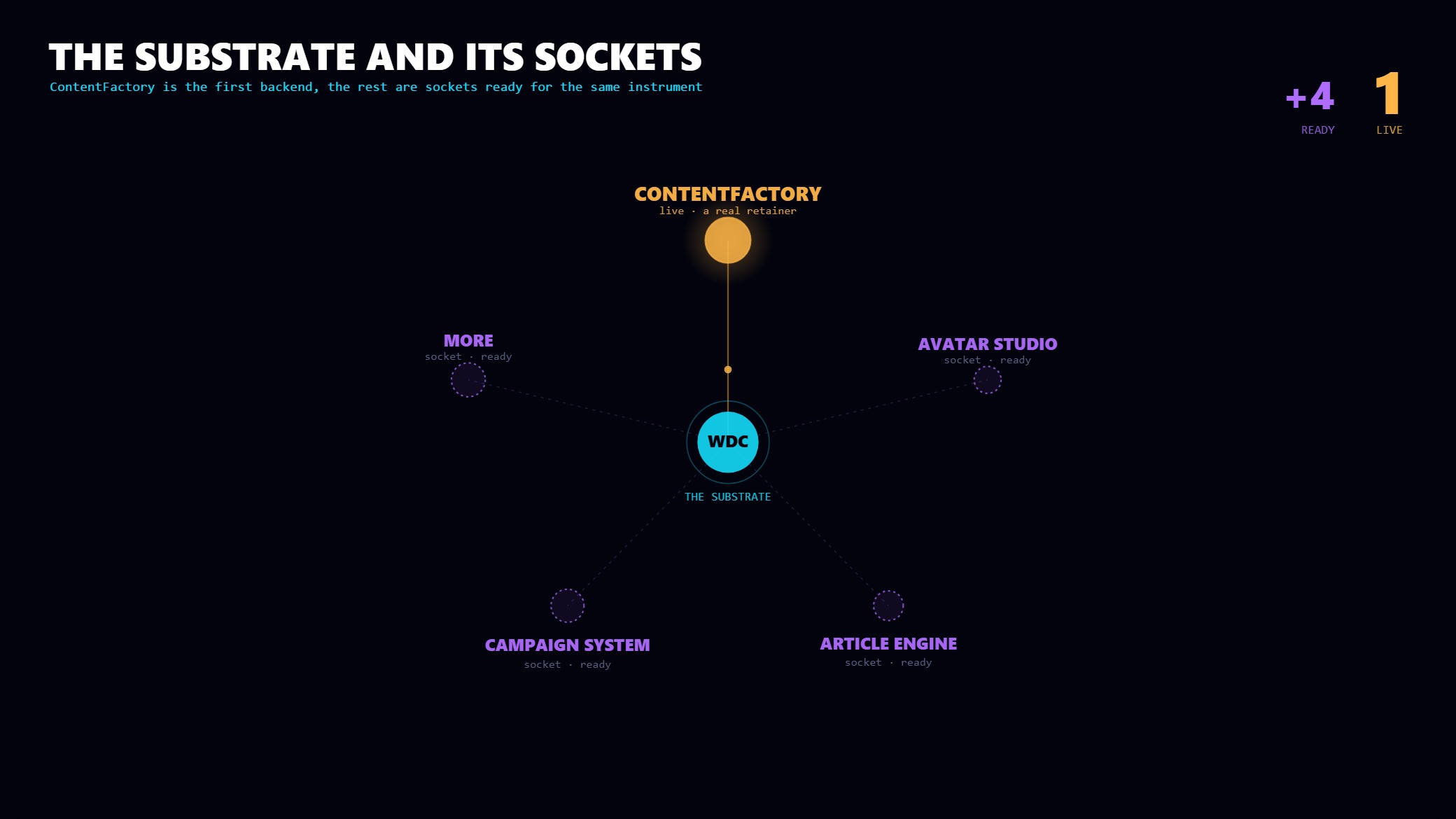
WikiDesignCo is the substrate, the intermediate representation and the compiler wrapped around it. ContentFactory, the firm's content production system, is the first backend, pointed at performance content for a real client paying a real retainer right now. The dozens of other things on the list, the avatar studio, the article engine, the campaign system, are more backends, each one the same instrument pointed at a different medium. It all comes back to the metagraph, because the metagraph is the intermediate representation. That's the architecture, and what keeps it from being a beautiful lie is the discipline of the desk.
Chapter Seven: The Institutional Desk
The phrase institutional quant fund carries a precise meaning, and that meaning is the whole difference between this being a discipline and this being a vibe with good production values. The firm is on the engineering side of that line. There are no visionary fuck-offs here selling empty ideas and taking real money for them, and no money taken for vibes. The firm designs the schematics and builds the thing.
A quant fund beat the market on infrastructure, not on smarter opinions than everyone else in the room: better data, a rigorous and clear-eyed accounting of uncertainty, calibration, and a brutal set of internal checks against all the ways a researcher fools himself. The edge was being more rigorous about what you don't know, more disciplined about your evidence, more systematic about catching your own mistakes, and then compounding that small edge through a machine that gets a little better every cycle. Content and culture are the last big, rich domain still run almost entirely on taste. That gap is the arbitrage, and the firm brings the discipline of the desk to the production of meaning.
The Seven Ways a Backtest Lies
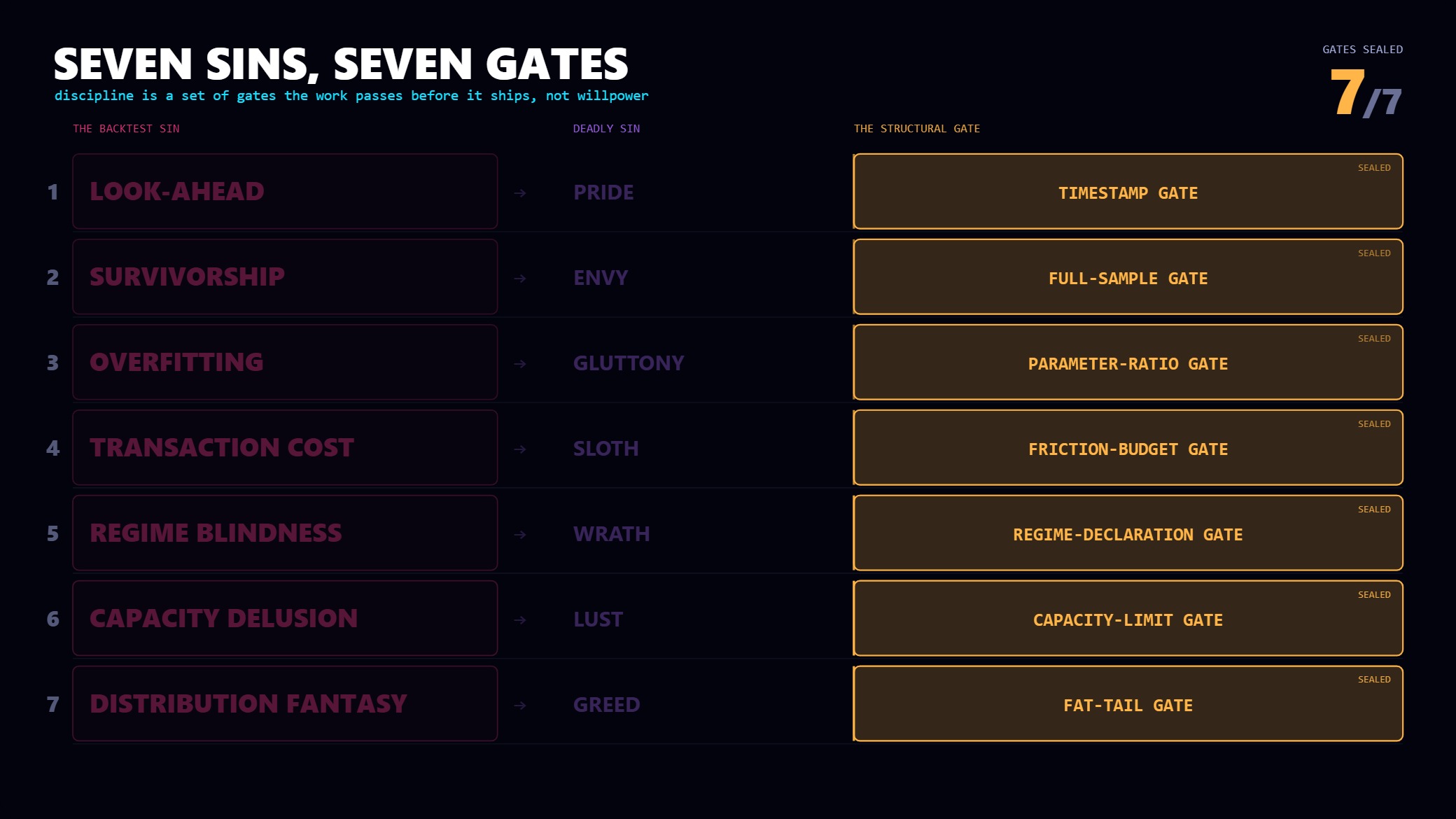
Start with self-deception, because that's where the funds put their attention and the amateurs don't. There's a catalog of the standard ways a backtest lies to you, and it maps clean onto the oldest list of human failures we have.
| Backtesting sin | Deadly sin | The gate that neutralizes it |
|---|---|---|
| Look-ahead bias, using information you could not have had at the time | Pride | Timestamp gate: no decision uses information from after the decision |
| Survivorship bias, studying only the winners | Envy | Full-sample gate: study the failures, not just the survivors |
| Overfitting, drowning the signal in noise | Gluttony | Parameter-ratio gate: cap the knobs against the evidence |
| Transaction-cost fantasy, ignoring friction | Sloth | Friction-budget gate: price every action before it ships |
| Regime blindness, refusing to see the rules changed | Wrath | Regime-declaration gate: name the regime the strategy assumes |
| Capacity delusion, wanting more than the system holds | Lust | Capacity-limit gate: cap the projection at sustainable size |
| Distribution fantasy, assuming thin tails and a gentle world | Greed | Fat-tail gate: stress the assumption against the tail |
The firm reads the two catalogs as structurally analogous, with several pairs running at full isomorphism and the rest as productive working pairings, used with the caveat that the mapping is heuristic and not proven. One point holds across all seven. These are properties of the observation apparatus, baked into how cognition works, so the fix has to be structural. You build gates that sit outside the observer. A timestamp gate, so no decision uses information it couldn't have had. A full-sample gate, so you study the failures and not just the survivors. Discipline is a set of gates the work passes before it ships.
Each Sin Corrupts One Component
There's a precise version of why the sins matter, and it runs through the Bellman equation. Every sequential decision the firm makes has four components: the current state estimate, the discount factor weighting future against present, the reward function scoring outcomes, and the transition model predicting how the world responds. Each sin corrupts one component. Pride inflates the state estimate, the proud read of the world the firm is operating inside. Greed corrupts the discount factor, overweighting the immediate return against the compounding value the institutional capital was built to produce. Envy corrupts the reward function, importing a survivorship-biased comparison that scores against a competitor's visible wins and excludes their failures. Wrath corrupts the transition model, reframing the world as a system to punish rather than an environment to optimize inside. Gluttony drowns signal in volume. Sloth maintains a process long after the data moved, because the cost of inaction stays invisible until the decay curve arrives. Lust pursues the exciting opportunity past the point where excitement is uncorrelated with expected value. The optimal solution to a corrupted world model is suboptimal for the world that actually exists, which is why the gates carry the whole weight. They are the difference between a machine that compounds and a machine that quietly optimizes against a fiction.
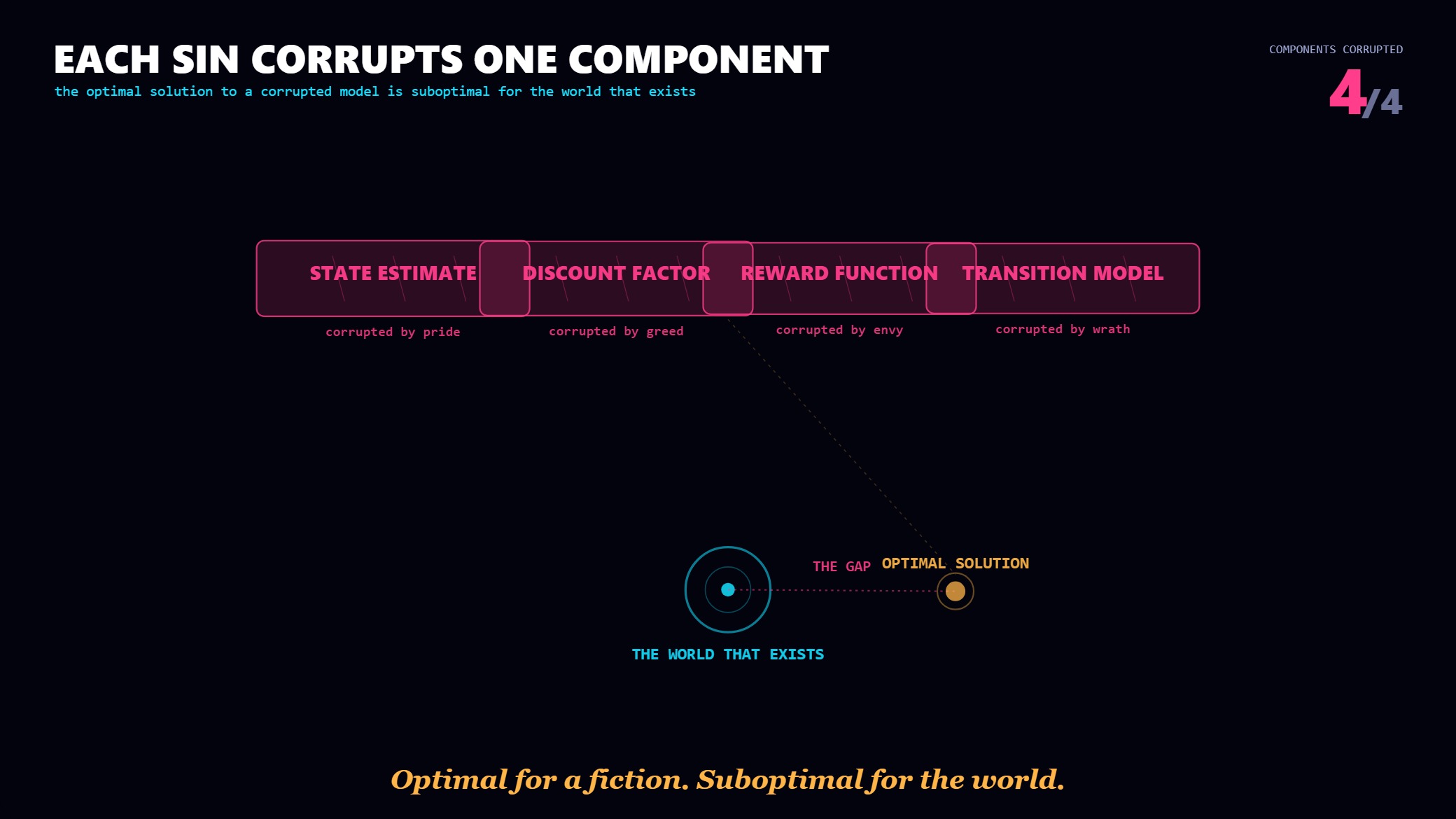
So the firm builds the institution to run at the structural register and skip the moral one, the same posture it takes toward the suffering loop. The failure modes are properties of the apparatus, and the fix is structural every single time.
Four Classes of Decision
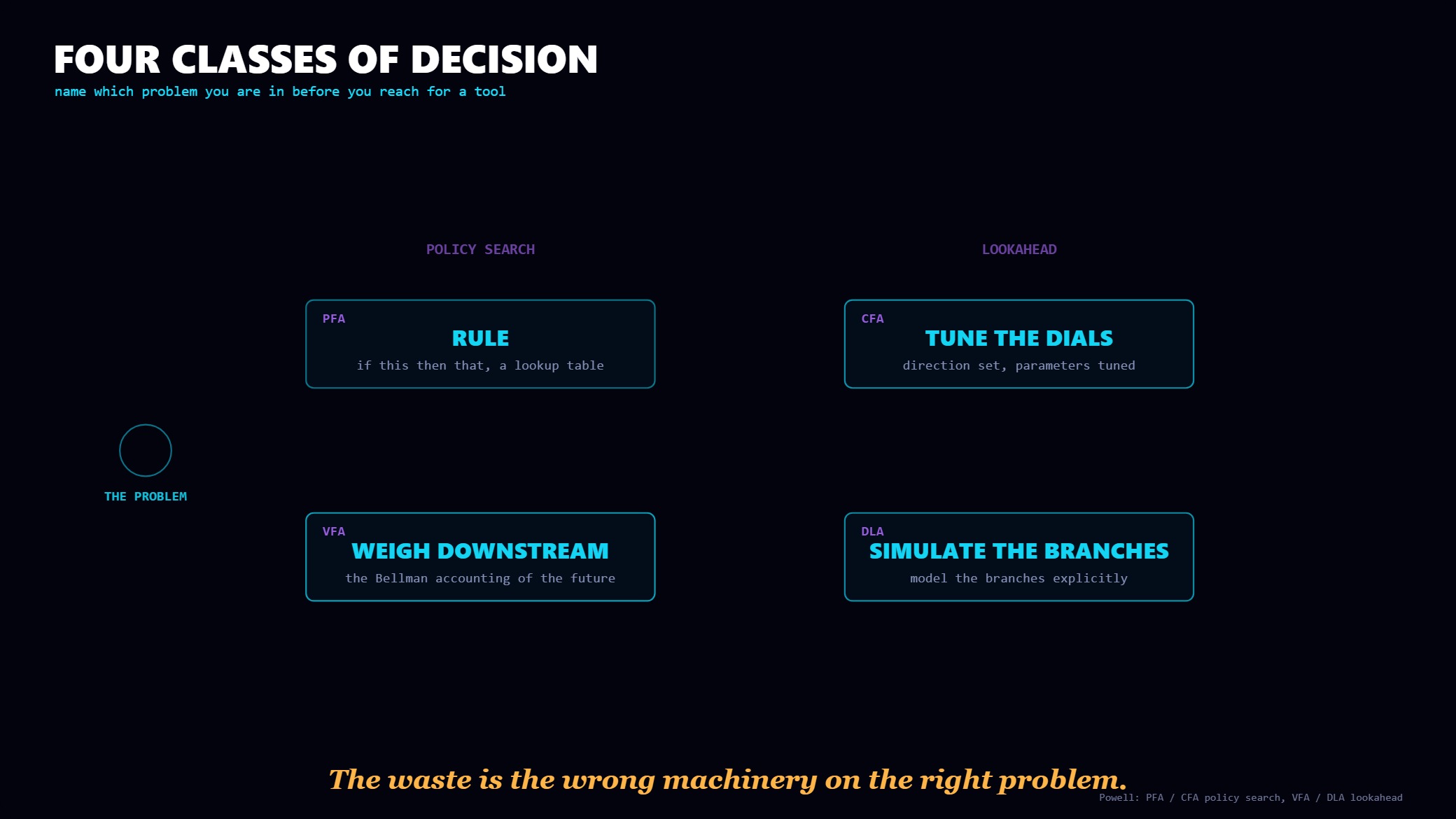
Then comes routing, because not every decision deserves the same machinery. Warren Powell partitions every possible decision policy into four classes, and the firm uses them as its decision discipline:
| Class | When to use it | The waste |
|---|---|---|
| Rule (PFA) | If this then that, a lookup table | Reaching for anything heavier |
| Tune the dials (CFA) | The direction is set, only the parameters need tuning | Re-deriving a direction you already have |
| Weigh downstream (VFA) | The immediate move trades against future consequences, the Bellman accounting | Ignoring the discounted future |
| Simulate the branches (DLA) | Stakes high and irreversible enough to model explicitly | Spending simulation on a lookup-table problem |
The discipline is naming which kind of problem you're in before reaching for a tool, because the most common waste in the building is bringing a full simulation to a problem that needed a lookup table, or a lookup table to a problem that needed the simulation.
Creative Upstream, Enforcement Downstream
The agents write freely, explore, overproduce, take the big swing. The gates decide what ships, and the gates are deterministic and binary, with no human mood in the room at the moment of judgment. Lint, voice, structure, evidence, each one a pass-or-fail check that doesn't care how good the prose felt to write.
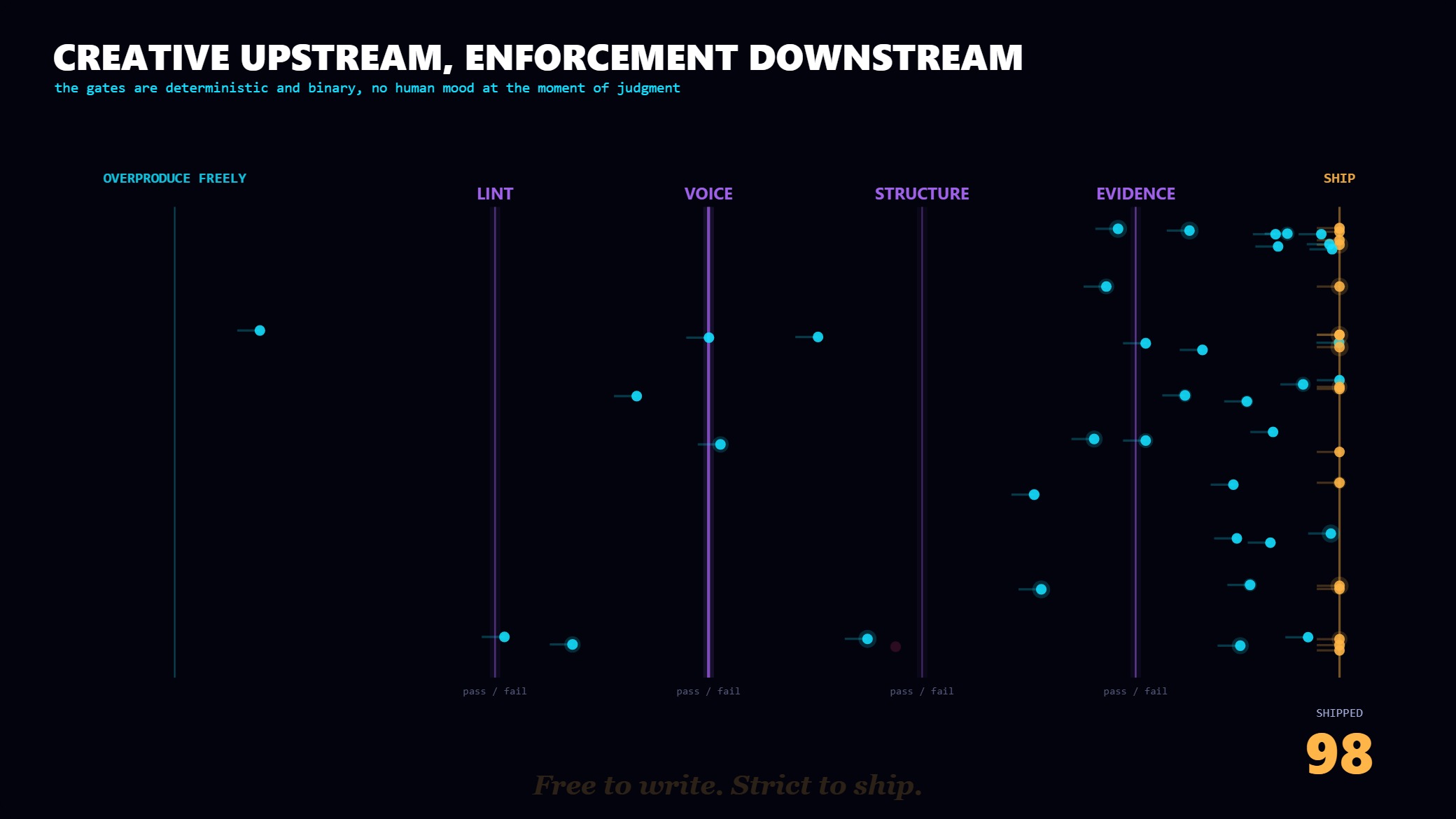
That split between free drafting and hard gates separates a system that knows what it knows from a content mill cranking out confident sludge at scale. The fund that survives the decade is the one whose machine compounds a real edge while the gates keep it from blowing up. The same thing holds here. A system that knows what it doesn't know, and builds the loop to keep getting better at knowing it, compounds in a direction confident ignorance can never follow. That's the whole bet, and it's the only bet on the table worth making.
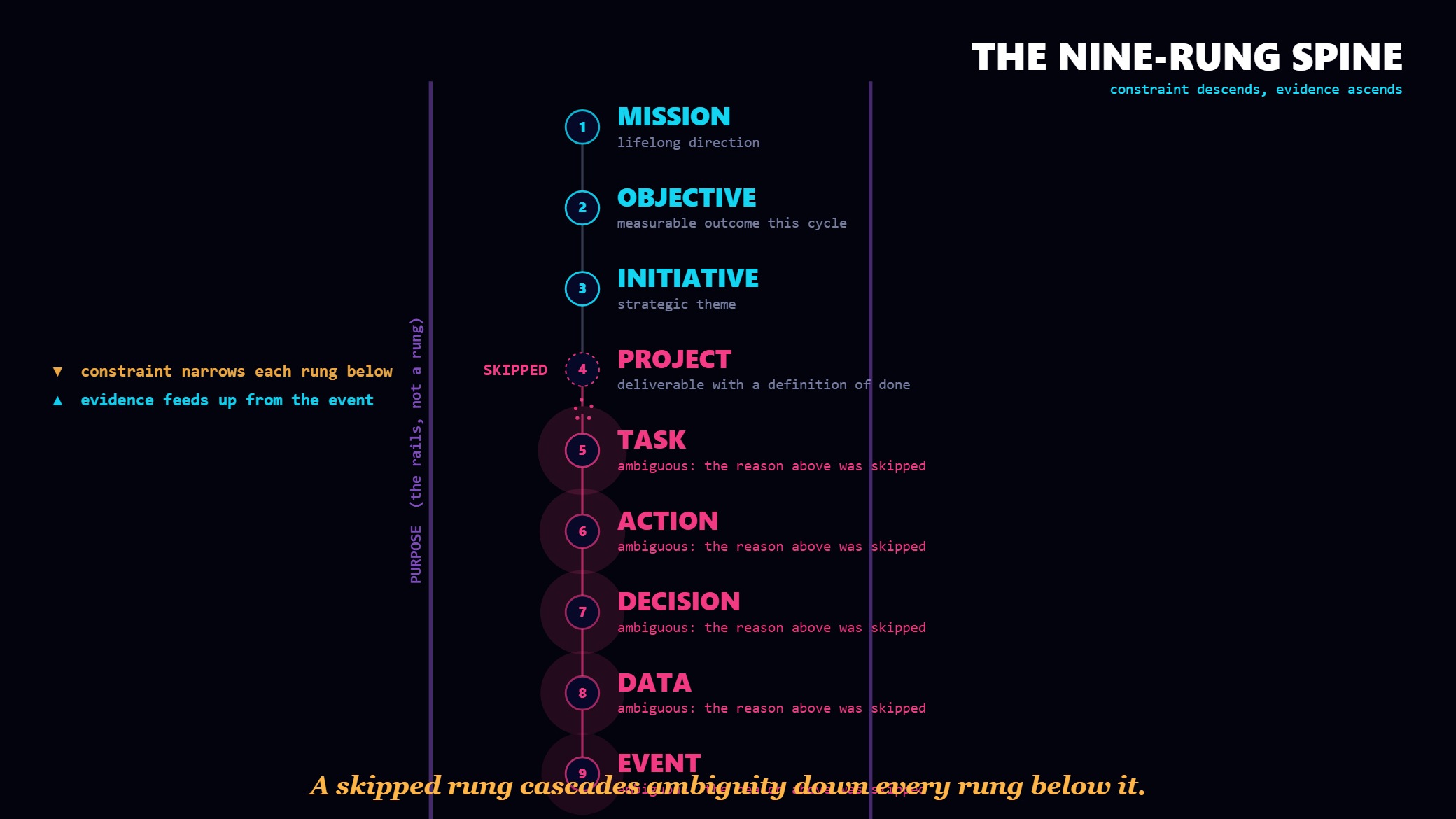
What keeps the bet disciplined is the spine the gates hang from. The firm's operational hierarchy is a ladder of nine rungs that runs from Mission at the top down to the single Event the system observes at the bottom, and every piece of work has to trace up to a reason it exists and down to the real-world occurrence it captures. Purpose is the two rails the ladder is fixed to, the connective alignment present at every level, the thing you hold onto at every rung. No step completes it. Drop a rung in the middle and the ambiguity introduced at the broken rung cascades into every rung beneath it, so a vague Objective produces a vague Initiative produces a vague Task, and by the time the failure reaches the Event it's unrecoverable. The discipline is to fill every rung, every time, and to watch what happens to the ones below when you don't.
Chapter Eight: Rigor and Reach
Several large claims are on the table, and the framework underneath this whole piece, the firm's Standard Model of Effective Media, says the disclosure that costs the writer something is what earns a reader's trust.
Run the four domains the article leans on, math, cognition, persuasion, and universals, through three columns each: the theorem that genuinely holds, the shared formal language one rung softer than a theorem, and the reach where a careless version would overclaim. The seam sits between the middle column and the last one.
| Domain | Theorem | Shared formal language | Reach |
|---|---|---|---|
| Math | Arnold 1966, made rigorous by Ebin and Marsden | The shared skeleton: generators, least-action, log-transforms | The three equations welded into one |
| Cognition | Control-as-inference, rigorous for certain classes | Free energy principle as best available frame | Active inference as a finished theory of all cognition |
| Persuasion | Transportation, nostalgia, and safety effects | Precision-lowering as a coherent interpretation | Defenses lowered increase accuracy (they increase plasticity) |
| Universals | The affective dimensions and the NSM primes | The thin laminar layer as an intermediate representation | A single universal story, emotions fixed across all cultures |
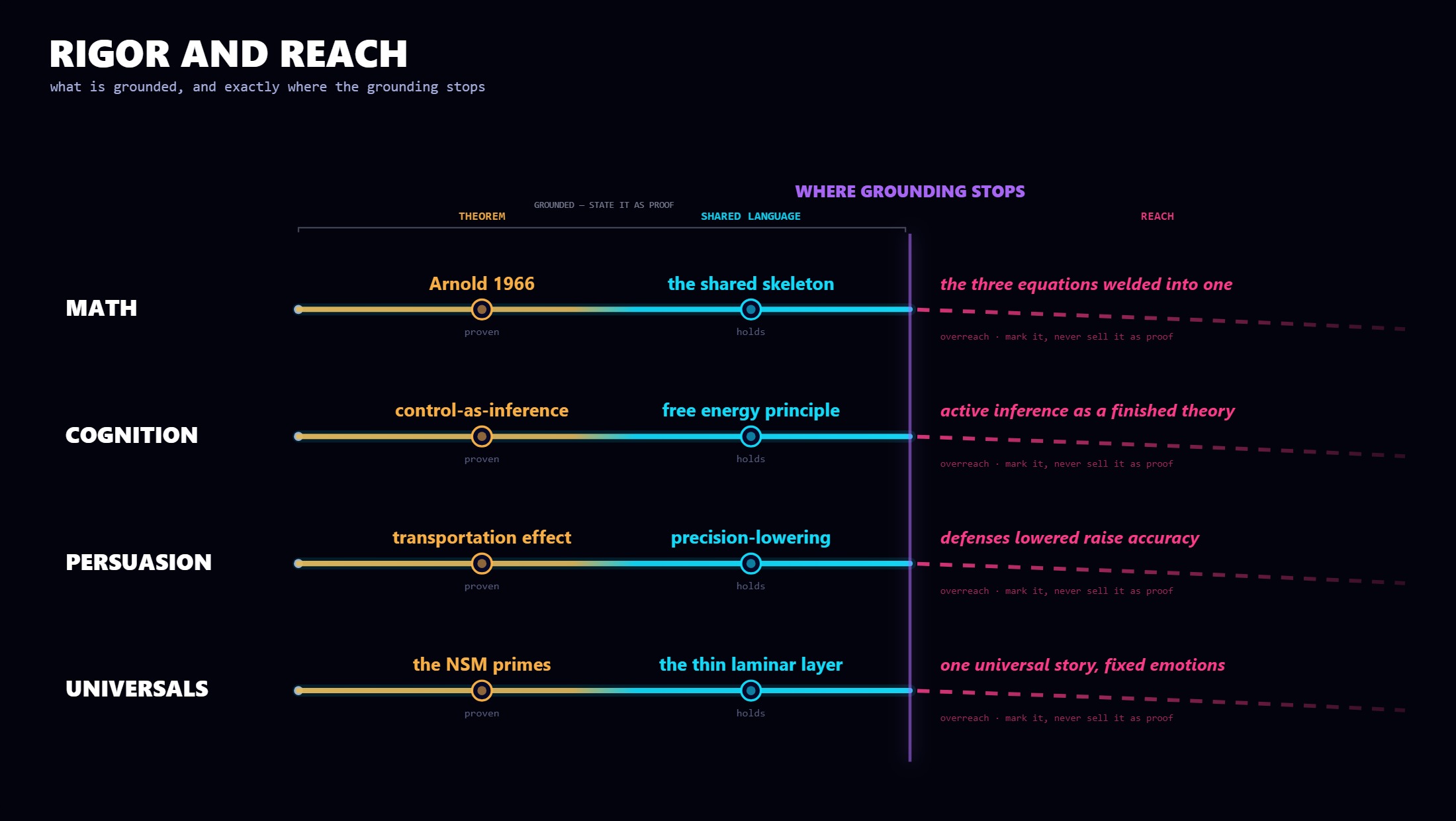
The Four Seams
Start with the math. Arnold's result, that an ideal frictionless fluid moves along the straightest path on the group of volume-preserving diffeomorphisms, is a genuine theorem, made rigorous by Ebin and Marsden. That part is real. Add viscosity and the clean geometry breaks into dissipation, so anything the firm says about real, friction-bearing flow is a heuristic standing on the shoulders of a theorem, not the theorem itself. The control transform, the exponential that linearizes the hard decision equation, is rigorous for the linearly-solvable class and not in general. The bridge from the diffusion equation to the Schrodinger equation is a real analytic move, not a claim that a market is a quantum object. And the big one: Bellman, Navier-Stokes, and Schrodinger aren't the same equation. They share a formal skeleton, generators and least-action structure and transforms that linearize in special cases, and that shared skeleton is why the same intuitions keep working across all three. The skeleton is the claim that holds. The single welded equation is the seductive lie, and a careful reader stops trusting you the moment he feels the weld.
The cognitive science comes next. The free energy principle and active inference, the frame that lets the firm say echolocation is how a brain works, is a powerful unifying modeling language and not a finished theory of the brain. Control-as-inference, the thing that joins perception and decision at one piece of math, is rigorous for certain classes and programmatic as a claim about all of cognition. Treat it as the best available frame rather than settled fact. The manual-model thesis, that some minds build an explicit model of other humans by hand when the automatic one is unreliable, integrates real findings, precision-weighting and central coherence and systemizing, and it remains an interpretation rather than one settled result. It's a tendency and a strategy, never a verdict, and it carries no implication of a missing heart. Treat it as a description of a buildable capability rather than a judgment on any group of people.
The persuasion comes third, because that's where the ethics live. That an innocent surface opens a person to a deeper message is well supported through transportation and nostalgia and safety. That it works specifically by lowering the confidence on defensive predictions is a clean interpretation and not a nailed-down fact. And the firm won't round off the sharp edge: opening a person raises his plasticity while his accuracy stays exactly where it was. The same door lets in truth and lies. The only thing that separates the invitation from the mugging is whether the thing you walk a person toward is true, and that's a choice the mathematics can't make for you.
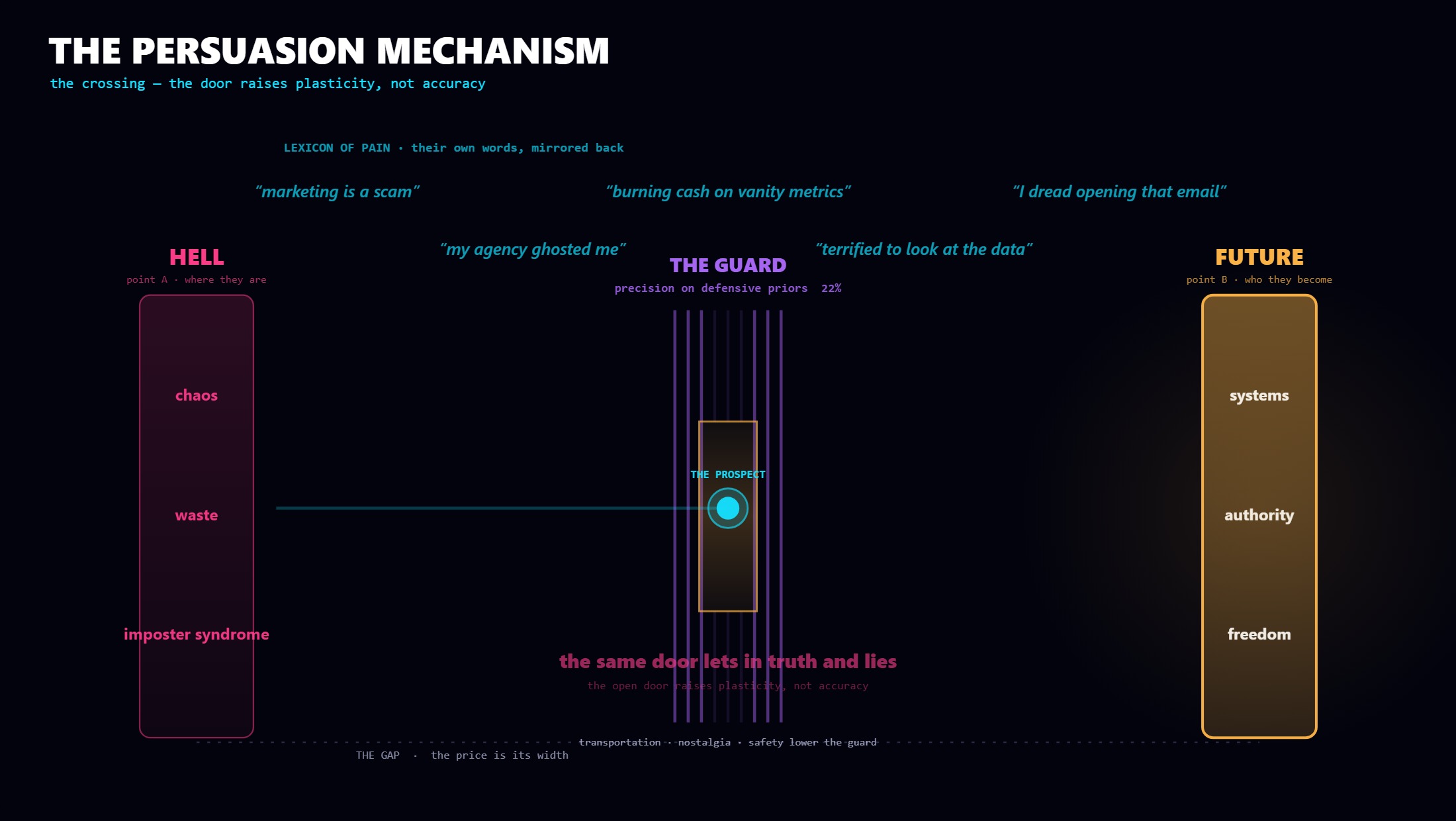
The universals come last. The thin laminar layer the firm defends, the affective dimensions, the interactional patterns, the small core of cross-linguistic concepts, is real and grounded. The thick version, a single universal story and a fixed set of named emotions experienced identically everywhere, is overreach, and the emotion vocabulary and the Hawkins ordering the firm finds useful are ontological heuristics, scales for visualization and design, not validated science. The firm uses them because they make the model legible. The firm marks them because using them as proof would be the exact failure the rigor-versus-reach discipline exists to refuse.
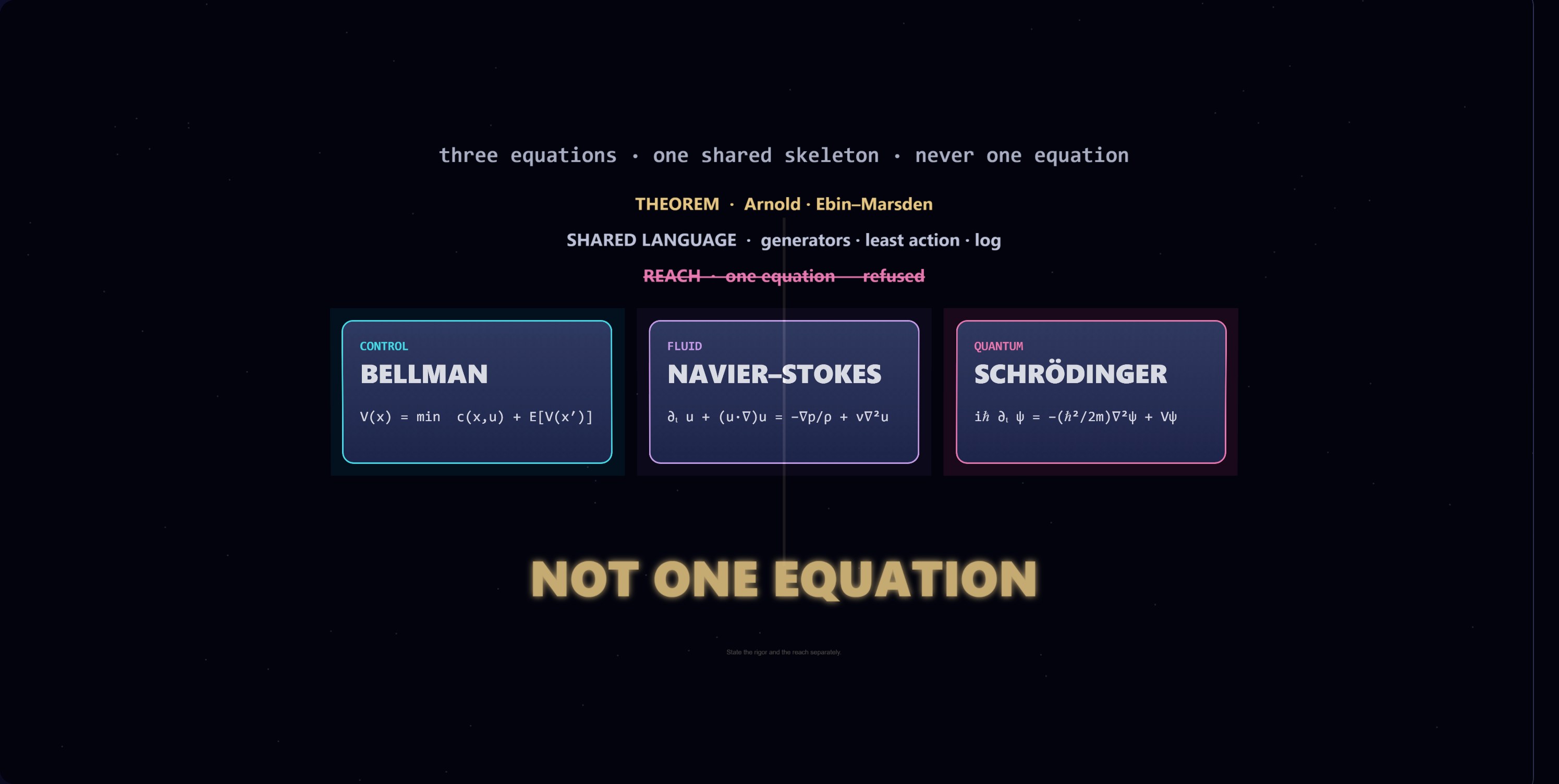
The durable move connects an innocent surface to a deep truth, and trust shows up when the disclosure costs the speaker something. A version that claimed the three equations were one, that active inference was proven, that the universals were rich and fixed, would read stronger and be weaker, because the reader who knows better would feel the weld give and stop walking through the door. Stating the seams is what earns the close.
Build the Shovel First
The last discipline keeps a vision this total from turning into a cathedral the firm dies still building. Most of what the firm has described isn't built yet. The metagraph runs as a pseudo-version on borrowed infrastructure. The compiler is partial. The dozens of backends exist as a list today.
The difficulty of building the rest is where the moat is, because the population of people who can hold high-ticket persuasion, multi-vertical systems, knowledge engineering, and clinical psychology in one head at the same time is, near enough, zero, and the difficulty that keeps everyone else out is the same difficulty that keeps the edge alive. None of this is finished, and the firm is the first to say it's only scratching the surface. It's also already a long way deeper than demographics and psychographics, which is the whole reason it converts the way it does.
Back in the dark, with the bat. The room keeps changing. The map is always a little wrong the second you finish drawing it, and possessing the map was never the job. The job is to keep screaming into the dark and to keep getting better at reading what comes back, clear about the gap between the room and your model of the room, and brave enough to walk through the doors you find in it.
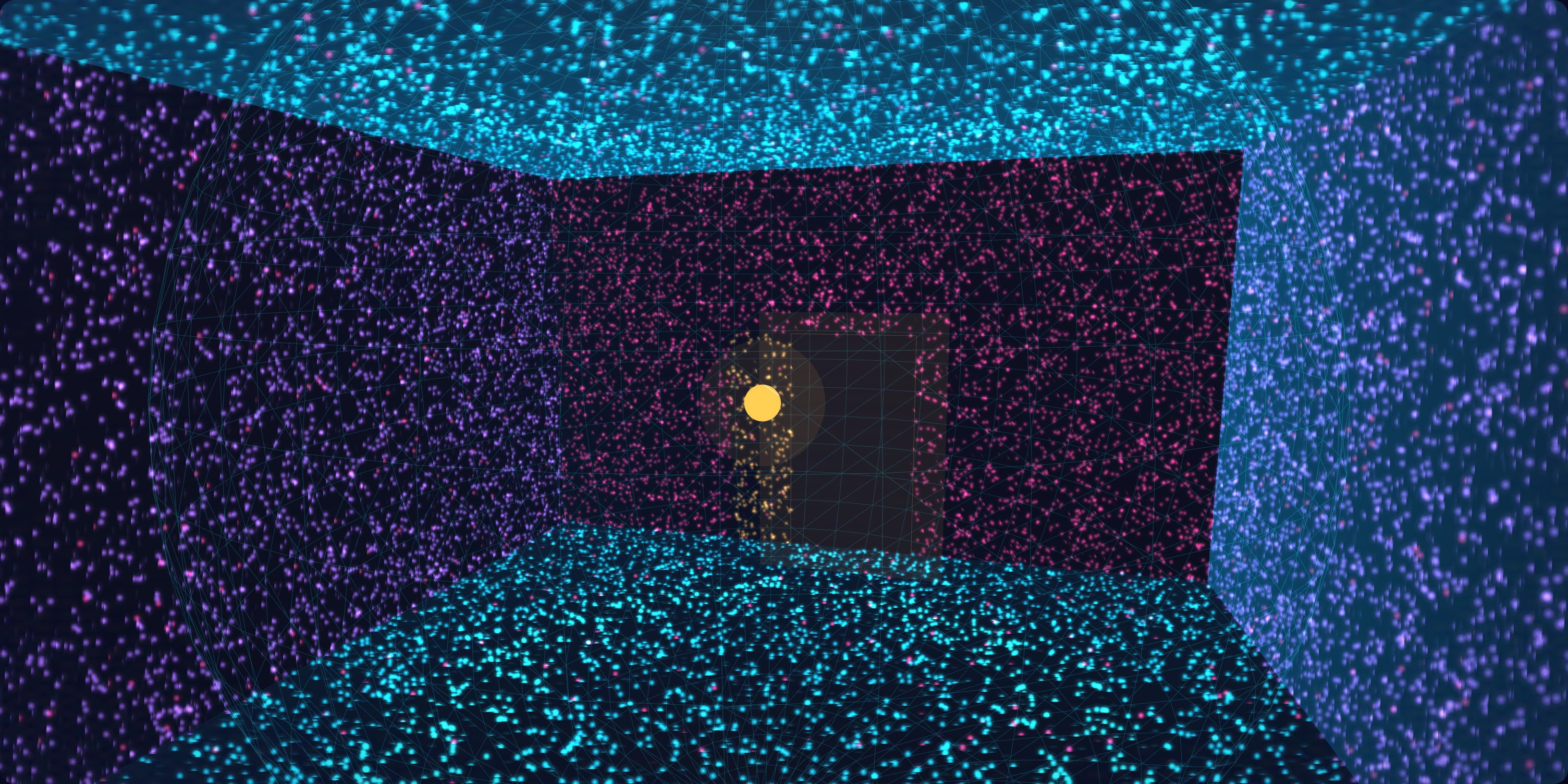
END OF ESSAY 14 · THE WORLD MODEL