It's 11:47pm in San Francisco. The founder is still at his kitchen island, laptop open to a Slack channel that hasn't been quiet since June. The recruiter has just typed three words and they sit unread at the top of the stack. Still no luck. Below it sits a second message from eight minutes later. Three candidates next week, but two are part-time and one wants to stay on the East Coast. The founder closes the lid, walks to the kettle, and stares at the cabinet for thirty seconds while the water boils. The kettle is the only thing in this apartment that finishes anything on schedule.
The job posting that generates these messages has been on the company's website since late October. A second senior posting next to it has been there a little longer. Both carry equity bands at the top of the market for a Series A. Both have the phrase we are not hiring ML researchers in the second paragraph, because the founder learned the hard way that filter belongs near the surface. The wage band is $180K to $250K. The equity band is 1.0% to 1.5%. The role requirement is "six plus years of production engineering with shipped agentic systems."
Seven months in, the result is what you'd expect when a Series A startup asks for somebody who doesn't yet exist at the price the founder is willing to pay. Somewhere on the other side of the Pacific, in a small studio apartment in Cebu, an operator is also up. He's staring at a Logfire trace, watching a retrieval pass tag five product manuals from a Topcon dealer in Anchorage. His coffee has gone cold. He'll ship a content batch in another forty minutes and close his laptop. The customer in Anchorage will wake up tomorrow to fourteen new pieces of finished content keyed to the equipment categories his dealership sells.
The Posting That Will Not Close
The posting belongs to Zep, a memory-and-context-graph startup, and it sits at the visible edge of a category. For senior AI engineers at memory-and-context-graph startups, time-to-fill runs sixty to ninety days, going by the median Series A AI infrastructure figures in Lightcast's Q4 2025 labor report. Forward Deployed Engineer roles run about twenty percent slower than that. Every memory-and-context-graph company has a version of the same posting, and every one of them has been open for a season longer than the founder expected.
The competitive cluster, named
These are the companies filing the same shape of posting in 2026, ordered by how long each posting has been open:
| Company | Role pair | Open since | Days |
|---|---|---|---|
| Zep | Senior AI Eng + Lead FDE | Oct 14 2025 | 214 |
| Mem0 | Senior Backend + Solutions Eng | Dec 03 2025 | 160 |
| Letta | Senior Eng (agent runtime) | Jan 18 2026 | 115 |
| Cognee | Forward Deployed Eng | Feb 02 2026 | 100 |
| Cognition Labs | Lead FDE | Feb 24 2026 | 78 |
| Pinecone | Solutions Architect (agentic) | Mar 11 2026 | 62 |
What the market is telling the founder
The market is functioning correctly. Its signal is that the role, at the founder's price and in the volumes the founder needs, exists only inside companies that have already won the prior round of this hiring competition. That sentence takes a quarter to accept and a year to act on. Howard Marks calls this kind of mispricing a "second-level" miss: the recruiter, the candidate pool, and the comp band are first-level inputs the founder can see and adjust. The shape of the engagement is the second-level input, and second-level inputs are the ones that determine outcomes.

What the Role Actually Is
Daniel Chalef, the founder at Zep, wrote the role description himself. As Lead Forward Deployed Engineer, you will embed with customer engineering teams to integrate Zep into their production agent systems: diagnosing context-quality failures, designing memory architectures around their data, and shipping the integrations that make their agents actually work in the wild.
The sentence carries four verbs: embed, diagnose, design, ship. The job description then spends another six paragraphs explaining what the role is not, and that negative space does most of the work:
- Not a sales engineer with a code editor. The customer's senior engineer is in the room and will see through it.
- Not a solutions consultant who writes architecture diagrams. The diagrams have to compile.
- Not an ML researcher with a customer-facing personality grafted on. The personality can't fix a retrieval pipeline.
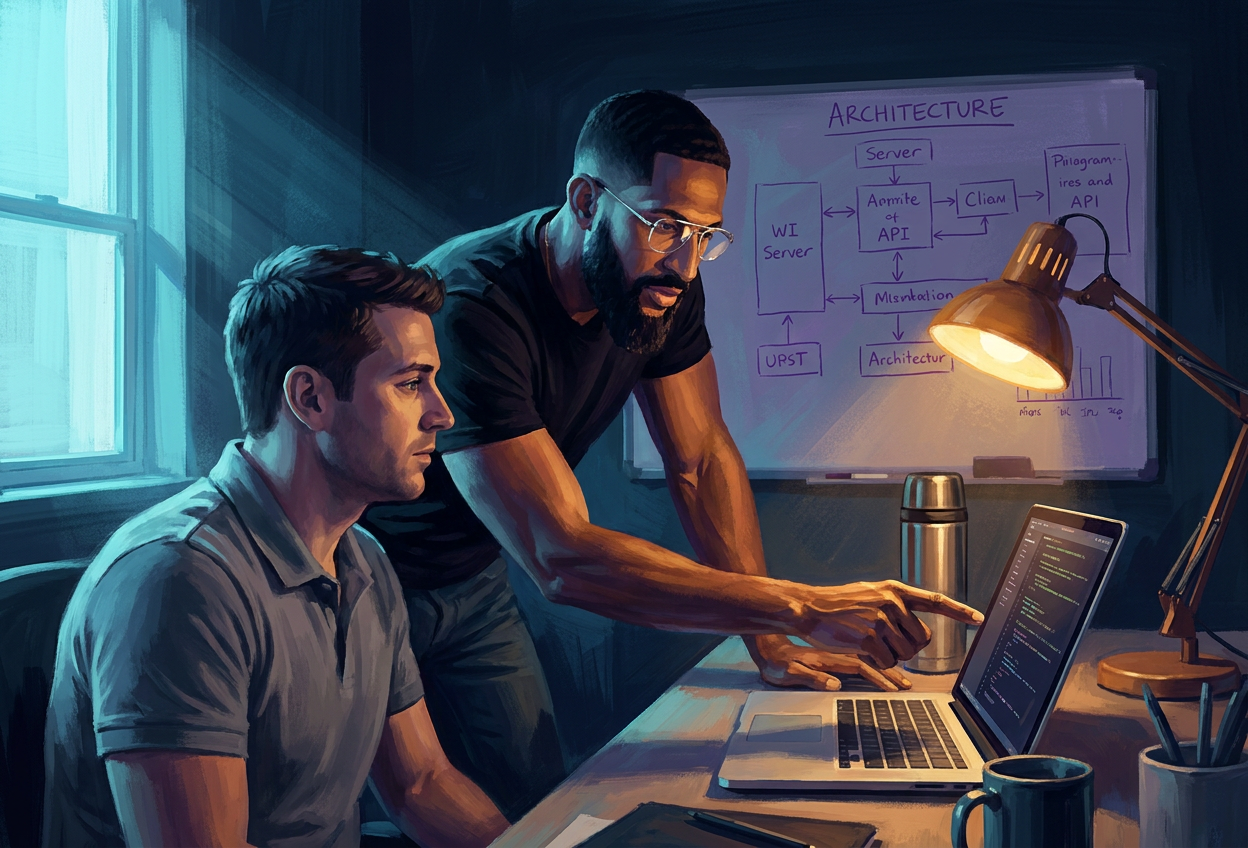
Structurally, the role is a senior backend engineer who spends most of their week inside somebody else's codebase.
The shape of a week
Across three deployments this year the operator's time has settled into a stable distribution. Diagnosis is the largest slice because most production failures live in the trace, not the API surface. Schema design and pair programming consume most of what remains. Playbook capture is the part Palantir called the recycle step, and it's the slice that compounds across customers.
CSM versus Engineer
Tomasz Tunguz wrote that the Forward Deployed Engineer is the new Customer Success Manager. That framing misses the difference between the two jobs:
| Dimension | CSM | FDE |
|---|---|---|
| What they sell | Outcomes | Working code |
| What they hold | The relationship | The codebase |
| Surface area | Quarterly review deck | The customer's pull request |
| Escalation path | Escalates to engineering | Is engineering |
| Renewal posture | Calls when renewal is at risk | The reason renewal is not at risk |
The Engineer is the company's eyes on the production failure mode the framework author can't reach from headquarters. The framework author optimizes for the median deployment. The Forward Deployed Engineer optimizes for the deployment in front of them. The two optimizations diverge after the third customer, and the framework author needs the Engineer to write back the patterns the median deployment can't see.
The Palantir Cycle
In 2008, a Palantir engineer named John Hwang sat in a secure facility in Northern Virginia for the better part of a year. The customer was a three-letter agency. The customer's analysts had a problem the customer's existing software vendors had declined to solve, because the customer's data didn't fit any vendor's general-purpose schema. The engineer's job was to write a working integration against the customer's actual data, in the customer's actual facility, on the customer's actual machines, while sitting next to the customer's actual analysts. He shipped. The integration worked. The customer renewed.

Deltas and Devs
Palantir had been calling these engineers Forward Deployed Engineers since 2003, but the internal name that stuck was Delta. The framework engineers back in Palo Alto, the ones who built Foundry and Gotham, were called Devs. Until 2016, the Deltas outnumbered the Devs by a meaningful margin. Stephen Cohen, the cofounder, wrote internal essays defending the pattern against recurring board-level pressure to convert Palantir into a normal software company. Cohen's argument ran like this:
The recycle cycle, five steps
Hwang's canonical 2020 essay "On the Importance of Forward Deployed Engineers" lays out the cycle that turned thousands of one-off integrations into a public-company-grade platform. It has five steps, and each one produces the input the next one consumes:
- Arrive with a working hypothesis. The Delta brings the framework's current shape to the customer site.
- Discover the hypothesis is wrong. The customer's data doesn't match. The schema is dirtier than the framework author assumed.
- Rewrite the integration against actual data. Ship inside the customer's deployment. Stay long enough to watch the customer's analysts use the working version.
- Write the debrief. Name what was customer-specific (the schema, the data hygiene rules, the access controls) and what was generalizable (the pattern, the abstraction, the missing primitive).
- Recycle the generalizable half. The pattern flows back to the Devs at headquarters, who fold it into the platform. The next Delta starts one rung higher.

What changed between 2008 and 2026
Two structural differences separate today from then. Cycle time has collapsed (a Palantir Delta in 2008 spent a quarter at a customer site to ship one integration; today's FDE ships in two to three weeks because the underlying agentic primitives have already been built). The customer pool has widened (the Palantir Delta worked for three-letter agencies that could absorb $100M contracts; today's FDE works for Series A AI infrastructure companies with $40M in the bank). The economics on both sides have compressed by an order of magnitude, and the pattern hasn't changed.
The Real Cost of the Hire
The founder has run the spreadsheet. It has three rows, because he's finally accepted that the visible two-role Zep posting understates the real headcount.
| Specialist | Base salary | Equity |
|---|---|---|
| Senior AI Engineer | $215,000 | 1.0% |
| Lead Forward Deployed Engineer | $215,000 | 1.0% |
| Knowledge Engineer (ontology + temporal schema) | $200,000 | 1.0% |
| Sum of bases | $630,000 | 3.0% |
The founder left out payroll tax, benefits, recruiter fees, ramp cost and replacement risk. In his head, the bookkeeper will sort the payroll tax out at quarter-end. The benefits broker has been quoting the same number for two years. At least one hire will come through a warm intro. And these will be the last hires for at least eighteen months, until the first one leaves and the founder starts over.
Per-seat math, decomposed
The per-seat arithmetic is simple once the line items are named. Benchmarked against Carta's 2025 Series A equity report, the SHRM 2026 benefits and payroll-tax survey, and the Lightcast Q4 2025 labor report, the per-seat loaded annual figure lands between $400K and $500K:
| Line item | Multiplier | On a $215K base |
|---|---|---|
| Base salary + bonus | 1.00x | $215,000 |
| Payroll tax (FICA, FUTA, SUTA, workers comp) | 0.12x of base | $25,800 |
| Benefits (SHRM 2026 family rate) | 0.30x of base | $64,500 |
| Equity (1% of $100M post-money, 4y amortized) | · | $75,000 |
| Recruiter contingency (25% of first-year cash) | 0.25x year 1 | $53,750 |
| Ramp-up (3-4 months below productive) | 0.20x of base | $43,000 |
| Replacement risk (1.5-2x at 18m tenure) | amortized | $28,000 |
| Per-seat loaded, year 1 | ~2.0x sticker | ~$505,000 |
The equity column the founder is underestimating
The 3.0% dilution across three seats at a $100M post-money valuation looks, on the spreadsheet, like $3M of nominal stock. The founder is treating the figure as a future liability because the equity doesn't show up in the monthly burn report. Every dollar of equity is a dollar the founder will be selling at the exit, and the price the founder will sell it for is set by the dilution stack today.

The staffing iceberg
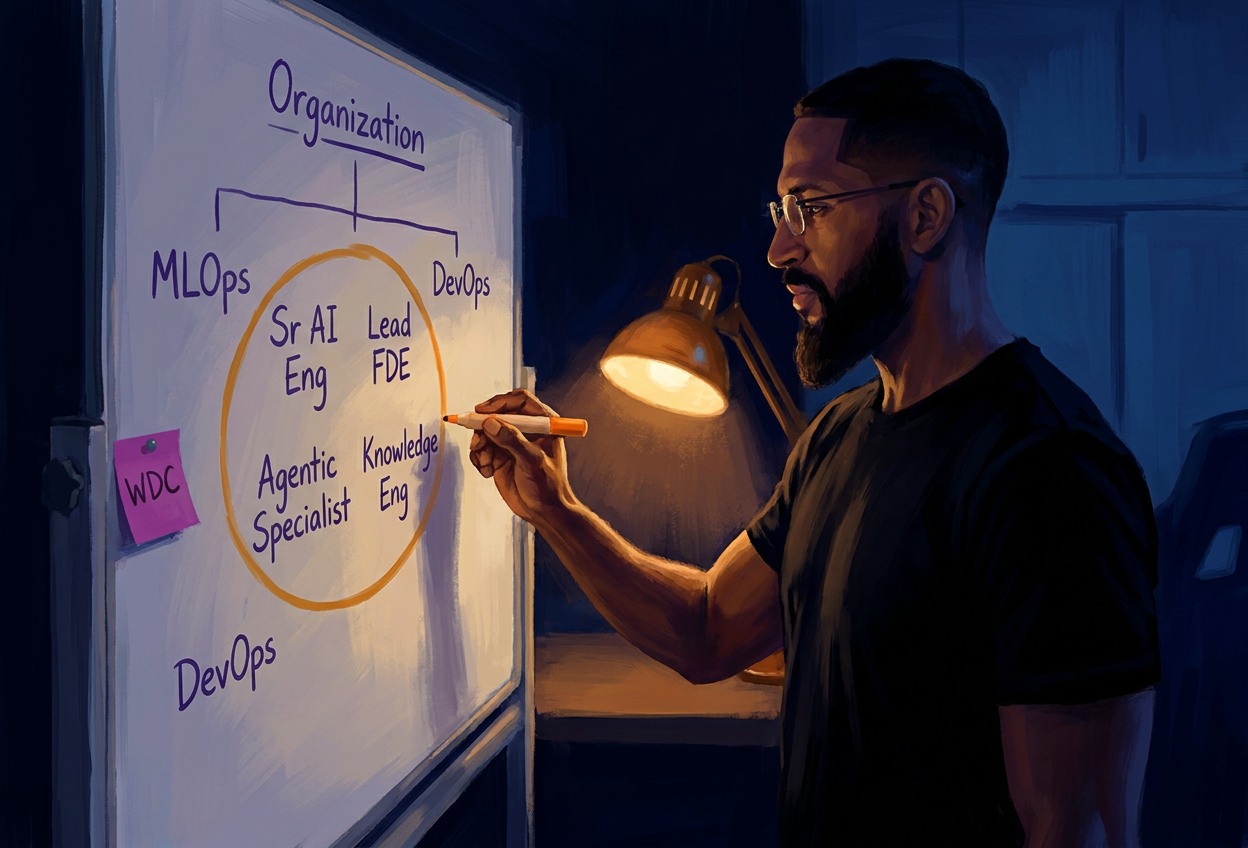
The two open Zep postings are above the waterline. Underneath, the founder has three more roles that can't be collapsed regardless of infrastructure choices:
| Role | Why it is non-collapsible |
|---|---|
| MLOps Engineer | Owns model serving + internal eval infrastructure |
| DevOps / SRE | Runs the distributed graph store, vector index, cloud cost |
| Security & Compliance | HIPAA, GDPR, SOC2 depending on customer mix |
The article's argument applies to the three agentic-infrastructure roles, not the operational three. The $2,800 retainer collapses the two posted roles plus the Knowledge Engineer into one external engagement. The MLOps, DevOps, and Security/Compliance hires remain the founder's decision.
The Job They Cannot Hire For
The Zep posting filters candidates aggressively, applying four filters in order:
- Shipped a non-trivial agentic system to production. Most LLM-adjacent production code in 2024 and 2025 was single-turn chat completion.
- Tuned retrieval and context pipelines against real failures. Most retrieval work happened against benchmark datasets.
- Built evaluation harnesses to catch regressions. Eval harness work is the unglamorous half of the agent stack.
- Ran production memory or state systems for agents. The specialty emerged inside a small number of companies, and only from about 2024 onward.
Each criterion is defensible on its own and the four together are close to disqualifying. The one measured figure available is the lived-through-production filter, which the labor research puts at excluding roughly ninety percent of senior engineers, and it's the first of four. What the remaining three subtract on top of that hasn't been measured, so the size of the surviving pool is a question the posting raises rather than a number this essay can hand you. The founder is hiring against whatever is left.

The candidate is doing the math
OpenAI's Forward Deployed pod is the comp benchmark. Total compensation on those seats lands around $600K when the cash, the equity, and the secondary windows are loaded in. Zep is offering $250K cash plus 1.5% equity at the top of the band, which lands at maybe $375K total comp if the company hits a $1B exit before dilution, and $250K to $300K if it doesn't. The candidate the Zep founder is trying to attract has Anthropic and OpenAI ringing their phone. The candidate is doing the math.
The Metagraph Gap
The intellectual case for a metagraph as the right substrate for agent memory, the layer these engineers spend their weeks integrating, has been sitting on academic and industry shelves for three years. Ben Goertzel's OpenCog Hyperon papers make the case at the theoretical layer: facts about facts about facts, recursive node typing, temporal validity on edges, contradiction as first-class structural information rather than a runtime exception.
Three voices converging on the same diagnosis
Three sources, from slightly different vantage points, converge on the same observation: the substrate is correct, and it's also operationally expensive to ship.
- Daniel Chalef (Zep): "Two to three years away from off-the-shelf metagraph-native infrastructure that a customer can buy and turn on."
- Ben Goertzel (SingularityNET): The substrate is operational today, but only inside SingularityNET's own deployments.
- Mem0 state-of-agent-memory 2026 report: The architecture is real, the libraries are real and the deployment patterns are emerging; the gap is the operational work no vendor product has compressed yet.
Where the cost actually lives
The cost lives in the specific data work the abstractions require to be useful. Four operational gaps remain that the open-source framework layer doesn't close yet:
- Valid-time window calibration. A metagraph that doesn't know what "valid" looks like for a specific customer's domain flags every entity update as a contradiction.
- Ontology mapping. A metagraph without mappings between the customer's existing schemas and the agent runtime's expected schema ingests data the agent can't reason over.
- Cross-store consistency. A metagraph in Neo4j and Qdrant simultaneously, with no enforced consistency model, fails differently on retrieval than on write.
- Production-trace evaluation. A metagraph that passes evaluation on synthetic traffic fails on real traffic for reasons the framework author can't reproduce from headquarters.
The Forward Deployed Engineer works inside those four gaps. The framework half is carried by the open-source ecosystem. The customer-specific half is the work no library author has shipped because it can't be shipped as a library.
Surface, depths, mirrors
The mental model that helps is the Mirror Ocean metaphor from a companion essay in this library. When the agent memory layer is working, it has three layers visible from the surface:
| Layer | What it stores | Failure mode when missing |
|---|---|---|
| Surface (waves) | Real-time agent calls | Becomes a chatbot with no memory |
| Depths (embeddings) | Temporal-validity windows + provenance | Becomes a vector store, atemporal |
| Mirrors (reflection) | Evaluation loops; reasoning fed back into the graph | Stays a research project, no production trust |
Any one layer on its own fails the way the table shows. The production system needs all three working together, calibrated to the customer's actual data. The calibration is the customer-specific half.
The AAA Studio Arbitrage
A AAA video game studio building a $300M title in 2022 employed somewhere around 200 to 500 people across the production cycle. The GDC State of the Industry 2024 survey splits that headcount roughly half on the creative side, a quarter on engineering, a quarter on production management and marketing. The creative half ran around $150M of the $300M budget.

The compression, line by line
A five-person team operating Higgsfield, ElevenLabs, Suno, Claude and Gemini, and Veo or Sora can deliver the creative half of a comparable game today for approximately $5.6M across the same production window. The per-asset-minute cost on the creative pipeline drops from approximately $1.5M per finished minute to approximately $56K per finished minute. The reduction is 27x. The table shows the math for a team running these tools in production today, against industry-standard rate cards:
| Asset type | AAA studio cost / unit | API stack cost / unit | Compression |
|---|---|---|---|
| Still art (per finished frame) | ~$3,000 | $0.02-0.15 | ~20,000x |
| Voice acting (per minute, secondary cast) | ~$400 | $0.50-2.00 | ~200x |
| Music composition (per track) | ~$2,500 | $0.50-2.00 | ~1,200x |
| Narrative + dialogue (per 1K words) | ~$120 | $0.02-0.15 | ~800x |
| Cinematic sequence (per cut) | ~$100,000 | $200-500 | ~200x |
What the API stack does not yet replace
A complete account of the arbitrage has to name what stays human:
- Principal voice cast. Emotional-nuance limitations on synthesized voice remain real for plot-bearing roles.
- The engineering half of the studio. Engine work, gameplay programming, networking, platform-specific optimization. The senior gameplay programmer stays on payroll through 2026 and 2027.
- The 10-20% human-in-the-loop overhead. First-pass AI image generation produces 80-90% usable output. The remaining 10-20% needs human retouch.
The bottleneck across every scale (AAA studio, enterprise agency, in-house content team, customer content pipeline) is the same: it's the operator who knows which API call to make for which output, which prompt frame to use for which character register, which LoRA to fine-tune against which customer's brand assets, which evaluation suite to run against which channel. Composing those calls is the work.
The Operator
The operator in Cebu is me. In February of 2023, in the back room of a small non-profit office in Cebu, I was on a call at three in the morning local time with two people in Kyiv who needed a piece of donor-facing media shipped by Friday or the grant they had been waiting on for six weeks was going to expire. The internet kept dropping. The Kyiv team was operating out of a basement because the air raid sirens had gone off twice that week and the basement was the only place with steady power. We shipped it on Friday. The grant cleared. The villagers it was meant to feed got food. Nobody on the project remembers my name, which is correct.

The pattern across scales
It wasn't the first time I'd shipped under those conditions. The pattern repeats across decades and customer scales:
| Year | Customer state | What shipped |
|---|---|---|
| 2013 | Cebu earthquake response, tent + generator | Coordinated relief logistics data to three regional teams |
| 2018 | Kylin Web3 project, treasury rugged by cofounders | Wound down operations in the open, learned not to trust verbal cap-table commitments |
| 2023 | Kyiv basement, air raid sirens, grant deadline | Donor-facing media, voiceover from Manila at 4am |
| 2024 | Topcon dealer launch, primary brochure corrupted | Rebuilt and shipped twelve hours before customer deadline |
| 2026 | GPS Alaska, content factory, fourteen nightly assets | Production agent loop, Topcon catalog metagraph |
The customer is in a hostile system. Hostile means the data is dirty, the schemas are inconsistent, the network is unreliable, the upstream vendors have failed before, and the customer's internal team is operating under pressure they didn't choose. The Engineer's job is to ship a working result inside that environment.

The scars are mine to name
The failures are the real qualification, so I name them here for you to audit:
- Kylin 2018: CEO of a Web3 project that rugged on its community when cofounders moved treasury through wallets that didn't belong to the project. I wasn't the founder who pulled. I was the operator who discovered it six months in. The community lost most of what they put in. The lesson: never trust verbal commitments on capital allocation when a participant operates outside protocol.
- Metal wall art 2017: $10K of personal capital went into a paid acquisition campaign that didn't convert. It took three rebuilds, and the third worked once I exported the Facebook data and discovered my buyers were forty-five-year-old women buying gifts, not the trendy young people I was targeting. The store went from $10K to $150K monthly in ninety days. The lesson: trust the data, not the founder's vibe.
- Agency retainer years 2019-2021: Several digital agencies went bankrupt during engagements where the conversion work was working. The agency model itself was upside-down. The lesson: the shape of the engagement carries the weight. The economics have to work at the engagement layer, or the work can't save the company.
The 2AM Debug
It's 2:14am in Cebu. The desk lamp is on. The coffee has been cold for an hour. The Slack channel has lit up because the customer's agent is failing in production. A user in Anchorage tried to retrieve a product spec from a Topcon brochure ingested last Tuesday, and the agent returned a spec from a different brochure retired in 2023.

The four-phase debug loop
The debug cycle runs every two to three weeks at the customer site. It runs in four phases, in order, and the total elapsed time is two hours twenty-three minutes:
- Alert triage (15 minutes). Pull the trace into the session. Confirm span IDs match between the customer's senior engineer's view and mine. Diff against the last three successful retrievals.
- Reproduction (95 minutes). Binary search across daily snapshots. The bug entered on last Tuesday's snapshot, the same day the customer added the EngCon tiltrotator catalog. The graph layer knew. The vector layer didn't. The retrieval pass returned the chunk from the vector layer because that was the only layer with the matching chunk ID.
- Fix (8 minutes). It's a one-line change to the propagation rule: the validity flag now propagates across every chunk-level entry derived from the entity. Push to staging, run the eval harness, push to production.
- Post-incident (25 minutes). Write the note. Add the eval test that catches this class of failure. The mug's still cold, and the desk lamp goes off.
Already Built. Already Shipping. Already Live.
What this essay has been describing in the abstract has been running in production at a real customer for fourteen months.
| Field | Value |
|---|---|
| Customer | GPS Alaska (Topcon construction equipment dealer, Anchorage) |
| Platform | ContentFactory-GPS v1 on WikiDesignCo v0 infrastructure |
| URL | contentfactory-ten.vercel.app |
| Cadence | Nightly Convex cron · ~14 finished assets per night |
| Substrate | Graphiti + Neo4j (temporal graph) · Qdrant (vectors) · Typesense (full-text) |
| Orchestration | LangGraph + PydanticAI · Claude + Gemini · Vertex NanoBanana Pro |
| Observability | LogFire spans + arbitrary-query SQL surface |
| Customer-facing fee | $2,800 / month flat |

Per-API cost-of-delivery, monthly
The math works at the customer side because the API stack absorbs the variance and the operator absorbs the composition. The table gives the aggregate cost of delivery across the engagement at present scale:
| API surface | Purpose | Monthly cost |
|---|---|---|
| Gemini Embedding 2 | Vector index across 200-doc corpus | $32 |
| Claude / Gemini compilation | Agent loop content generation | $400 |
| NanoBanana Pro (Vertex AI) | Per-asset character + product imagery | $200 |
| Qdrant + Typesense hosting | Vector + full-text retrieval | $40 |
| Convex source-of-truth | Operational data + realtime sub | $5 |
| LogFire observability | Tracing + arbitrary query | $20 |
| Neo4j AuraDB (Graphiti) | Temporal knowledge graph | $100 |
| Inngest durable functions | Cron + retry orchestration | $200 |
| Vercel + Clerk + small tail | Hosting, auth, edge surface | $300 |
| Voice + cinematic API tail (optional) | ElevenLabs + Suno when scope calls | $150 |
| Eval + research tooling | Perplexity + InfraNodus + small SaaS | $50 |
| API rate-limit headroom + buffer | Surge absorption | $200 |
| Misc operational reserve | Domain, certs, monitoring | $450 |
| Aggregate cost-of-delivery | internal accounting only | $2,547 |
| Customer-facing flat retainer | part-time tier | $2,800 |
The margin lives in the markup the platform absorbs, the startup credits stacked across the dozen-plus startup programs (Google for Startups Cloud, Microsoft for Startups Founders Hub, AWS Activate, OpenAI Startup Program, Anthropic for Startups, Pinecone, MongoDB Atlas, Neo4j AuraDB, Convex, Inngest), and the operator's accumulated tooling that the next customer onboarding inherits at zero marginal cost.
The compression lands
The compression ratio between $33,600 a year (GPS Alaska's annual retainer at the part-time tier) and $1.2M to $1.5M a year (the loaded cost of the equivalent three-specialist in-house team) is 35x to 45x. The customer share is 2.24% to 2.80% of the in-house equivalent. That's the number to land on from the opening.
The Math That Pitches Itself
The engagement shape
The engagement comes in three tiers, each a flat fee to the customer. Contracts run quarterly at the locked monthly rate, with a monthly exit. There's no equity stake, no cap-table seat, no governance request and no preference stack. The cap table stays the founder's, the work is the operator's, and the output belongs to the customer.
| Tier | Monthly | Quarterly | Use case |
|---|---|---|---|
| Part-time | $2,800 | $8,400 | Established content op, scale + maintain |
| Full-time | $4,000 | $12,000 | Ship the agent in production this quarter |
| Real-time | $8,000 | $24,000 | Critical-path customer integration, embedded |
The audit is the alignment mechanism
At engagement start, the audit walks the existing content operation, names the document classes, measures velocity, prices the per-document and per-corpus and per-sprint cadence, and locks the deliverable allotment for the engagement quarter. The audit is what makes the flat retainer possible. The platform absorbs all upstream API cost variance inside the management-fee markup that the software-subscription line item carries.
- The customer sees two line items per invoice: the retainer for my time plus the software subscription, and nothing else.
- No usage invoice. There's no surprise and no mid-engagement repricing.
- The platform takes the API-cost risk. The customer takes the predictability.
- Aligned incentives: more usage at fair markup means more revenue without surprising the operator.
Seven objections, seven antidotes
Seven objections rise in the founder's head as the math lands. Each is answered with a concrete artifact at engagement start:
| Objection | Antidote |
|---|---|
| 1. Forward-projection bias: will 35-45x hold for my content needs? | Audit-quantified deliverable allotment locks the ratio against your actual customer state at engagement start |
| 2. Selection bias: is GPS Alaska representative? | Compression sourced from production economics and benchmarked against your actual API rate cards |
| 3. Overfitting to GPS Alaska content velocity | Audit walks your specific content operation, not someone else's |
| 4. Transaction-cost fantasy: what about IP, SLA, compliance? | Work-for-hire clause at signing · 24-72hr SLA · D&O addendum · scoped access |
| 5. Regime mismatch: my customer state is different | Audit diagnoses your regime, not GPS Alaska's |
| 6. Capacity delusion: can one operator scale? | Two-to-three concurrent engagement ceiling per operator; WikiDesignCo handles scale-layer above |
| 7. Distribution-assumption failure: my customers do not match the model | Audit measures your customer state, not the population GPS Alaska sits inside |
The platform behind the operator
The infrastructure stack underneath the retainer comes in versions: v0 ships at GPS Alaska today, v1 lands inside this year, and v2 is the metagraph-native rebuild:
| Layer | v0 (live) | v2 (in build) |
|---|---|---|
| Source of truth | Convex | Convex + Pydantic-as-IR |
| Knowledge graph | Neo4j | Graphiti on Neo4j (temporal) |
| Vector retrieval | Qdrant | Qdrant alongside metagraph |
| Full-text | Typesense | Typesense alongside metagraph |
| Durable functions | Inngest | Inngest + LangGraph workflows |
| Agent stack | PydanticAI + Claude | PydanticAI + LangGraph + Claude Agent SDK |
| Asset generation | NanoBanana Pro · Vertex AI | NanoBanana + Higgsfield + Suno + ElevenLabs + Veo |
| Observability | LogFire spans | LogFire + Hypothesis property-test eval |
Two apartments. One bridge.
It's 11:47pm in San Francisco. The kettle is still doing its job. The founder is going to close the lid, walk to the cabinet, and pick a tea. Tomorrow he's going to open the spreadsheet, add the four columns he's been deferring, and watch the loaded annual number land somewhere between $1.2M and $1.5M. Tomorrow night he's going to open a tab to contentfactory-ten.vercel.app and watch a customer's dashboard ship a content batch nightly, against a Topcon dealer's catalog, at $2,800 a month. Tomorrow morning he's going to send a Slack DM with a different subject line than the one he's been sending for seven months.
END OF ESSAY 13 OF 13 · THE GIGA LIBRARY · WIKIDESIGNCO